Get Full Government Meeting Transcripts, Videos, & Alerts Forever!
Get email alerts on the Groundwater topic
No spam. Unsubscribe anytime.
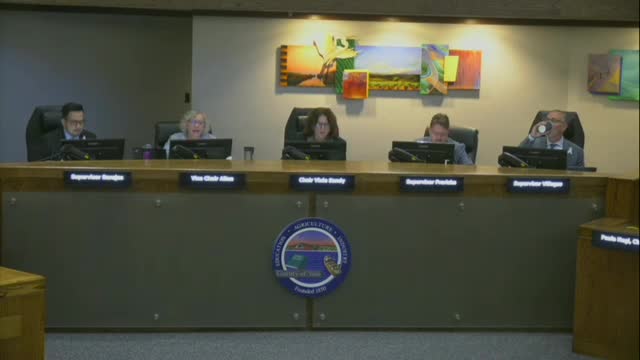
Yolo County extends moratorium on new agricultural wells in focus areas for up to 10 months
Summary
The Board of Supervisors voted to extend a temporary moratorium on new agricultural-well permits within Yolo Subbasin Groundwater Agency (YSGA) focus areas for up to an additional 10 months and 15 days, directing staff to narrow the moratorium scope, provide periodic updates and form a working group to recommend long-term rules.
The Yolo County Board of Supervisors voted to extend a temporary moratorium on approval of new agricultural-well permits in YSGA-designated focus areas for up to an additional 10 months and 15 days, with staff directed to provide regular updates and convene a working group to study permit rules and related land-use issues.
County environmental health director April Meneghetti told the board the moratorium — first adopted as a 45-day urgency ordinance in August — was intended to allow time for staff to review whether changes to county well-permitting and land-use rules are warranted in parts of the Yolo Subbasin where groundwater declines and dry wells have been reported. Meneghetti said staff recommend narrowing any extended moratorium so it applies only to wells physically located inside the focus-area boundaries the YSGA established through its public process.
The board’s action follows weeks of public comment from farmers, farming advocates and nearby residents and a multi-hour staff presentation describing the current environmental-health and YSGA review process for new agricultural wells. Meneghetti said the moratorium would not block continued processing of applications — environmental health and YSGA said they will continue technical reviews so permits are ready to proceed if the moratorium is lifted — but final issuance would be on hold unless a hardship exemption is granted.
Why it matters: The YSGA focus areas were drawn to reflect parts of the subbasin with reported declining groundwater levels, subsidence concerns and dense domestic well use. The board’s extension gives staff and stakeholders time to evaluate tools proposed during recent meetings — metering pumps, additional hydrogeological review for some permits, and restrictions on crop conversions that increase year-round irrigation demand — while avoiding a rushed permanent policy change.
Most important facts - The board adopted an ordinance extending the moratorium up to 10 months and 15 days, with the board saying staff should aim to complete work sooner if feasible and return with periodic updates (board direction requested updates every 60 days). April Meneghetti presented the recommended extension. - Staff recommended narrowing the moratorium so it applies only to proposed wells located within the YSGA focus-area boundaries, not to entire parcels that merely overlap a focus area. - The extended moratorium includes a hardship exemption heard by the Planning Commission (health/safety or economic hardship may qualify) and appealable to the board. - The board directed staff to convene an agricultural well-permit working group with representatives from YSGA, farm organizations, well drillers, focus-area landowners and subject-matter experts to produce recommendations for the board.
Board discussion and public comment Supervisors raised multiple procedural and policy questions about replacement wells, the scope of the hardship exemption, data gaps and the timeframe for staff work. Chief Assistant County Counsel Kimberly Hood confirmed staff revised the hardship language to clarify that either economic impact or health-and-safety hardship may qualify for an exemption; she said the revision was intended to allow flexibility rather than require a narrow “takings” showing.
Kristin Cicki, executive officer of the YSGA, told the board the agency plans to update focus-area delineations as new data becomes available and is working on a groundwater sustainability plan due to the state in 2027. Several public commenters urged either a narrow moratorium or a broader one depending on their perspective: agricultural representatives argued for minimizing the number of affected farms and adding a clear exemption for replacement wells, while residents and local stewards supported the extension to prevent further groundwater stress and to produce data and safeguards before additional irrigation is added.
Formal action and outcome The board approved the urgency ordinance extending the moratorium, with the motion including direction to: narrow the moratorium to wells located within focus-area boundaries; adopt a flexible hardship exemption that can include economic and health-and-safety hardship; require periodic reporting to the board (about every 60 days); authorize staff to codify existing emergency permitting requirements into the county well ordinance and return with ordinance language; and form the agricultural well-permit working group to advise staff. The motion was seconded and the board voted in favor; the motion carried.
What happens next Staff will convene the working group (the goal is to meet within about 30 days) and continue technical reviews with YSGA; the working group’s recommendations will come to environmental health staff and then to the board. Staff also indicated they will return with ordinance language to codify the interim permit rules and with regular briefings to the board during the extension period.
Quotations “Because of the uncertainty as to what longer term changes to well permits and any related land use issues…staff is recommending that the board approve the 10 month, 15 day extension,” April Meneghetti said. Chief Assistant County Counsel Kimberly Hood said the revised hardship language “does clarify its economic and health and safety hardship also qualify for the exemption.”
Ending The extension preserves county authority to act while staff and a broader stakeholder working group study longer-term changes to permitting and land-use policies; the board signaled a preference to complete work sooner than the full extension if feasible and to return frequently for updates.