Get Full Government Meeting Transcripts, Videos, & Alerts Forever!
Get email alerts on the Variance Manufactured Home topic
No spam. Unsubscribe anytime.
Planning commission approves variance to place manufactured home at 128 First Avenue
Summary
The Taylor Planning and Zoning Commission approved a variance allowing a manufactured home to be sited with its façade not parallel to the front property line at 128 First Avenue after staff found the property met the city’s hardship criteria and no neighbors formally opposed.
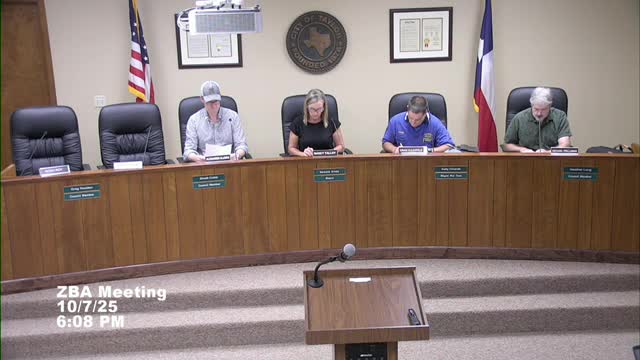
At a meeting of the Taylor Planning and Zoning Commission (date not specified), commissioners approved a variance for PZ2025-2578 to allow a manufactured home to be sited in a configuration that does not place the principal building façade parallel to the front property line at 128 First Avenue, a parcel in the Zella Jones addition (Williamson County appraisal parcel R017324).
City planner Preston Gannon told the commission staff had mailed 37 notifications and received no written opposition. He said the lot—just under 50 feet wide—cannot accept a standard orientation for the applicant’s 14-by-56-foot manufactured home without encroaching on adjacent property. Gannon said staff found the application meets the city’s variance/hardship criteria and indicated the applicant will also need to obtain a floodplain development permit before building because the site is in the floodplain.
The variance request was described to the commission as necessary because the manufactured home’s length (56 feet) makes rotating or reorienting the unit to run parallel with the street infeasible on the existing lot. Gannon said compliance would require placing the unit in a way that “would be encroaching onto the adjacent lot and putting a burden on the adjacent property owner.” He also advised the commission that state rules require meeting a minimum standard for hardship and that the agenda packet noted only one of the state criteria must be met for a variance application to proceed.
Resident Jolene McLean, who said she owns nearby property, spoke in support and described difficulty using similarly shaped lots in the neighborhood, noting she had “poured my life money into this land.” No speakers spoke in opposition during the public hearing.
A commissioner moved to approve the variance, and a colleague seconded. The commission approved the variance by voice vote; no roll-call tally was recorded on the meeting record. The chair declared the motion carried and notified the applicant that the variance was approved.
Next steps for the property owner include applying for a floodplain development permit and then the building permit process, during which staff said elevation and flood-impact documentation will be required.