
Hoover board approves routine business items; sets delegate and enters executive session
Get AI-powered insights, summaries, and transcripts
Sign Up Free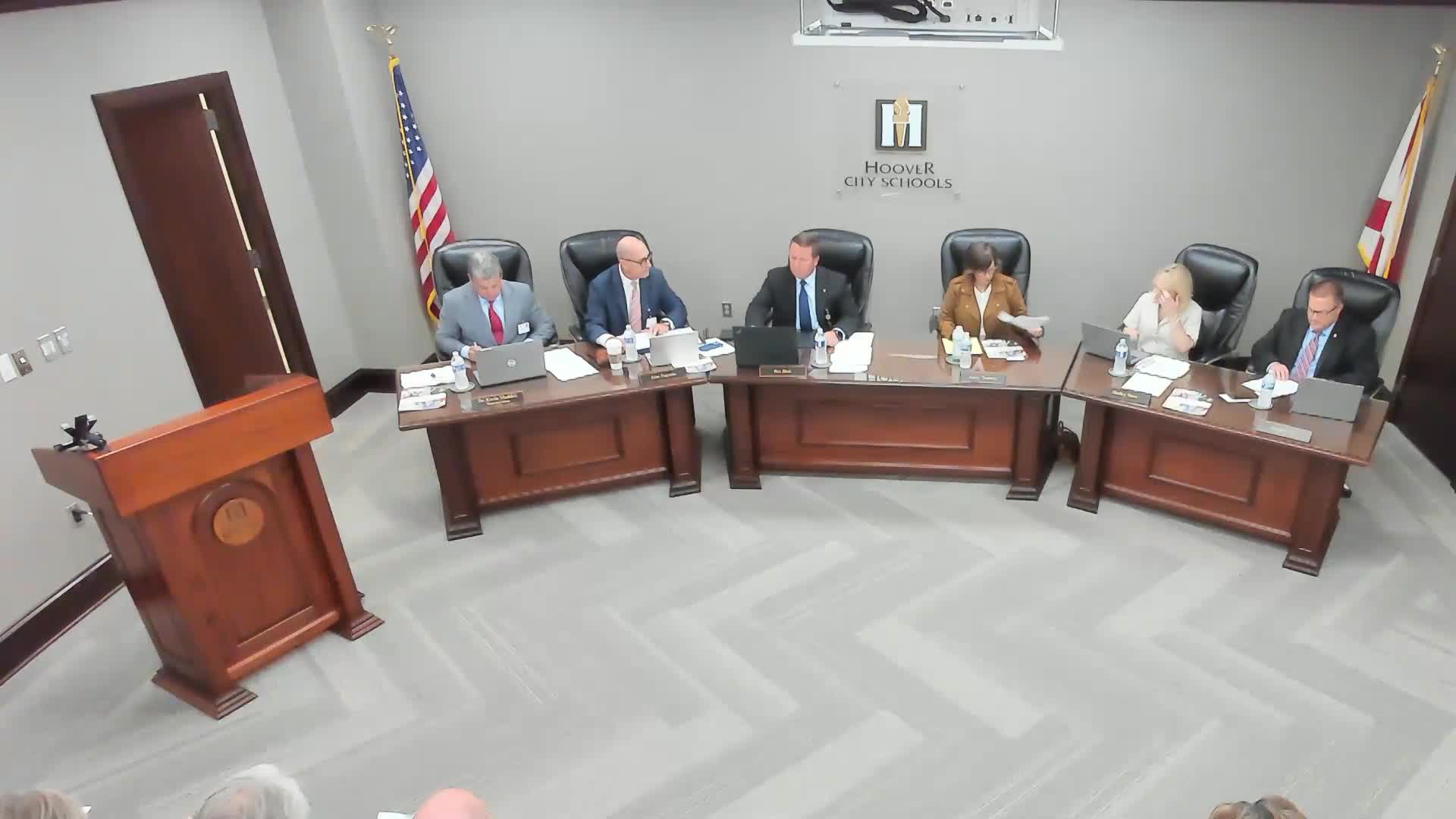
Summary
On Oct. 7 the Hoover board approved the agenda, minutes, consent agenda, business financial report, textbook committee appointments, the 2026–27 school calendar, and policy updates; it appointed a delegate for the AASB assembly and unanimously voted to go into executive session.
The Hoover City Schools Board of Education approved a series of routine and business items Oct. 7, including meeting minutes, the consent agenda and budget reports, and set a delegate to represent the district at the Alabama Association of School Boards (AASB) delegate assembly.
Key votes taken during the meeting included:
- Adoption of the Oct. 7 meeting agenda (unanimous). - Approval of meeting minutes from Sept. 9 (SpectraCall and regular meeting) (unanimous). - Approval of the consent agenda, which included personnel actions, contracts, field trips, surplus and capital asset actions (unanimous). - Approval of business actions and financial summary for the month ending Aug. 31, 2025: general fund expenditures reported at 92% of budget for 11 months of activity; current reserves 9.15 months; payroll for September $14,238,232.77; cash disbursements $17,734,761.47; special reserve fund expenditures reported as $24,800,000 (110% of budget) (unanimous approval of business actions as presented). - Approval of the 2025–26 textbook committee membership for upcoming social studies, fine arts and science adoptions (unanimous). - Approval of the 2026–27 school calendar as recommended by the superintendent (unanimous). - Approval of proposed policy updates recommended by AASB/ASB (unanimous). - Nomination and approval of Jeremy Vice as the district’s AASB delegate for the Dec. 4 delegate assembly (unanimous by voice vote). - Motion and unanimous vote to go into executive session to discuss potential litigation (certification by board attorney Mark Boardman cited code item “36 25 8 7 8 3”); the board stated it did not anticipate action following executive session.
Many of the routine items were described by staff as standard monthly business or regular committee appointments; several received little discussion before approval. The board president called for motions, and each item passed by voice vote with no recorded dissent.