Get Full Government Meeting Transcripts, Videos, & Alerts Forever!
Get email alerts on the Road Safety Mulberry topic
No spam. Unsubscribe anytime.
City hears 'Slow the Curve' plan for Mulberry Street; protected bike lanes and curve treatments proposed
Summary
A DVRPC-led team described a community-funded “Slow the Curve” project for Mulberry Street and North Clinton Avenue in East Trenton, proposing protected bike lanes, reflective chevrons and rumble strips to calm traffic and improve safety; council members praised outreach and asked for more resident input on parking impacts.
Delaware Valley Regional Planning Commission staff and neighborhood partners presented a community-driven road safety plan Tuesday night for Mulberry Street and North Clinton Avenue in East Trenton aimed at slowing traffic and improving safety near the sharp curve around St. Joe’s.
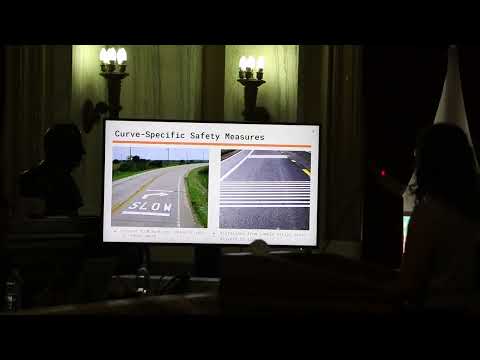
The presentation — led by Jen Harris of the Delaware Valley Regional Planning Commission and representatives of the East Trenton Collaborative — proposed removing narrow, unsafe parking lanes (measured at about 6.5 to 7 feet) and replacing them with protected bike lanes separated by reflective parking stops and flexible barriers, plus curve-specific measures such as reflective chevron signs, painted “SLOW” markings and transverse rumble strips.
The presentation’s organizers said the work has been driven by resident concerns voiced in a local road safety audit and implemented with quick-build tools for three years; the next phase, called “Slow the Curve,” focuses on the corridor between Route 1 and Lawrence Avenue. Harris said the project is fully community-funded through grants and is designed to calm traffic, reduce crashes and improve connections to schools and neighborhood destinations.
“Protected bike lanes are a tool to calm traffic,” Harris said, adding they can reduce bicycle crashes by more than 50% and reduce all crashes nearly 30%.
Kurt (surname not provided), a partner with the East Trenton Collaborative, said project outreach included visits to all 20 homes and six businesses on the corridor and bilingual flyers. He told council the feedback was “overwhelmingly positive” and that residents already avoid parking in parts of the corridor because they consider the spaces unsafe; the presenters also reported traffic counts showing more than 100 people bicycle on the road in sample counts and that about one-third of neighborhood households do not own a car.
Council members praised the organizers’ community outreach and funding work, with Council President Gonzalez and Councilwoman Frisbie commending the team for talking with residents and bringing a funded plan rather than simply presenting problems. Councilwoman Williams and others pressed for additional targeted engagement with a cluster of roughly eight to 10 homes that do park on Mulberry Street so those residents have notice and time to respond to any changes.
Organizers told council they do not expect major parking impacts because much of the existing parking on the corridor is already illegal or unused; they highlighted an image showing legal spaces across from Hasson Bean Creek where few residents park. The presenters said they will host another community engagement event on Saturday, Oct. 18, from noon to 3 p.m. near the curve at Mulberry and St. Joseph, and that the ordinance to restrict road parking on Mulberry Street and North Clinton Avenue between Route 1 and Orange Street is expected to be introduced to City Council on Oct. 21 with a vote planned for Nov. 6. If approved, installation could begin in early November, the presenters said.
Council members recommended adding physical posts or additional vertical delineators through the curve area to protect bicyclists and to ensure the planned reflective markings and rumble strips are included in the design. No formal council vote was taken on the project during the presentation; organizers asked council to “consider this presentation” and approval of the forthcoming ordinance to enable construction work funded by grants.
The project team said planned materials include painted buffers, flexible vertical delineators, parking stops and reflective chevrons targeted at the curve, and that the design aligns with the City of Trenton’s recently adopted bike plan.
If council puts the ordinance on the stated schedule and votes as planned, the presenters said they would begin installation in early November, pending council approval and permit clearances.