Get Full Government Meeting Transcripts, Videos, & Alerts Forever!
Get email alerts on the White Cane Awareness topic
No spam. Unsubscribe anytime.
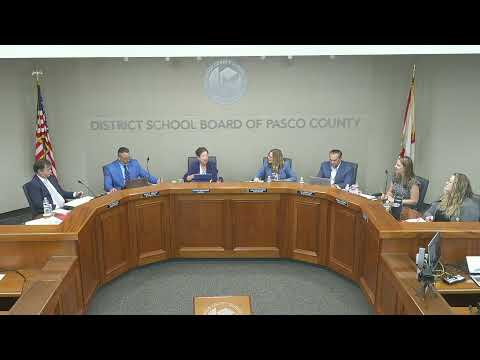
Pasco School Board proclaims Oct. 15 White Cane Awareness Day after Lighthouse presentation
Summary
The Pasco County School Board heard a presentation from Lighthouse for the Visually Impaired and Blind and unanimously approved a resolution declaring Oct. 15 White Cane Awareness Day; speakers urged expanded orientation-and-mobility supports and audible crossings at school intersections.
The Pasco County School Board on Wednesday heard from the Lighthouse for the Visually Impaired and Blind and voted to adopt a resolution declaring Oct. 15 as White Cane Awareness Day.
The board adopted the resolution after a short presentation from Lighthouse representatives Rhonda Warren and Carly Klein that described the organization’s programs and urged the district to expand supports for visually impaired students. “White cane is more than a tool. It’s a symbol of freedom, confidence, and mobility,” Carly Klein said, introducing the Lighthouse staff and a guide dog that accompanied them.
Why it matters: the resolution recognizes the white cane as an instrument of mobility and calls on the public and employers to support independence for people who are blind or visually impaired. Lighthouse representatives also highlighted district-level needs that affect students’ independence and safety—most notably the lack of audible pedestrian signals at many school intersections.
During her remarks, Rhonda Warren, a Lighthouse board member, asked the district to pursue audible crossings at school intersections. “Our biggest issue is independence. And when you can’t cross the street because there’s no audible signs to help you, it makes a big difference,” Warren said. She also offered data drawn from the district: “Currently, we have 95 students who are visually impaired and blind. Forty of them get O and M, which is orientation mobility. And we currently have 8 and a half teachers of the visually impaired in our system.”
The resolution text included a summary of the Lighthouse mission and language asking schools and the public to recognize the white cane and to expand training and employment opportunities for people who are visually impaired or blind. The resolution also references Florida law’s requirement that motorists exercise appropriate caution around people using a white cane or guide dog and urges public awareness of that law.
Board action and next steps: A board member moved to approve the resolution, the motion was seconded, and the board chair called the vote. “All in favor? Aye. Motion carries,” the chair said. The motion record in the meeting transcript lists the motion as made and seconded (first by Harding, second by Hernandez) and shows the resolution was approved; the transcript does not include a numeric roll call tally.
The Lighthouse representatives and district staff said they hope to expand partnership work with schools to increase orientation-and-mobility services, training for families, and audible crossings at school intersections. District staff did not commit to a specific timeline for installing audible signals during the meeting.
Ending: The board’s adoption of the resolution formalizes district recognition of White Cane Awareness Day and places an emphasis on expanding mobility supports for visually impaired students, though the transcript records no binding timeline or funding commitment for audible crossings.