Get Full Government Meeting Transcripts, Videos, & Alerts Forever!
Get email alerts on the Municipal Complex Design topic
No spam. Unsubscribe anytime.
Rowlett council picks roundabout and narrows park to Option 1C for Hereford municipal complex
Summary
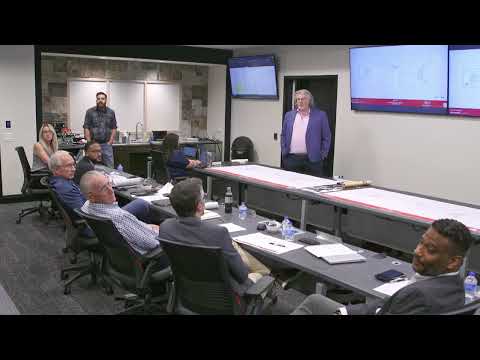
At a council work session Oct. 1, Rowlett officials voted to use a roundabout on the municipal complex access road and directed staff to develop park programming built from “Option 1C,” while debating costs for a proposed water feature and confirming animal-shelter turf as a must-have.
The Rowlett City Council on Oct. 1 directed staff to advance a municipal complex design that uses a roundabout for site access and chose a park layout based on “Option 1C” after a work-session presentation from the city manager and the project design team.
City Manager David Hall opened the session by telling council members they were at a “very critical point” where the choices they made would “inform both budget and design impacts.” Architects and contractors from HEW, Swinerton and Westwood presented two primary circulation schemes — a roundabout or a four-way stop — and four park-layout variants for each scheme. After discussion of traffic, pedestrian safety and aesthetics, the council approved the roundabout as the preferred intersection treatment and settled on Option 1C as the starting park configuration.
Why it matters: The council’s decisions set the high-level site layout that will shape construction scope, budget and later, specific building programming. The roundabout vs. stop-sign choice affects right-of-way, pedestrian experience and an immediate materials/civil cost difference that council flagged during the meeting. The council also identified priorities and “must-have” items — notably an artificial-turf surface for the animal shelter’s kennel area — to guide budget tradeoffs as designers refine cost estimates.
Council discussion and outcome Councillors and the design team debated traffic flow, pedestrian safety and community character. Representatives noted that roundabouts allow continuous traffic flow but require driver familiarity; four-way stops generally produce slower vehicle speeds and a different pedestrian perception. HEW explained that each main choice (roundabout vs. four-way stop) carried four sub-options for placement and amenities, and Swinerton provided high-level cost differentials.
A motion to select the roundabout (Option 1 as presented) passed by council voice vote; the mover and second were not specified in the meeting record and a roll-call tally was not recorded in the transcript. Separately, after working through amenity placements with tangible scale models and sketches, the council coalesced around Option 1C — a layout that combines courts (three tennis courts, six pickleball courts and two basketball courts), an informal soccer turf, several play nodes, pavilions and a pond along Main Street — as the baseline for further development.
Cost and trade-offs Swinerton and others discussed cost differences among circulation options and park features. Swinerton said the roundabout-to-stop-sign infrastructure difference in the baseline estimate is “about a $117,000 difference,” a figure referenced during council questions; elsewhere in the discussion a council member cited roughly $170,000 as a comparison figure. Designers warned those figures reflect the physical intersection infrastructure only and do not include decorative elements or art features placed in a roundabout center. Budget allowances and contingency reductions remain under staff control; city staff said they had asked the construction team to reduce contingencies to free funds for desired options.
The council debated a proposed water feature on the Main Street frontage. Designers described two ponds: a front reflecting pond meant to read as a wet feature from Main Street and a larger retention/ detention pond behind the site. During the cost-review phase staff said the wet reflecting pond would require an external water source and ongoing maintenance; one number called out later in the session for the wet front feature was $350,000. Council members expressed concern about maintenance and operational cost before committing to any permanently wet element.
Park programming and must-haves Designers presented a menu of amenities collected from boards, commissions and stakeholder meetings. The council instructed staff to prioritize items rather than try to include everything: key elements the council prioritized were courts (pickleball/tennis/basketball), informal soccer space, multiple small play “nodes” rather than one large playground, shade structures distributed across activity areas, and at least one pavilion near the dog park. The animal-shelter kennel artificial turf and shade elements were identified in the meeting as nonnegotiable: the design team said the turf in the kennel area is “a must have.”
Traffic, pedestrian safety and site speed Designers and council members discussed target speeds and sight lines. The design team noted the project aims for a posted speed of about 30 mph on the approach streets, with speeds through a roundabout expected to slow to roughly 15 mph. Council members who favored the roundabout emphasized visual quality and long-term value, while others prioritized pedestrian calm and the park character that the four-way stop might support.
Next steps Staff and the design team will convert the council’s Option 1C selections and placement decisions into a refined plan set and updated cost estimate. The team said they will photograph and digitally capture the live sketching exercise performed at council direction, compare the selected features to the project contingency and present a prioritized list of alternates and allowances at a follow-up meeting. No final construction authorization occurred at the Oct. 1 session.
Quotes “We’re at a stage where the choices you make will inform both budget and design impacts,” City Manager David Hall said at the start of the presentation.
“If you choose the roundabout, you’ve got four choices there,” James Beers of HEW told the council as he described the two circulation pathways and sub-options.
From Swinerton: “It’s about a $117,000 difference,” referring to the baseline cost gap called out between roundabout and four-way stop alternatives (infrastructure only, not including center art features or other architectural elements).
Dorothy Whitmire of Westwood clarified amenity placement: “In the base images, the dog park in connection to the pond is in the same location.”
Councilmember Reese argued for the roundabout on long-term visual and safety grounds: “When you think about 40 years … what that actual cost is, it’s really not that much when you spread it out over that time.”
Ending The council left Option 1C as the working baseline and asked staff and the design team to return with refined costs, an ordered list of prioritized alternates and a proposed schedule for the next review. The design team said it would use the council’s placement sketches and the updated contingency figures to produce the next packet of materials for council consideration.