Get Full Government Meeting Transcripts, Videos, & Alerts Forever!
Get email alerts on the Youth Employment topic
No spam. Unsubscribe anytime.
Committee reviews $2 million federal youth employment grant; members press for higher hourly pay and reporting
Summary
The committee heard details of a $2 million U.S. Department of Labor 'Growth Opportunities' grant for youth employment and violence‑prevention work. Sponsors said it funds training, work experience and supports for about 160 participants; councilors urged higher wages and requested progress reports.
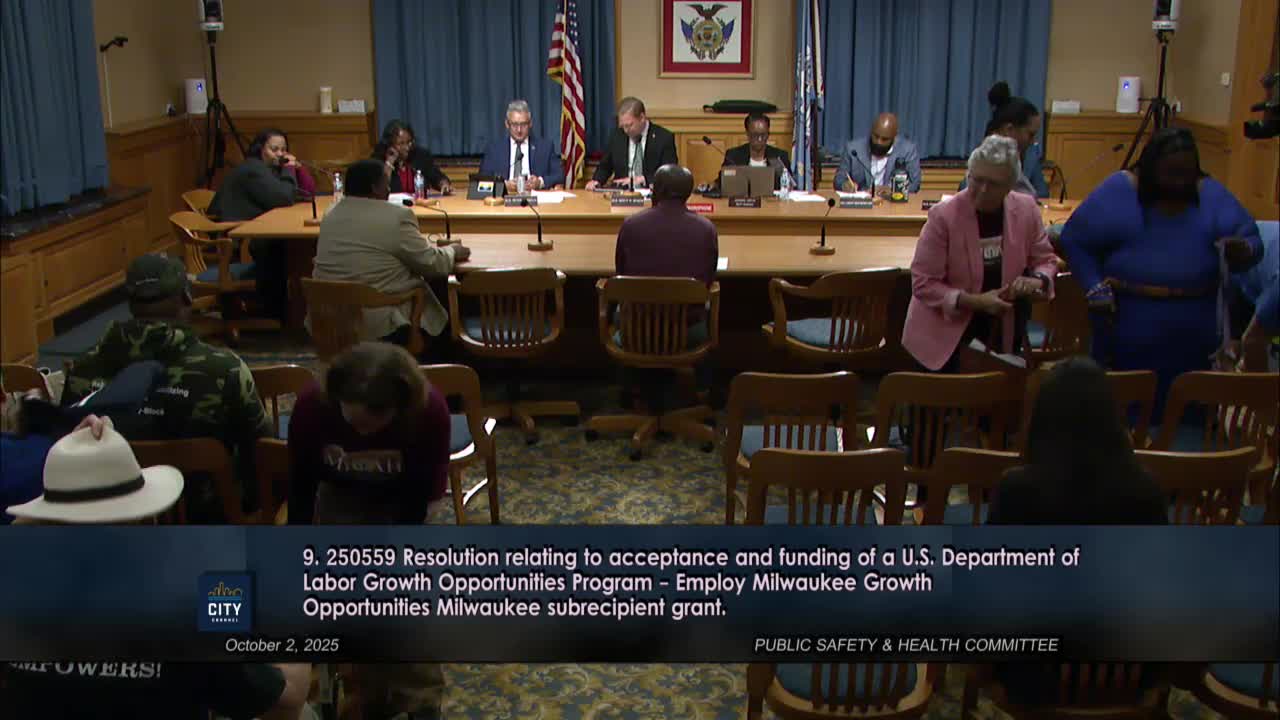
Milwaukee — The Public Safety and Health Committee on Oct. 2 reviewed a $2 million federal Grow Opportunities grant awarded to Employ Milwaukee, with the Office of Community Wellness and Safety as a subrecipient. The program will target roughly 160 youth considered at higher risk of violence and provide training, work experience and supportive services.
Wilbur Holloway of Employ Milwaukee told the committee the grant aims to combine a six‑week work‑readiness academy with up to 200 hours of paid work experience and wraparound supports. Daryl Lofton of the Office of Community Wellness and Safety said the program includes case management, needs‑based payments and will add a community outreach specialist within OCWS.
“Some of the root causes are employment for our young people,” Daryl Lofton told the committee. “We’re excited to work alongside Employ Milwaukee.”
The committee pressed for specifics about wages. Holloway said the program intends to start participants at about $13.14 per hour, reflecting Employ Milwaukee’s current standard for youth work placements; members including Alderman Coggs, Alderman Bergallis and Alder Cox raised concerns that the $13 hourly rate is low for older youth and urged the department and Employ Milwaukee to seek higher pay where grant rules allow.
Committee members also asked for reporting and oversight. The grant’s timeline runs through August 2028 and funding will support a mix of training, incentives, work experience and staff time. Holloway said the program expects to enroll participants in cohorts and provide up to 12 months of post‑placement follow‑up where possible.
Alder Taylor moved referral of the resolution to the Finance and Personnel Committee for acceptance and funding; the motion was made with no recorded objection and the committee ordered referral. Council members requested a later briefing on program metrics including participant outcomes, number of work hours completed, and how funds are allocated between overhead, training and direct participant wages.