Get Full Government Meeting Transcripts, Videos, & Alerts Forever!
Get email alerts on the Maternal Health Doula topic
No spam. Unsubscribe anytime.
Advocates press city to expand postpartum doula services after east-side clinic closure; council asks health department for budget update
Summary
Milwaukee inner-city congregations and residents urged the Public Safety and Health Committee to expand the city doula program to deliver hands-on postpartum support, lead‑safety education and year‑long follow-up. The committee held the item for further budget and program details.
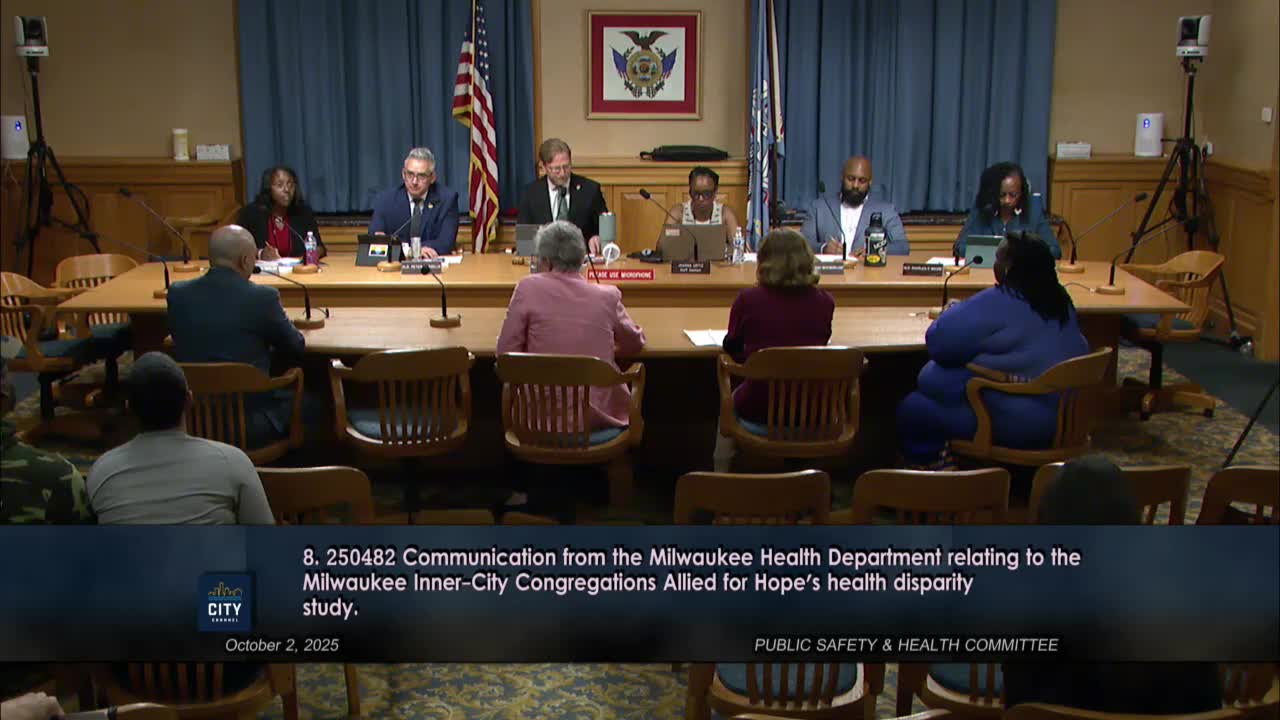
Milwaukee — Members of the Milwaukee Inner City Congregations Allied for Hope (MICA) Health Equity Task Force told the Public Safety and Health Committee on Oct. 2 they want the city’s doula program expanded to provide more intensive postpartum services, including hands‑on lead‑safety training and a 12‑month tapered follow‑up schedule.
Mary Ann Robbins of MICA presented a proposal that focuses on postpartum care in neighborhoods the group identified as disparately impacted. Deanna Branch, a local mother who had relied on a now‑closed pediatric clinic, told the committee she received only pamphlets after her child’s lead exposure and said in‑person support from a doula would have made a material difference.
“I didn’t know the educational resources on how to keep my children alive safe. And now that the clinic is gone, the doula program — I wish I had known what that was,” Branch said at the committee meeting.
MICA asked that the city’s doula program provide: state‑licensed doulas trained for postpartum care; bilingual and culturally sensitive staff; 12 months of tapered postpartum follow‑up (the national standard cited in MICA’s proposal); hands‑on lead education including use and maintenance of water‑filter cartridges; accompaniment to well-child visits to ensure lead testing; breastfeeding support; mental‑health screening and referrals; and worker protections to reduce doula turnover.
Health Department Commissioner Mike Todoridis updated the committee that the department’s doula staff already perform many culturally competent and lead‑education referrals, and that the department plans to announce “substantial changes” to its doula program on Oct. 8 as part of its 2026 budget presentation. He also confirmed the department provides filters and makes lead‑program referrals; he said front‑line doula staff generally do not perform home remediation or heavy‑duty cleaning themselves.
Committee members asked whether funding changes would be required to deliver 12‑month postpartum services and whether doulas could provide hands‑on lead‑safety training rather than only making referrals. Commissioner Todoridis said expanding the postpartum portion would cost additional staff time and that the department would include proposed options in its budget materials; he told the committee departmental leaders expect to address several of MICA’s requests in next week’s budget hearing.
The committee agreed to hold the item to the call of the chair so the Health Department can provide the fuller budget and program plan it promised. Sponsor Alderman Stamper and other members praised MICA’s proposal and asked the department to return with specificity on costs, staffing levels and expected outcomes.
“Those are the avenues that we can do that,” MICA’s Robbins said. “We would definitely want lead education to be included in the doula programming, providing water filters, teaching them how to…change the cartridges.”
The department and MICA will continue discussions during the city’s budget process and through the Board of Health, which Commissioner Todoridis said had discussed the doula program at its most recent meeting.