Get Full Government Meeting Transcripts, Videos, & Alerts Forever!
Get email alerts on the Child Welfare Hotline Prevention topic
No spam. Unsubscribe anytime.
Philadelphia DHS says hotline diversions, prevention funding rose as placements fell
Summary
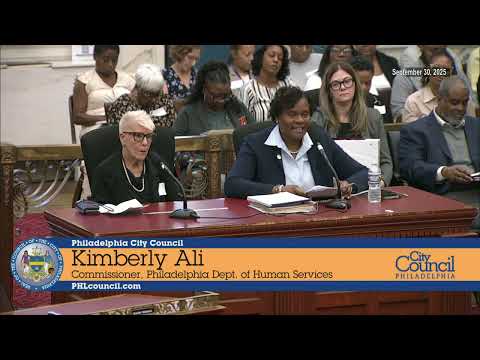
At a Sept. 30 Committee on Public Health and Human Services hearing, Philadelphia Department of Human Services Commissioner Kimberly Ali presented data showing a drop in children in placement since 2017 and described how the city routes calls through its child abuse hotline and funds prevention services.
Philadelphia Department of Human Services Commissioner Kimberly Ali told the City Council Committee on Public Health and Human Services on Sept. 30 that calls to the city’s child abuse hotline trigger DHS involvement and that the agency has shifted a large share of incoming reports into prevention and diversion services.
"The call to the child abuse hotline initiates DHS involvement," Commissioner Kimberly Ali said, explaining the intake and screening process that determines whether a report becomes a formal investigation or is diverted to prevention partners.
Ali presented DHS figures showing 38,184 calls or contacts entered into the hotline system in fiscal year 2025. Of those, she said, 60% — about 23,080 — were diverted from formal investigation and 15,104 received an investigation by a DHS social worker. Of the 15,104 investigations, 2,598 children were accepted for ongoing child protective services, she said.
The numbers, Ali said, are tracked through a case management system and on federal reporting platforms. "Of the 15,104 that were investigated, only 2,598 children were accepted for formal child protective services," she told the committee.
Why it matters: Ali said the statistics reflect a multi-tiered approach intended to keep children safe while expanding services that stabilize families so removal is not necessary. She pointed to long-term trends showing a decline in the number of children in placement citywide — from 6,194 on June 30, 2017, to about 2,406 as of the testimony — a reduction DHS described as roughly 60% compared with the department’s high point in 2017.
How prevention is funded: Nadine Parisi, DHS chief financial officer, told the committee the department spends about $110 million a year on prevention services. Parisi said some prevention dollars are held as a city-managed emergency or "concrete goods" fund of about $3,135,000 and that roughly 70% of that fund is used for rental and utility assistance. She also described other prevention line items that support Family Empowerment Services and rapid-response initiatives.
Committee members pressed DHS for clarity on how the department documents voluntary family contacts, what fraction of diverted calls receive concrete supports, and whether prevention funding is sufficient to reduce removals further. Commissioner Ali said prevention databases were consolidated with the department’s case management system in recent years so referral and diversion activity is now better documented.
DHS described the intake process and follow-up timeline for children removed from their homes: when a judge grants removal, a hearing must occur within 72 hours; another hearing within 10 days; and review hearings at least every three months until the case is closed.
Ending: Council members said they want more granular budget and outcomes data on prevention spending and its impact on removals, and they asked DHS for fiscal-year trend reporting. DHS agreed to provide additional data to the committee.