
Michigan Supreme Court hears challenge to vehicle search based on marijuana odor and occupants' ages
Get AI-powered insights, summaries, and transcripts
Subscribe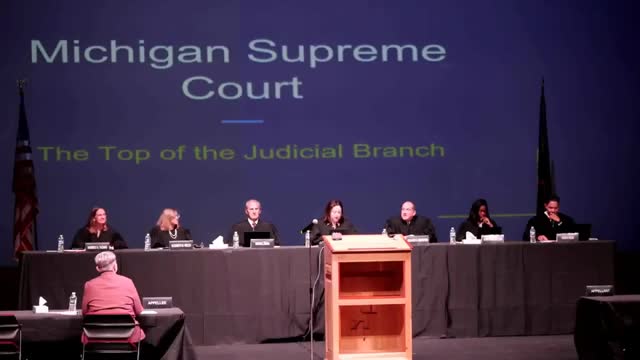
Summary
The Michigan Supreme Court heard oral arguments in People v. Freddie Wilkins III (Docket No. 167737), testing whether marijuana odor and occupants’ ages justify a warrantless vehicle search and whether evidence found after an extended stop must be suppressed.
The Michigan Supreme Court heard oral arguments in People v. Freddie Wilkins III (Docket No. 167737), a case testing whether the odor of marijuana and the ages of vehicle occupants justify a warrantless vehicle search and whether evidence uncovered after an extended Terry stop must be suppressed.
Defense attorney Zachary Houghton, representing Freddie Wilkins III, told the court that the case raises four questions of major significance: whether the smell of marijuana alone establishes reasonable suspicion of unlawful possession; whether reasonable suspicion of a civil infraction authorizes a Terry stop; whether evidence discovered after a Terry stop extended by an unrelated inquiry should be suppressed; and whether the automobile exception permits a warrantless search for evidence of a civil infraction. “First, this case presents the issue of whether the smell of marijuana alone establishes reasonable suspicion that an individual unlawfully possesses it. It does not,” Houghton said, adding he would reserve three minutes for rebuttal.
Houghton argued that because Michigan’s regulatory framework now permits lawful adult possession and because hemp-derived products and medical marihuana can lawfully be present, the odor of marijuana is not particularly probative of unlawful possession. He told the court that, for Fourth Amendment purposes, contraband should be limited to property whose possession is criminal and that a mere civil infraction should not be treated as contraband that justifies an automobile search.
The attorney pressed the court on thresholds for officers in the field: besides odor and occupants’ ages, Houghton listed additional indicia that could support probable cause for a search (for example, signs of recent use, visible paraphernalia, impairment, or a sufficiently large quantity), and he argued the record lacked such corroborating facts. He also urged suppression of evidence found after what he described as an extended search of Wilkins’s person, saying the extension rendered the subsequent vehicle search unlawful.
Kimberly Manns, an assistant prosecuting attorney for Kent County representing the people, countered that the trooper’s conduct was reasonable because he had probable cause to believe the vehicle contained contraband unlawfully possessed given the occupants’ ages and the odor. Manns acknowledged that, after the Michigan Regulation and Taxation of Marihuana Act (MRTMA) took effect, odor alone no longer automatically supports probable cause under this court’s recent decisions, but she urged the court to consider the entire factual context. “The trooper’s action in searching this vehicle was reasonable because he had probable cause to believe that that vehicle contained contraband, unlawfully possessed,” Manns said.
Manns told the justices that even if a small amount would constitute only a civil infraction, the MRTMA authorizes forfeiture of unlawfully possessed marihuana, and she argued that contraband for Fourth Amendment purposes can include unlawfully possessed goods regardless of whether the violation is categorized as criminal or civil. She acknowledged there is no clear Michigan or U.S. Supreme Court precedent expressly approving automobile searches to recover only civil-infraction–level contraband.
Throughout argument, several justices pressed both parties on practical and doctrinal limits. One justice asked what additional facts would be needed to convert odor plus age into probable cause for a vehicle search; Houghton reiterated that odor and age alone were insufficient and listed possible corroborating signs. The bench also explored whether treating civil-infraction-level possession as Fourth Amendment contraband would open broad powers to search vehicles when a lawful adult could have created the odor or when odors come from legal sources such as hemp-derived products or medical marihuana.
Counsel discussed Rodriguez and the court’s recent Armstrong decision. Houghton argued that an evidentiary search of Wilkins’s person extended the stop beyond its traffic-related scope and that evidence found after that extension is a fruit of an unlawful seizure. Manns said the search of the person was part of the officer’s investigation and, even if an evidentiary frisk exceeded Terry, the remaining facts supported probable cause to search the vehicle; she also noted that a firearm was discovered in the vehicle during the search.
Arguments concluded with defense counsel noting the constitutional risks of allowing odor-plus-age to justify routine vehicle searches: such a rule, he said, would subject many 21-year-olds who live with or ride with lawful marihuana users to repeated investigative stops. The court took the case under advisement and submitted the matter for decision.
The case will determine how Michigan courts apply the automobile exception and Terry-stop principles in the wake of Michigan’s marihuana statutes and could affect traffic-stop practice statewide.