
Residents seek moratorium on proposed Menomonie data center; Dunn County committee discusses zoning, authority
Get AI-powered insights, summaries, and transcripts
Subscribe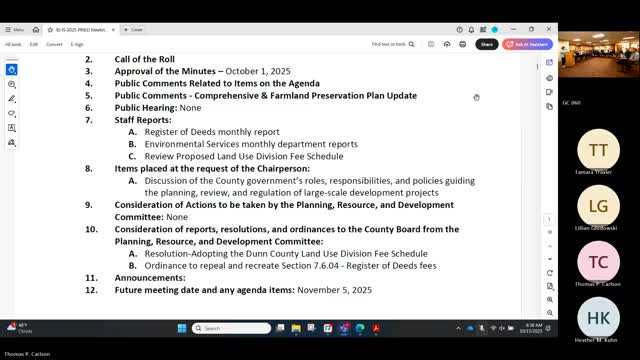
Summary
Terry Seibold, a Menomonie resident, urged the Dunn County Planning, Resource and Development Committee on Oct. 15 to pause any approvals for a proposed data center near Menomonie.
Terry Seibold, a Menomonie resident, urged the Dunn County Planning, Resource and Development (PRD) Committee on Oct. 15 to pause any approvals for a proposed data center near Menomonie.
"I urge you to be courageous as public officials and say no to data centers in Dunn County," Seibold told the committee during the public-comment period, saying the project would transform more than 300 acres of farmland and raise concerns about energy and water use, noise, traffic and property values.
Seibold was one of 11 speakers who addressed the committee about the proposal. Speakers cited water consumption, light and noise pollution, nondisclosure agreements surrounding city-level negotiations, and uncertainty about long-term local benefits. Joanna Kellner said, "Why should we let such a water consuming project take our water?" Other speakers warned of falling property values and said the development process had been rushed and opaque.
Adam Acula, identified in the record as director of economic development for Greater Dunn County, urged the committee to frame the debate around the limits of county authority and the townships the county regulates, saying, "Any policies enacted by the county board regarding development will apply specifically and exclusively to the townships that follow county zoning." He recommended preparing review criteria and working with utilities before ruling out an entire industry.
Why it matters
Speakers told the PRD Committee the proposal — discussed publicly in Menomonie and involving land annexation and zoning changes at the municipal level — has raised concern because of its scale and the number of parcels involved. Residents asked the county to use the comprehensive-plan update to define clearer policy and screening criteria for large-scale projects that could affect groundwater, rural character and municipal services.
What the committee and staff said
Tammy (Zoning Administrator) summarized how county zoning and the comprehensive plan interact: most of Dunn County’s zoned land is agricultural, and large industrial projects located outside municipalities would typically require rezoning to a heavy-industrial district. Tammy said the county’s zoned townships contain roughly 94% agricultural zoning and that county-administered heavy- and light-industrial districts account for relatively small amounts of acreage; she said about "310 acres zoned heavy industrial and 149 acres zoned light industrial" (staff figures presented at the meeting).
Tammy and other staff outlined the procedural path for a large project: town-level review and recommendation, a county rezone request (if the land is under county zoning), PRD Committee consideration, and final action by the county board. Staff also noted that permitted uses are decided by the zoning administrator, conditional uses and some appeals go to the Board of Adjustment, and disputes can be appealed to circuit court.
On moratoriums and limits
Committee members asked how and whether the county could impose a moratorium. Tammy said moratoria are possible but must be tied to a legitimate public purpose (for example, documented infrastructure limits or public-health and safety risks) and are typically time-limited; she said the county has used a six-month moratorium in the past to allow study and public deliberation. She cautioned that some project types carry state-level preemption or oversight (for example, certain large-capacity wells and utilities are regulated by state agencies), which can limit local options.
On transparency and nondisclosure agreements
Several speakers and committee members criticized nondisclosure agreements used in prior municipal negotiations, saying they hampered public understanding. Committee members asked whether the county or its ethics rules could restrict the use of NDAs in public-development negotiations; staff said that addressing NDAs and related disclosure practices will likely involve legal counsel and intergovernmental coordination.
Public comments cited claims and studies; staff responses and legal limits
Speakers reported studies and online materials describing high water and energy use at large data centers; those claims were presented as part of public comment and attributed to the speakers. Staff repeatedly emphasized the distinction between county authority in unincorporated townships (where county zoning applies) and city-level decisions (which are controlled by municipalities). Adam Acula warned that a blanket ban might preclude beneficial projects, while multiple residents asked the county to consider a moratorium to allow technical study of water, utilities and long-term economic impacts.
What happens next
The committee closed public comment and proceeded with other agenda business, noting the comprehensive-plan update process will continue through the winter and next year. Staff said the comprehensive plan review is the appropriate venue to develop clearer standards and that additional ordinance updates (zoning definitions, industrial-use definitions, shoreland/floodplain rules) may be needed.
The committee asked county legal counsel to participate in future meetings about jurisdictional limits and moratorium authority; counsel was not present at the Oct. 15 meeting.
Ending
Committee members and staff said they will use the comprehensive-plan process and further ordinance review to consider clearer definitions, criteria and intergovernmental agreements that would govern large-scale projects. Residents who spoke asked the committee to prioritize transparency and to evaluate water, energy and community impacts before any rezoning or permitting of a large industrial site outside municipal boundaries.