Get Full Government Meeting Transcripts, Videos, & Alerts Forever!
Get email alerts on the School Based Mental Health topic
No spam. Unsubscribe anytime.
Santa Clara County behavioral health reports expansion of school-based services, highlights sustainability work
Summary
Behavioral Health Services reported fiscal year 2025 schooling services activity — including school-based wellness centers, program participation counts, and next steps to sustain services under a state fee schedule — and the committee voted to receive the report and forward it to the full Board with additional follow-up items.
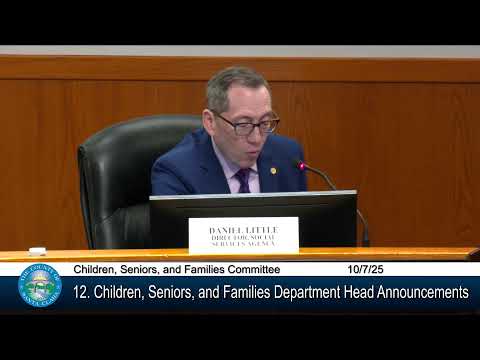
Behavioral Health Services presented its annual schooling services report Oct. 7 to the Children, Seniors and Families Committee, summarizing FY 2025 program activity, school-based wellness center rollouts and plans to pursue sustainable financing for school mental-health services.
The report said the schooling services family engagement program — operating in partnership with 27 school districts — served roughly 7,400 students in FY 2025 and the department recorded 11,906 referrals into schooling services programs. Staff said 40 school-based behavioral health wellness center projects have launched under the county grant program and that local education agencies such as the County Office of Education and Sunnyvale Unified have started billing under the Department of Health Care Services’ multi‑payer school-based Medi‑Cal fee schedule.
Catherine Spares, division director with Behavioral Health Services, said the county aligns schooling services with a multi-tiered system of supports (tier 1 universal strategies; tier 2 targeted supports; tier 3 individualized treatment). She described a FY25 mix of activities: family engagement, prevention/early intervention programming and school-campus outpatient treatment. “We served over a thousand students receiving outpatient treatment on school campuses,” Spares said.
Committee members focused questions on continuity of care for students when school wellness centers close and on program sustainability given pending federal and state funding shifts. Spares said districts with closed sites were meeting with county staff to identify receiving school placements and that the behavioral health call center and county-contracted providers will be used to connect displaced students to services. When asked for counts of how many students were reconnected after closures, staff said the exact number was not immediately available but that they would provide that data to supervisors’ offices.
Committee members asked about short-term follow-up for families who earlier declined referrals. Spares said schooling services coordinators track referral status and staff can work with coordinators and county-contracted providers to build a follow-up process for families that previously declined services.
Budget pressures were a recurring concern. A county staff member warned that behavioral health faces structural deficits across major funding streams — MHSA, realignment, and Medicaid (Medi‑Cal) — and that programmatic redesign and prioritization will be required as the department assembles budget proposals for the county executive’s recommended budget. Committee members asked for line items and per‑child cost comparisons (including the cost to detain youth) to show long‑term fiscal consequences of reductions in prevention and school‑based services; staff agreed to provide more detailed cost and district‑level breakdowns in future reports.
The committee voted unanimously to receive the schooling services report, to forward it to the full Board of Supervisors as part of the Behavioral Health quarterly report, and to include additional information requested during the meeting (district/school breakdowns, counts of students reconnected after closures, program cost per child and follow‑up procedures for declined referrals). The motion passed on a 2–0 roll call by committee members present.
Committee members and staff indicated next steps will include continued data collection, quality improvement for wellness centers, leadership engagement with districts about the Medi‑Cal fee schedule, piloting universal screening for FY 2026, and development of sustainability plans to support wellness centers beyond grant funding.