Get Full Government Meeting Transcripts, Videos, & Alerts Forever!
Get email alerts on the Search And Seizure topic
No spam. Unsubscribe anytime.
Michigan Supreme Court Hears Case on Marijuana Odor and Warrantless Vehicle Searches in People v. Wilkins
Summary
The Michigan Supreme Court heard oral argument in People v. Wilkins (docket 167737), a case testing whether the odor of marijuana and a driver and passenger being under 21 justify a warrantless vehicle search under the automobile exception and whether an extended Terry stop required suppression of a gun found in the vehicle.
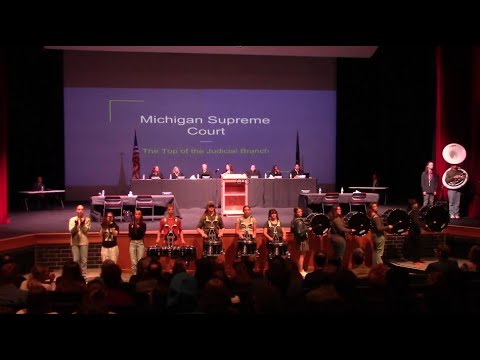
The Michigan Supreme Court onstage at Big Rapids High School heard argument in People v. Wilkins, No. 167737, a case that asks whether smelling marijuana and learning that vehicle occupants are under 21 can give police probable cause to search a vehicle without a warrant and whether evidence discovered after an allegedly unlawful search of a person must be suppressed.
The case traces to a January 2023 traffic stop in which a trooper stopped a car for speeding, detected the odor of marijuana, learned the driver and a passenger were under 21 and — after backup arrived and a search of the passenger compartment — found a handgun in a backpack. The driver, Freddie Wilkins III, was charged with carrying a concealed weapon in a motor vehicle and moved to suppress the firearm as the product of an unlawful search and seizure.
Cheryl Nowak, chief commissioner of the Michigan Supreme Court, summarized the procedural history before argument: the circuit court denied suppression, the Court of Appeals affirmed in an unpublished decision, and the Supreme Court ordered oral argument on whether (1) the officer's search of Wilkins exceeded the permissible scope of a Terry stop; (2) any recovered weapon was causally connected to that search; and (3) the automobile exception permits a warrantless search for evidence of a civil infraction where the officer had probable cause to believe only a civil infraction (possession by a person under 21) occurred.
Defense counsel Zachary Houghton, arguing for Wilkins, told the justices, “The smell of marijuana alone...it does not,” and pressed three central points: that the odor of marijuana is now ubiquitous after legalization and therefore not probative of unlawful possession; that Terry v. Ohio authorizes brief stops tied to suspected criminal activity, not civil infractions; and that evidence discovered after an unrelated inquiry that extended a Terry stop should be suppressed because the seizure became unlawful.
Assistant prosecuting attorney Kimberly Manns, representing the people of the state of Michigan, acknowledged Armstrong (an April 2025 Michigan Supreme Court decision) narrowed the use of odor alone for probable cause but argued the facts here differ because “no one in the vehicle could legally possess any marijuana because they're both underage,” and therefore the automobile exception authorized the search. “The trooper's action in searching this vehicle was reasonable because he had probable cause to believe that that vehicle contained contraband,” Manns said.
During argument justices pressed both sides on practical and doctrinal limits. Justices questioned whether an admission by a passenger that small amounts of marijuana were present in the vehicle would supply probable cause, whether the officer's investigatory steps extended the traffic stop in a manner covered by Rodriguez, and how to draw workable bright lines for officers encountering odor when legal adults and illegal under-21 possession may coexist in the same vehicle. Counsel and the prosecutor debated whether the Fourth Amendment’s reference to “contraband” requires contraband to be criminal in nature (i.e., possession criminal rather than merely a civil infraction) for the automobile exception to apply.
Counsel for Wilkins emphasized that, absent additional indicia such as visible paraphernalia, signs of impairment, or an admission establishing a criminal amount, common factors (odor plus denial plus age) did not suffice to establish probable cause to search for criminal contraband. The prosecutor countered that where none of the occupants can legally possess marijuana under Michigan law, any amount in the vehicle is contraband and thus gives rise to probable cause for a vehicle search.
Students and community members attending asked practical questions after the argument about how officers assess odor (fresh versus residual), how long the stop was extended, and whether an officer's credibility can be challenged if patterns of false reports exist; counsel declined to address certain evidentiary specifics that are part of the ongoing criminal proceedings. Court staff explained that the justices could resolve the case with a short order (which can be issued in weeks) or a fuller opinion (which can take months).
The court took the case under advisement and the attorneys were excused. If the court suppresses the firearm as the fruit of an unlawful search, the prosecutor said the gun would not be admissible and the concealed-weapon charge would likely be dismissed; if the court affirms admissibility, the criminal case would proceed to plea negotiation or trial. For now the key questions placed before the justices are how Armstrong's limits on odor-as-probable-cause should be applied to under-21 possession, whether the automobile exception extends to evidence of civil infractions that the prosecutor characterizes as contraband, and whether any extension of the Terry stop requires suppression of the discovered weapon.