Get Full Government Meeting Transcripts, Videos, & Alerts Forever!
Get email alerts on the Land Use Housing topic
No spam. Unsubscribe anytime.
Developers and residents clash over proposed rooftop-solar setbacks that critics say would curb housing
Summary
Speakers at the Oct. 6 Cambridge City Council meeting debated a policy order proposing fifth- and sixth-floor setbacks to protect rooftop solar; developers and housing advocates warned the change would reduce multifamily housing and inclusionary units, while some residents supported setbacks for design and solar protection.
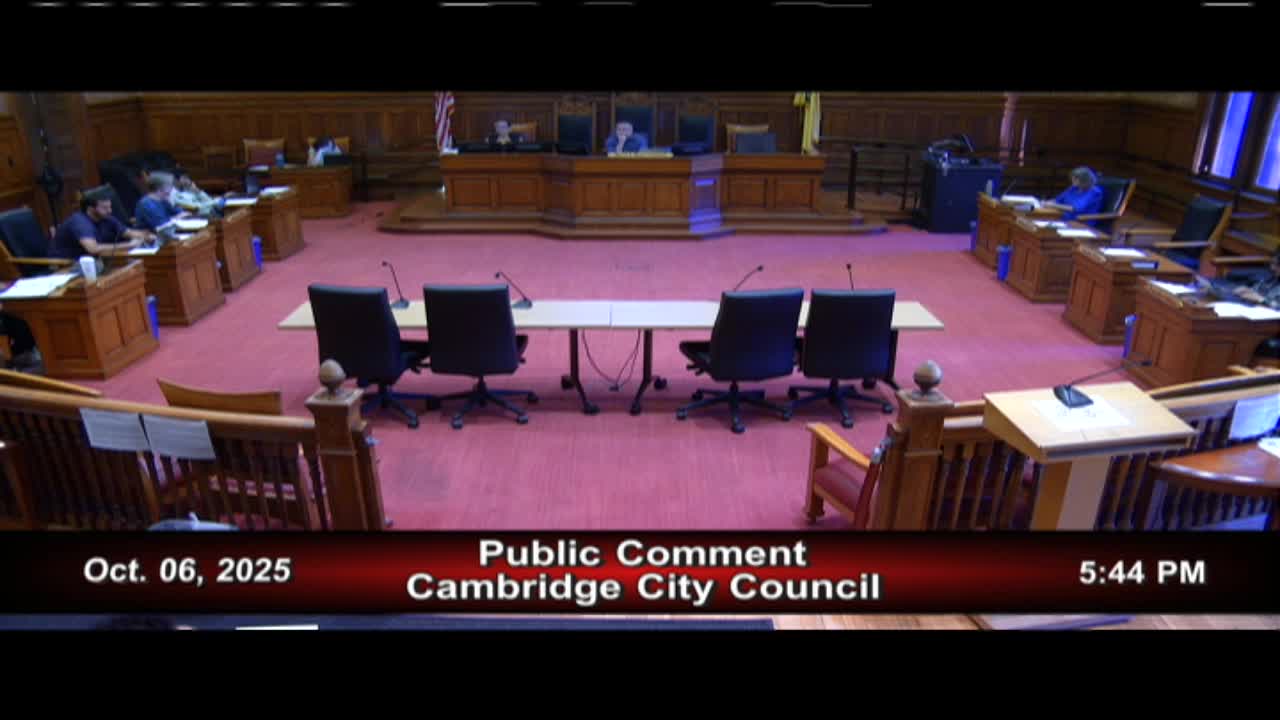
Speakers at the Oct. 6 Cambridge City Council meeting debated a policy order (referred to in public comment as policy order 137) that would add setback requirements on the fifth and sixth floors of new residential buildings to protect existing and future rooftop solar.
Sharmel Modi, a resident of 271 Cambridge Street, urged the council to reject the proposed setbacks, saying they would “cap residential construction at 4 stories” on midsize lots and make 5- and 6-story buildings economically infeasible. “If this council truly wishes to see more residential units built in the city of Cambridge, this proposal unquestionably runs exactly counter to that goal,” Modi said.
Developers and real-estate professionals described similar concerns. Patrick Barrett, who said he represents multiple projects in the city, warned that the new rules would reduce the financial viability of projects that rely on the inclusionary zoning bonus and said changes to the C1 zone could strip incentives for building 5- and 6-story projects. Edward Stewart and Lance Green, who identified themselves as property owners and a realtor, said proposed setbacks would cause some developers to pivot to smaller luxury townhouses rather than build multiunit inclusionary housing.
Speakers supporting setbacks framed the proposal as a measured way to protect solar installations and preserve sky access. Charles Franklin, who said he supported the city’s recent upzoning generally, argued that setbacks need not stop development and pointed to other dense cities with setback rules that still produce housing.
Several speakers offered technical or scale context. Rafi Freeman, who described himself as a developer of large-scale solar projects abroad and a residential solar owner in Cambridge, estimated there is roughly 5 megawatts of residential solar in the city and said that, given a typical New England capacity factor, rooftop residential solar accounts for a small fraction of city electricity usage. Freeman argued that the social and environmental benefits of building more housing outweigh the marginal gains from preserving some rooftop solar panels.
Other commenters proposed alternatives, including incentives for rooftop solar on larger buildings, community solar, compensation mechanisms for affected homeowners, or technical mitigations such as panel optimizers. Multiple speakers urged the council to weigh housing production goals against solar preservation rather than adopt a measure they said would amount to downzoning.
The transcript contains public comment and debate but does not show a council vote on the setback proposal during the recorded portion of this meeting.