Get Full Government Meeting Transcripts, Videos, & Alerts Forever!
Get email alerts on the Community Redevelopment topic
No spam. Unsubscribe anytime.
Alachua County staff urge sticking with 10-year GCRA plan amid city request to extend district
Summary
County staff presented a history of the Gainesville Community Redevelopment Area, said the city has proposed doubling the GCRAtimeline and expanding boundaries, and recommended following the original 10-year —1 Decade, 1 Mission— agreement rather than committing county general fund dollars to an extension amid fiscal uncertainty.
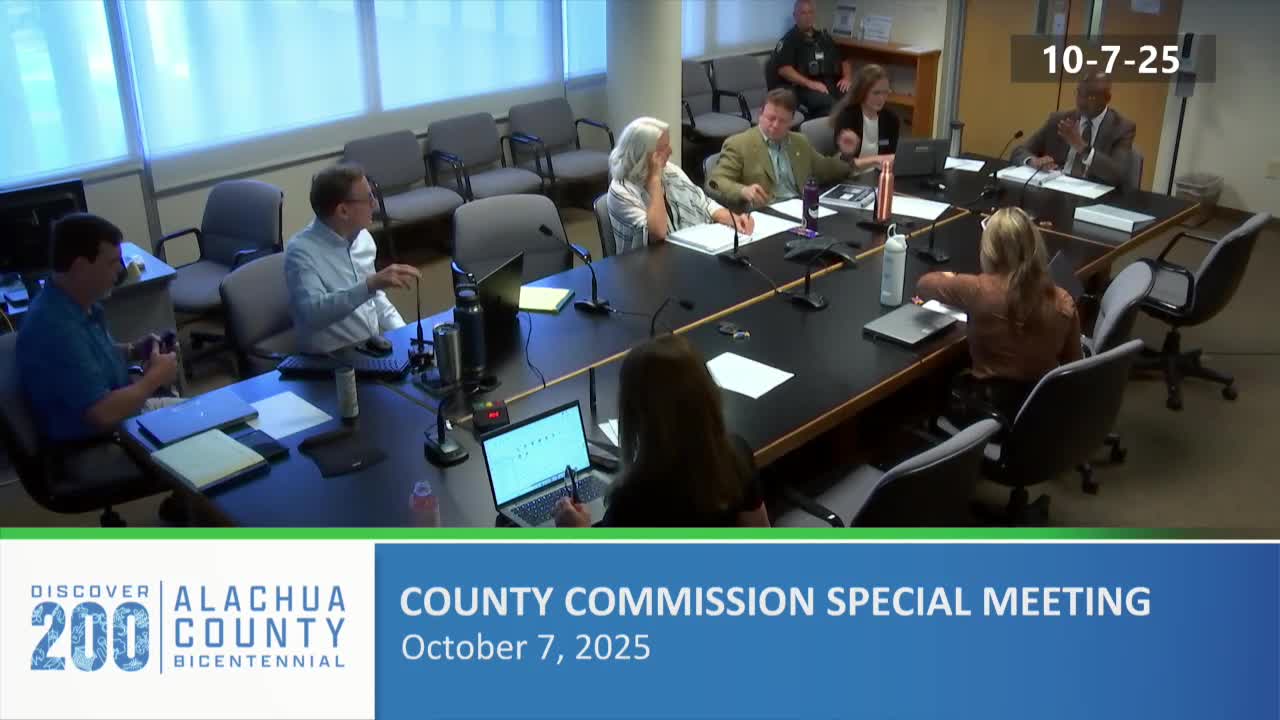
Alachua County staff told the Board of County Commissioners at a special meeting that the countyis not proposing to —end— the Gainesville Community Redevelopment Area but is recommending the county honor the original 10-year plan and allow the GCRA to sunset on schedule.
The presentation, given by Mark Sexton, the county communications director, and Tommy Crosby, assistant county manager in charge of finance, laid out the GCRAhistory, the county—s investments in East Gainesville and downtown, the cityof Gainesville—s request to extend the GCRA up to 69 years, and the county—s financial concerns. Sexton said recent public messaging incorrectly implied the county wanted to eliminate the GCRA, and stressed that —that was a city decision, not a county decision.—
Why it matters: Community redevelopment areas are funded by tax increment financing (TIF), which redirects property tax growth inside a defined district to redevelopment projects instead of to the general fund. County staff said that redirecting those tax increments affects countywide services paid from the general fund, and that any long-term county commitment to the GCRA would compete with public safety, roads and human services budgets.
What county staff told commissioners: Sexton traced Florida—s Community Redevelopment Act to 1969 and summarized local actions that culminated in a 2019 —10-and-done— plan. Under that 2019 interlocal agreement, the city consolidated prior CRA districts into the GCRA and committed to a 10-year program of specified, transformational projects with roughly $70 million in planned investments targeted to East Gainesville and downtown. County staff said the city then asked the county to extend the timeframe and — from information in a city PowerPoint and consultant George Burgess—s report — appeared to recommend enlarging the district, maintaining city majority representation, and exploring a countywide ballot referendum to issue bonds for GCRA projects.
Tommy Crosby, the assistant county manager, told the board the county faces near-term economic headwinds including inflation, high construction costs and potential state tax reforms that could lower property-tax revenue. Crosby said those pressures counsel caution about new, long-term commitments from the county general fund.
City proposal and unknowns: County staff summarized the city—s proposal (staff said they had seen a city PowerPoint but not all underlying details). From that document, staff said the city appears to seek a 20-year extension (to 69 years total), a possible expansion of geographic boundaries and a governance structure that may preserve a city majority on the GCRA board. The county said the city—s presentation did not make clear whether the county would be asked to double its contribution; if it did, staff estimated a county obligation on the order of $75 million over the extended period.
County track record and alternative funding: County staff emphasized dozens of independent county investments in East Gainesville and downtown: a $36 million federal investment tied to a U.S. Army Reserve equipment site, a multimillion-dollar East Gainesville legacy housing project, partnership grants for museums and festivals, investments in a new judicial complex and parking garage, and ongoing awards through the county—s Nature and Culture destination enhancement grant program. Sexton noted that Wild Spaces Public Places ballots have also directed more than $200 million in funding to city projects and that the city could choose to sustain a GCRA at a smaller scale using that or other local revenue sources.
Staff recommendation and board reaction: Sexton said the county—s recommendation was to —follow the original agreement, let the GCRA sunset,— while remaining open to case-by-case joint projects with the city in the future. Commissioners voiced concern about the timing of any decision. Commissioner Cornell said the county should wait until after the next state legislative session and further budget clarity before making long-term commitments, calling current proposals —premature.— Several commissioners — including Chestnut and others who noted long-term personal investment in East Gainesville projects — pressed for a clear accounting of unfinished work and budgets for the remaining four years of the GCRA—s ten-year plan.
City response and public comment: Gainesville City Manager Cynthia Curry told the meeting that a city email that suggested the county was seeking to —end— the GCRA was not authorized by her office and that city staff have attempted to coordinate presentations with the county; she said the city was seeking common ground. Members of the public, many with experience on GCRA advisory boards, urged county commissioners to protect grant funding and local programs that support arts, culture and downtown activity. Several speakers representing East Gainesville neighborhood groups said they welcome continued county investment and asked for tangible timelines for projects such as the Eighth and Waldo corridor.
Decisions taken and next steps: The county commission did not adopt a long-term change to the GCRA at the meeting. Commissioners directed staff to continue discussions with city staff and to bring more detailed budget information, timelines and project-level accounting back to the board. County and city staff indicated a joint meeting is scheduled in December and staff said they would revisit the issue when legislative and budget clarity improved.
Ending: County staff framed the immediate action as transparency and a request for a deliberate timeline: allow the current interlocal agreement and the —1 Decade, 1 Mission— commitments to proceed through 2029 while county staff and commissioners review project budgets and potential fiscal impacts before making any new, multi-decade funding commitments.