Get Full Government Meeting Transcripts, Videos, & Alerts Forever!
Get email alerts on the Hazard Mitigation topic
No spam. Unsubscribe anytime.
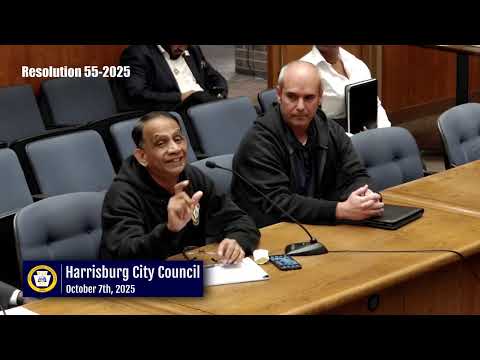
Public safety committee reviews Dauphin County 2025 hazard mitigation plan and regional projects including Paxton Creek dechannelization
Summary
The public safety committee reviewed the Dauphin County 2025 Hazard Mitigation Plan on Oct. 7 and discussed regional flood mitigation and emergency planning priorities tied to federal funding eligibility.
The public safety committee on Oct. 7 reviewed Resolution 65-2025, a request to adopt the Dauphin County 2025 Hazard Mitigation Plan as the city’s official hazard mitigation plan.
Fire Chief (and emergency management lead) Chief Ederlein explained that adopting the county plan brings Harrisburg into a countywide mitigation framework required under federal disaster mitigation law and that the unified plan makes municipalities more eligible for federal mitigation and reimbursement funding. He cited the winter storm Jonas response as an example where adherence to mitigation and documentation allowed the city to recover significant FEMA reimbursement dollars. He said Dauphin County is ahead of its scheduled readoption cycle after obtaining grant funding and that the county’s plan consolidates municipal work into a single countywide document.
Committee members focused on several policy points: Chief Ederlein and staff highlighted the Paxton Creek dechannelization project (described as roughly 400 acres removed from the floodplain by project construction) as a mitigation priority and said it is likely to be a multiyear, large-scale project (chief described it as “probably a $100,000,000 project”). Members also discussed emergency planning tied to Crane Clean Energy’s reopening and nuclear regulatory commission coordination; county-level and regional planning has been underway, with potential evacuation/reception sites and an expectation of continued work through preplanning and NRC-mandated updates.
The committee reviewed plan goals that guide mitigation projects (protect life and infrastructure, increase public awareness, restore natural resources, reduce risk for vulnerable populations, and improve infrastructure resilience). Members asked about population projections contained in the plan (the consultant data cited a 2% population increase from 2010–2020 and a projected 7% decrease by 2030) and requested the county provide multilingual or condensed public-facing materials; Chief Ederlein said he would follow up with Dauphin County regarding translations and public outreach.
The plan document is extensive (committee members referenced its 800-plus pages); committee discussion did not record a formal recommendation to place the county plan on the legislative agenda during the work session, but staff emphasized the importance of adoption for eligibility for federal mitigation dollars and pre-planning for major projects.