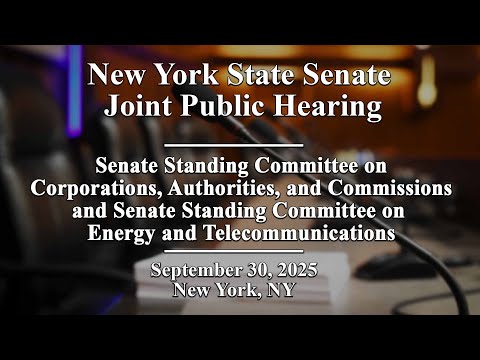
Utilities defend negotiated settlements, cite large infrastructure backlogs and affordability programs
Summary
Major utilities told legislators that settlement agreements and rate cases are tools to protect reliability and affordability while funding grid modernization and clean‑energy programs. National Grid, National Fuel, Central Hudson, NYSEG/RG&E and others described heavy cost pressures from aging infrastructure, storm recovery and property taxes and
Representatives of major utilities told the Senate joint committee that settlements, when negotiated with many parties, can deliver affordability and programmatic outcomes not easily obtainable through litigated one‑year rate cases.
Chris Kiefer, assistant general counsel for National Grid, summarized his company’s most recent joint proposal outcomes: the settlement trimmed more than $1 billion of the electricity and gas capital requests from the original filing, included roughly $290,000,000 in targeted bill credits and expanded outreach and assistance programs, and enabled multibillion‑dollar investments in safety, reliability and grid modernization. Kiefer said settlements allowed the company and 14 parties to accept a package that smoothed rate impacts and established affordability protections; he defended confidentiality in negotiation as a practical tool used under PSC settlement guidelines.
National Fuel Gas Distribution Corporation described long‑running emissions reductions tied to pipeline modernization and leak‑prone pipe replacement. Randy Raczynski, National Fuel’s regulatory counsel, said the company has reduced emissions about 70% since 1990 through targeted replacement and leak mitigation efforts and argued that the upstream gas system can play a role in near‑term decarbonization via renewable natural gas and future hydrogen blends.
Central Hudson stressed modest rate increases and targeted support. Joseph Halley, Central Hudson’s vice president for regulatory affairs, said the company’s recent rate decision produced a 4% first‑year decrease for low‑income electric customers and a 3% annual electric rate increase overall; he said 80% of Central Hudson’s capital program focuses on replacing aging infrastructure and that the company is leading on heat‑pump installations and customer effectiveness programs.
NYSEG/RG&E (Avangrid) said distribution and transmission upgrades are needed to connect growing load and new generation. Avangrid’s deputy CEO, Kimberly Harriman, told the committee the system is seeing “unprecedented” connection requests — including manufacturing and data‑center loads — and that wholesale prices and constrained supply are raising customer bills. She emphasized that delivery charges include property taxes and system costs that are outside the company’s direct control and urged continued attention to transmission planning and procurement to relieve congestion.
Why it matters: Utilities argued that a mix of approaches — settlement negotiations, public‑interest review and long‑range planning — allows the PSC to preserve reliability while making room for CLCPA goals. Utilities urged careful evaluation of capital priorities and urged lawmakers to consider program and financing mechanisms that reduce rate impacts and accelerate connections for clean energy projects.
Points of dissent: Advocates at the hearing argued that settlements are too secretive and that some approved large capital plans have insufficient independent justification. Utilities countered that settlements are subject to PSC review, staff audits and evidentiary records and that prolonged litigation and delayed decisions create ‘‘rate compression’’ and recovery problems that can raise bills.
Ending: Utilities told lawmakers they will continue to work with the commission, with legislative staff and with community stakeholders to preserve reliability, keep affordability central and expand programs for electrification and energy efficiency. The companies encouraged legislative and administrative coordination on transmission procurement, capacity planning and customer assistance.
AI generated
The text on this page is AI generated. Summaries, highlights, analysis, and video transcripts are all produced from the original source material.
AI can make mistakes, so if you spot one, and we will fix it for everyone.
Note: the source content is unaltered by us. Any content source we link to, be it a video, an audio recording, or a document, is presented exactly as its publisher released it. That publisher is usually a government body, sometimes an individual official or another organisation.