Get Full Government Meeting Transcripts, Videos, & Alerts Forever!
Get email alerts on the Housing Code Update topic
No spam. Unsubscribe anytime.
San Miguel County stakeholders begin code overhaul to ease housing barriers
Summary
County stakeholders and consultants opened a strategic roundtable focused on zoning and development rules to remove regulatory barriers and support a range of housing types to address urgent local need. Discussions emphasized infrastructure, certainty for developers, accessory dwelling units, deed restrictions and the limits of land-use authority.
San Miguel County convened a strategic stakeholder roundtable on land-use regulations on Oct. 24, 2025, as consultants and community members began a multi-phase code update aimed at removing regulatory barriers to housing production across the county.
Jen Gardner, a consultant with Logan Simpson, said the project is funded by “Proposition 1 23 local planning capacity grant from DOLA,” and described the immediate goal: “This code update is focusing more on removing barriers so that it can be easier for the entire community to contribute to that housing need.” The consultant team said the work will proceed in three phases: foundation and information-gathering, issue analysis, and code drafting.
The meeting assembled elected officials, planning commissioners, developers, nonprofit housing providers and residents to identify recurring problems that impede housing, especially small-scale multifamily housing and accessory dwelling units (ADUs). Gardner summarized local housing metrics cited from the county’s housing needs assessment: “about 1,400 employees commuting into the county for work daily,” roughly 200 unfilled jobs, about 70 people in temporary or homeless situations and about 110 units in overcrowded conditions. Consultants and attendees said the assessment also estimates more than 1,000 units of need by 2034 and flagged a large gap between local wages and home prices.
Participants described several recurring obstacles. Infrastructure capacity—particularly water, sewer and the single main highway in and out of valley communities—was raised repeatedly as a constraint that must be considered alongside code changes. Tony Durani, representing the Norwood Water Commission, described a recent developer request for a water-availability letter that the commission could not support; he said that experience shows local infrastructure limits can block otherwise viable projects.
Developers and builders stressed certainty, speed and predictability in the permitting process. A Norwood developer, Paul Major, described a 24-home infill project, Pinion Park, as a relatively rapid infill success but urged the group to “think about the outcome versus the process,” arguing that too many prescriptive steps can raise costs and kill small projects. Several speakers said review delays, late information from utilities or conditions that are added late in review increase costs and risk for proposed projects.
Stakeholders discussed specific code topics to prioritize including: by-right ADUs, clarified rules for modular and manufactured construction and height allowances for modular stacking, refinement of the county’s affordable- and community-housing zone experience, and how deed restrictions and definitions of “qualified buyer” affect long-term affordability. Several attendees pointed to past projects as case studies: Stephanie Solomon, speaking from her experience with a developer, called the Ilium/Iliam (Telsky) affordable housing PUD “really an 8 year project,” noting complex exception agreements, pandemic-related cost increases and that the developer eventually built nine of 31 allowable units, with other lots later sold or proposed for other uses.
Speakers proposed short-term and systemic changes. Short-term “quick wins” discussed included clearer by-right allowances for ADUs where water supplies permit, pre-approved ADU plan sets and incentives to convert short-term rentals to long-term rentals. Summit-County-style subsidy examples were raised as one way to bridge owner reluctance to convert ADUs away from short-term rentals. System-level items included a county-level approach to traffic/level-of-service standards, clearer coordination with CDOT and utility providers, and improved clarity in the county’s deed-restriction policies and qualified-buyer definitions.
The consultant team and county staff said infrastructure and some matters (water rights, municipal codes inside town limits, state law on well permits and taxation) lie outside the scope of the land-use code update but will be acknowledged as constraints. Kaye Simonson, the county planning director, confirmed that state well-permit rules limit ADU expansion in parts of the Down Valley served by residential well permits, while other areas on domestic well permits allow additional units—an example of how water law interacts with zoning.
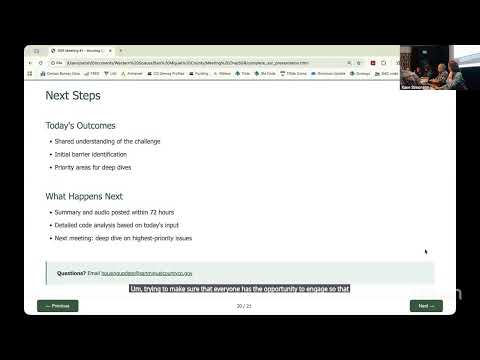
No formal votes or policy changes were taken at the meeting. The consultant team said it will perform a detailed code analysis, post a meeting summary within 72 hours, and return with recommended deep dives and draft code language. The team encouraged further community input through scheduled listening sessions and one-on-one appointments.
The discussion closed with agreement to continue the stakeholder process: consultants will synthesize the input, analyze the code for specific barriers and return with more detailed options and draft language for review.