Get Full Government Meeting Transcripts, Videos, & Alerts Forever!
Get email alerts on the Land Use And Planning topic
No spam. Unsubscribe anytime.
Metropolitan Planning Commission outlines 2045 comprehensive plan and outreach schedule
Summary
Melanie Wilson, executive director of the Metropolitan Planning Commission, presented an overview of the county's 2045 comprehensive plan update, emphasizing land use, infrastructure coordination and a countywide outreach program beginning in October.
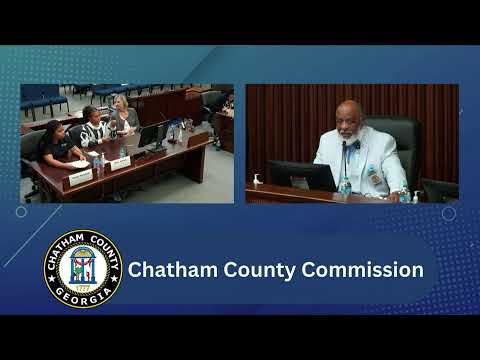
Melanie Wilson, executive director and CEO of the Metropolitan Planning Commission (MPC), presented an overview of the 2045 comprehensive plan and the public outreach schedule during the Chatham County Board of Commissioners meeting on Oct. 3.
Wilson told commissioners the comprehensive plan is intended as a 20-year road map that will be coordinated with the Metropolitan Planning Organization’s long-range transportation plan. "The comprehensive plan basically is a 20 year road map for the future," Wilson said, adding the update will place additional emphasis on land use and on matching growth to existing infrastructure.
Wilson said the MPC plans a robust public-engagement program, including an online survey, pop-up events at community festivals and parks, geocoding of respondent addresses for analysis, and a short “planning academy” in January to help citizens better understand planning and how to participate. She said the MPC expects an internal staff draft in January, a public draft in May, and submission to the Coastal Regional Commission (CRC) and the Georgia Department of Community Affairs (DCA) under the timetable required to preserve eligibility for certain state funds.
Commissioners asked how the county plan will interact with other planning efforts, including Vision 2033. Wilson said Vision 2033 is a separate, privately funded initiative that pulls together multiple planning documents; she emphasized that MPC should be at the table on that project because the MPC’s 2045 comp plan provides a longer-term, macro view that supports countywide decisions. She described attempts in other regions to use urban growth boundaries and development ‘‘nodes’’ to guide growth and said the county’s update will consider concentrated growth areas, performance standards for development nodes and coordination with neighboring jurisdictions’ infrastructure plans.
Commissioner Dean Kicklighter and other commissioners pressed on outreach and interjurisdictional coordination. Wilson said MPC will collect ZIP-code and address data during outreach and will incorporate neighboring cities’ plans where possible, but stressed that the comp plan focuses primarily on unincorporated Chatham County and the city of Savannah. On housing, Commissioner Hart asked whether the plan would require affordable units in new developments; Wilson said the comp plan is a policy guide and that specific ordinance requirements (for example, inclusionary zoning percentages) would need to be adopted through county ordinances if the commission wishes to pursue them.
Wilson said the MPC will submit a draft to the CRC for review and expects final approvals from both the county and the City of Savannah before submitting the plan to DCA. She urged commissioners to encourage public participation during outreach events.
The board did not vote on the comp plan at the Oct. 3 meeting; the presentation was informational and part of the planning process described by MPC staff.