Get Full Government Meeting Transcripts, Videos, & Alerts Forever!
Get email alerts on the Environment Water Quality topic
No spam. Unsubscribe anytime.
Council introduces amended ordinance to require triennial inspections of many on‑site sewage systems after lengthy debate
Summary
After extended public comment and several amendments, the council introduced a substitute ordinance that would require triennial inspections and certificates for many on‑site wastewater systems below the parish urban growth boundary; the introduction passed amid debate over testing, enforcement, exemptions and funding.
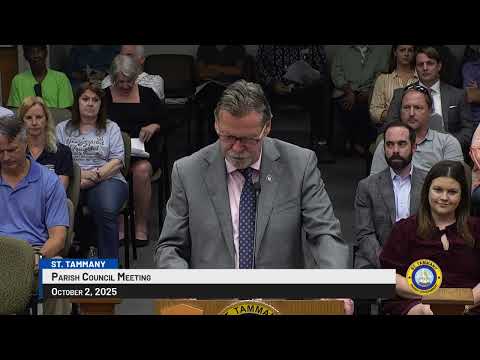
St. Tammany Parish Council members introduced an amended ordinance Oct. 2 that would require triennial inspections and certificates of inspection for many on‑site wastewater systems (septic tanks and aerobic treatment units) in parts of the parish. The ordinance was the subject of extensive public comment, technical briefing and council amendment before being introduced for further consideration.
The proposed program focuses on areas below the parish urban growth boundary and would exempt larger rural parcels and properties with overland disposal on the owner’s property. Parish staff cited pilot program results showing failure rates in targeted neighborhoods and said regular inspections would reduce untreated discharges to ditches and waterways.
Public concerns and technical issues: more than a dozen residents and stakeholders spoke. Speakers for inspection requirements — including the Pontchartrain Conservancy and North Shore River Watch — pointed to local studies and pilot inspections that found high malfunction rates in some neighborhoods and linked failing systems to degraded water quality and mosquito problems. Christy Trail of the Pontchartrain Conservancy said targeted inspection programs previously raised compliance in the Abita River area from low levels to 85% compliance after follow‑up work.
Opponents raised cost, logistics and enforcement concerns. Residents and elected officials said the parish would need to scale up inspections (estimates ranged toward 10,000–12,000 inspections per year to cover the population) and asked how inspections and any required repairs would be funded. Some speakers — particularly from rural and retirement communities — warned about the financial hardship of repair or replacement and asked for stronger assurance of grant and low‑interest loan support. Several speakers said they would prefer targeted water‑quality testing first, rather than blanket inspections.
Changes made before introduction: Council member Kevin Corbin moved a substitute amendment that narrowed the geographic scope (below the urban growth boundary), added an education and public‑communication requirement for the Department of Environmental Services, reduced penalties and clarified timelines, and built in a program for low‑income reimbursement (HUD grant eligibility was noted during the discussion). The ordinance references a $313,000 EPA grant administered with the Pontchartrain Conservancy for monthly water sampling at up to 20 locations to monitor impacts and help prioritize neighborhoods.
Votes and outcome at the meeting: after debate, the council approved the Corbin substitute and introduced the ordinance for final adoption at a later meeting. The substitute passed on the council floor by a recorded vote (9 yays, 5 nays). Multiple subsequent motions to postpone or substitute alternate language failed. The matter will return for final adoption in accordance with the parish ordinance adoption timeline.
Why it matters: the parish contains a very high number of on‑site wastewater systems and several waterways listed as impaired; officials and advocates say inspections and corrective action are necessary to protect public health and water quality. Critics say the program as written could be burdensome, that funding and testing protocols should be clearer, and that the parish should continue to explore regional sewer alternatives.
Ending: The ordinance was introduced for further consideration; council members directed staff to continue outreach, refine implementation processes for inspection scheduling and low‑income assistance, and provide monthly reporting to the infrastructure committee.