Get Full Government Meeting Transcripts, Videos, & Alerts Forever!
Get email alerts on the Sovereign Immunity Mcl 600 6431 topic
No spam. Unsubscribe anytime.
Michigan Immigrant Rights Center asks court to allow suit against governor over workers’ compensation policy
Summary
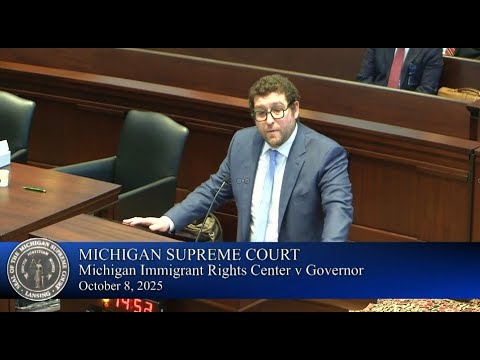
The Michigan Immigrant Rights Center asked the Michigan Supreme Court during oral argument to let its lawsuit proceed against the governor over a state policy the center says directs denial of wage-loss workers’ compensation benefits to undocumented workers.
The Michigan Immigrant Rights Center asked the Michigan Supreme Court during oral argument to let its lawsuit proceed against the governor over a state policy the center says directs denial of wage-loss workers’ compensation benefits to undocumented workers. David Maraskin, counsel for the plaintiff, told the court the center seeks only prospective relief to stop current and future enforcement of that policy.
The case, docketed as No. 167300, arrives after the Court of Appeals dismissed the suit on the ground that the governor can assert sovereign immunity or that the Court of Claims Act provision MCL 600.6431 bars the claim. "The governor cannot assert sovereign immunity against this case," Maraskin said, adding that courts have authority to order government officials to comply with the law going forward.
The dispute centers on whether MCL 600.6431 — a provision the parties and lower court treated as a time bar for claims against the state — governs a prospective-equitable claim against a state officer in her official capacity. Maraskin argued the statute focuses on "stale claims" and does not reach forward-looking relief; he also said the statute on its face applies to the state, not to an individual officer, and that the Court of Appeals misapplied precedent in dismissing the complaint.
The attorney representing the governor, identified in the transcript as an assistant attorney general, urged the justices to be cautious about breaking new ground in Michigan law. The assistant attorney general said MCL 600.6431 applies to official-capacity claims and that the Court of Appeals reasonably concluded the injury Merck (as transcribed in parts of the record) alleges stems from the underlying Sanchez decision and therefore accrued when that decision issued.
Both sides disputed how to treat recurring institutional harms. Maraskin said the complaint alleges continuing harms — including diverted clients and additional costs incurred by the plaintiff organization — that constitute ongoing and accruing injury, and that the case seeks relief cutting off future enforcement of the policy. The assistant attorney general countered that Merck (as transcribed) has not pleaded a series of wrongs directed at the organization itself that would create independent accruals of claims.
The parties debated analogies and controlling precedents. Counsel for the plaintiff invoked Ex parte Young principles (allowing equitable relief against state officers) and cited this court’s decisions in Taxpayers and Haney to support the proposition that prospective relief is not barred by a statute of limitations focused on past harms. The state’s counsel relied on Pike, City of Mount Pleasant, and other decisions to argue that an official-capacity suit is, for purposes of the statute, effectively a claim against the state and therefore subject to MCL 600.6431.
Justices questioned whether naming the governor in her official capacity effectively equates to suing the state for purposes of the statute, and whether the complaint alleges recurring, independently accruing wrongs or a single prior wrong (the Sanchez decision) giving rise to the alleged institutional injuries. Maraskin told the court the complaint pleads both current diversion of cases and costs within the year before filing and continuing harm that would end if the governor changed course.
No decision was announced from the bench. After argument concluded, the bench indicated the case would be submitted for decision.
The complaint and argument reference multiple Michigan court of appeals decisions (Pike; City of Mount Pleasant), this court’s prior decisions (Taxpayers; Haney), and U.S. Supreme Court precedent cited by counsel (Lawrence v. Texas). Counsel also framed the case against the backdrop of the Ex parte Young doctrine and the Court of Claims Act provision MCL 600.6431. The record of oral argument notes that each side had 15 minutes for argument and that plaintiff’s counsel intended to reserve approximately three minutes for rebuttal.