Get Full Government Meeting Transcripts, Videos, & Alerts Forever!
Get email alerts on the Assessment District Proposal topic
No spam. Unsubscribe anytime.
Residents raise legal and affordability concerns about proposed citywide assessment district
Summary
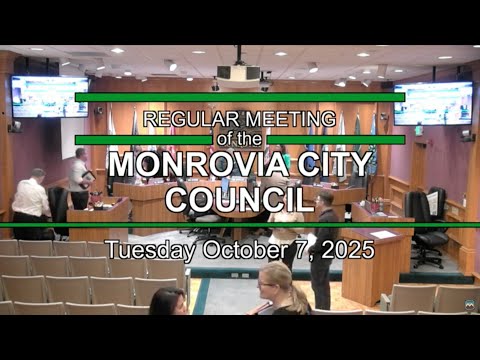
At the Oct. 7 Monrovia City Council meeting, residents criticized a proposed citywide assessment district and the engineer's report that would raise property assessments; city staff said materials are available and that the proposal was crafted to comply with state law.
A string of public commenters at the Monrovia City Council meeting on Oct. 7 urged the council to reconsider a proposed citywide assessment district that would raise property assessments to fund maintenance for street lighting, traffic signals, street trees, landscaping and parks.
Resident Michael Johnson told the council the proposal likely violates state constitutional limits on assessments. “The state constitution is very clear. Property assessments can only be used for improvements that provide particular benefit to lands and buildings and not a general benefit to the public,” Johnson said, citing Proposition 218 and a court case referenced in the engineer’s report.
Why it matters: The city’s engineer’s report calculates a general-benefit share and a special-benefit share to set assessment amounts. Johnson argued the report’s methods do not demonstrate the constitutionally required “special benefit” to specific parcels and objected to the report’s use of pass-through traffic as a measure of general benefit.
City response and next steps: City Manager Dylan Feek (city manager) told the council the city is distributing information about the district and encouraged residents to contact staff with questions. “There is a lot of misinformation in his comments that were made publicly here tonight,” Feek said. He said the city crafted the proposal “according to state law and consultation with [the] city attorney’s office and NBS,” the firm that prepared the engineer’s report, and posted materials online.
No formal legislative action on the district was taken at the meeting. The council approved routine consent items and continued other business; staff said they were making information publicly available and responding to inquiries from residents.
Details from public comment: Johnson said the assessment increases would be large for some property owners—he said single-family parcels could see increases of $300–$400 per year and some multifamily parcels “thousands of dollars,” language he attributed to the engineer’s calculations. He also said the engineer’s method arbitrarily reduced a general-benefit measure by 50 percent and that similar assessments have been overturned in court.
What the city says is next: City staff said they will continue outreach and provide detailed responses to public questions. The mailed ballot for the proposed assessment district must be received by the city by 6 p.m. on Nov. 18, staff reminded residents; the city is also planning informational materials and responses to one-on-one inquiries.
Ending: Residents and the city differ on legal interpretation and on whether the proposal adequately demonstrates parcel-specific benefits. The council did not vote on establishing the district at the Oct. 7 meeting; the city manager said staff will continue to answer questions and provide documentation to interested property owners.