Get Full Government Meeting Transcripts, Videos, & Alerts Forever!
Get email alerts on the State Legislation topic
No spam. Unsubscribe anytime.
Consultant presents draft 2026 General Assembly agenda; housing and infrastructure top priorities
Summary
Devin Cabot of Two Capitals Consulting presented a draft legislative package to Richmond council members that emphasizes housing affordability, school construction financing, and water and sewer infrastructure funding; council members asked to add inclusionary zoning to the top priorities list and requested more time to refine policy positions.
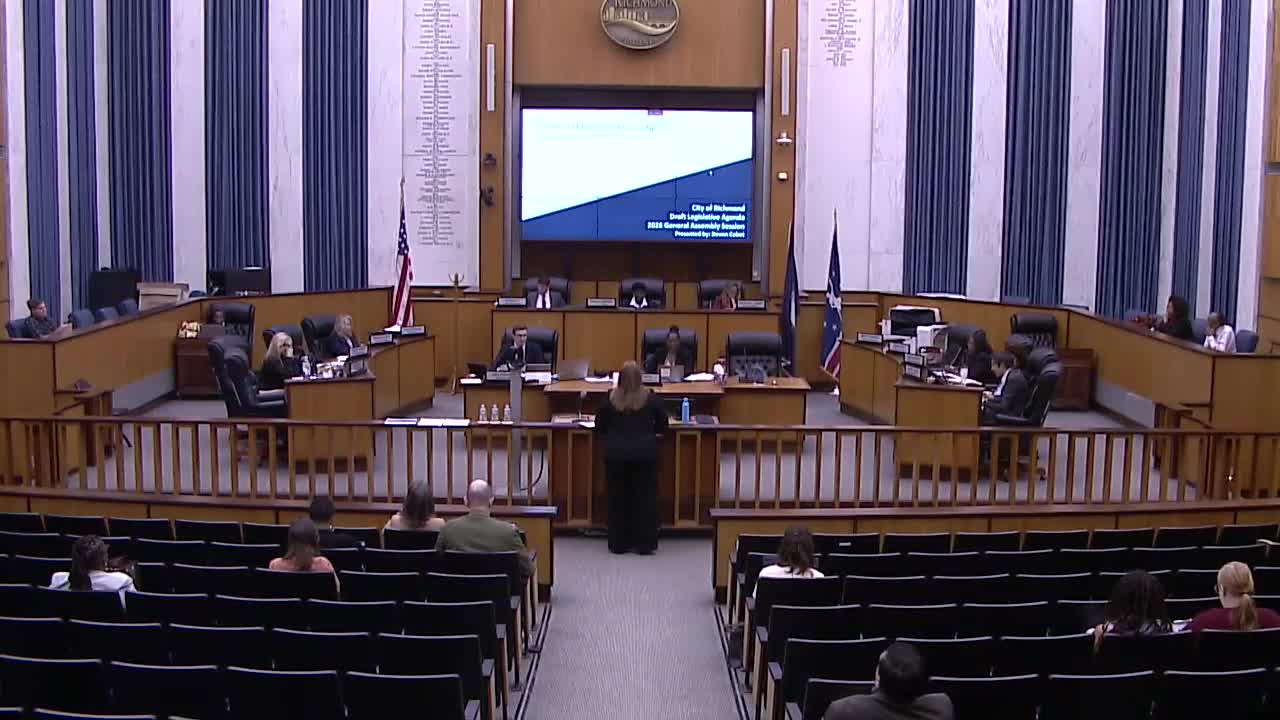
Devin Cabot of Two Capitals Consulting presented a draft legislative agenda to the Organizational Development Standing Committee, laying out five potential top legislative items and a broader set of policy positions the city may pursue with the Virginia General Assembly in the 2026 session.
Cabot said the themes that emerged from consultations with council and administration were housing affordability, K‑12 education funding and school capital needs, infrastructure funding and maintenance (including water and sewer), and community building and code enforcement. “So the first item that came up in a lot of conversations is the faith and housing bill, the yes in God’s backyard,” Cabot said, referring to proposed statutory changes to make it easier for religious organizations to develop multifamily affordable housing.
He said the five top legislative items under consideration are: the faith‑based housing bill (sometimes called YIGBY), renter protection/anti‑rent‑gouging authority for localities, continuation of a long‑term owner occupancy program study (LOOP), reinstated financing and bonding authority for public facilities, and school construction legislation to allow a 1% local sales‑tax referendum to fund school modernization. Cabot also presented two budgetary requests he had discussed with the administration: $40 million in state funding for the city’s water‑treatment plant in each of fiscal years 2027 and 2028, and large state contributions for combined sewer overflow (CSO) upgrades (Cabot said the state had already designated roughly $100 million to the city and staff were recommending requests of $100 million in year one and $150 million in year two of the biennial budget).
Cabot walked the committee through a longer appendix of policy positions the consultant and city staff had compiled, covering additional housing tools (including LIHTC and short‑term rental rules), education funding formulas, maternal and behavioral health supports, public safety funding, zoning and land‑use issues, transportation and multimodal connectivity, and opposition to unfunded state mandates. He described a timeline of next steps that included a meeting with the state delegation at the Valentine Museum (noted in the presentation for Oct. 28), a resolution introduced at a special council meeting on Nov. 3, and a council vote on Nov. 10 to adopt the city’s final package. Cabot noted that the 2026 General Assembly session is scheduled to begin Jan. 14 and will run 60 days.
Council members raised questions about how the top items differ from the broader policy positions and how the city will refine and prioritize the larger list. Councilman Bridal asked about deadlines for providing additional technical detail; Cabot asked for information in advance of the delegation meeting so the city presents a coordinated position. Councilwoman Gibson pressed to add mandatory inclusionary zoning to the city’s top priorities, saying the adopted Richmond 300 plan calls for lobbying the General Assembly to give Richmond authority under Virginia Code § 15.2‑2304 to adopt mandatory inclusionary zoning programs and for a local target of 10,000 affordable units over 10 years. Gibson said she understood inclusionary zoning to be a top priority and said she expects it to be included among the city’s lead items.
Cabot said policy positions that do not make the top five will still guide staff when weighing thousands of bills during the session, and that the longer list will be used to determine the city’s stance on introduced legislation. He said staff and the consultant will continue researching items marked for further review and will accept additional council input before the delegation meeting. The committee did not take a final vote on the package during the meeting; members were asked to provide additional detail and suggested changes ahead of the upcoming delegation meeting and the November resolution process.