Get Full Government Meeting Transcripts, Videos, & Alerts Forever!
Get email alerts on the Ambulance Fee Schedule topic
No spam. Unsubscribe anytime.
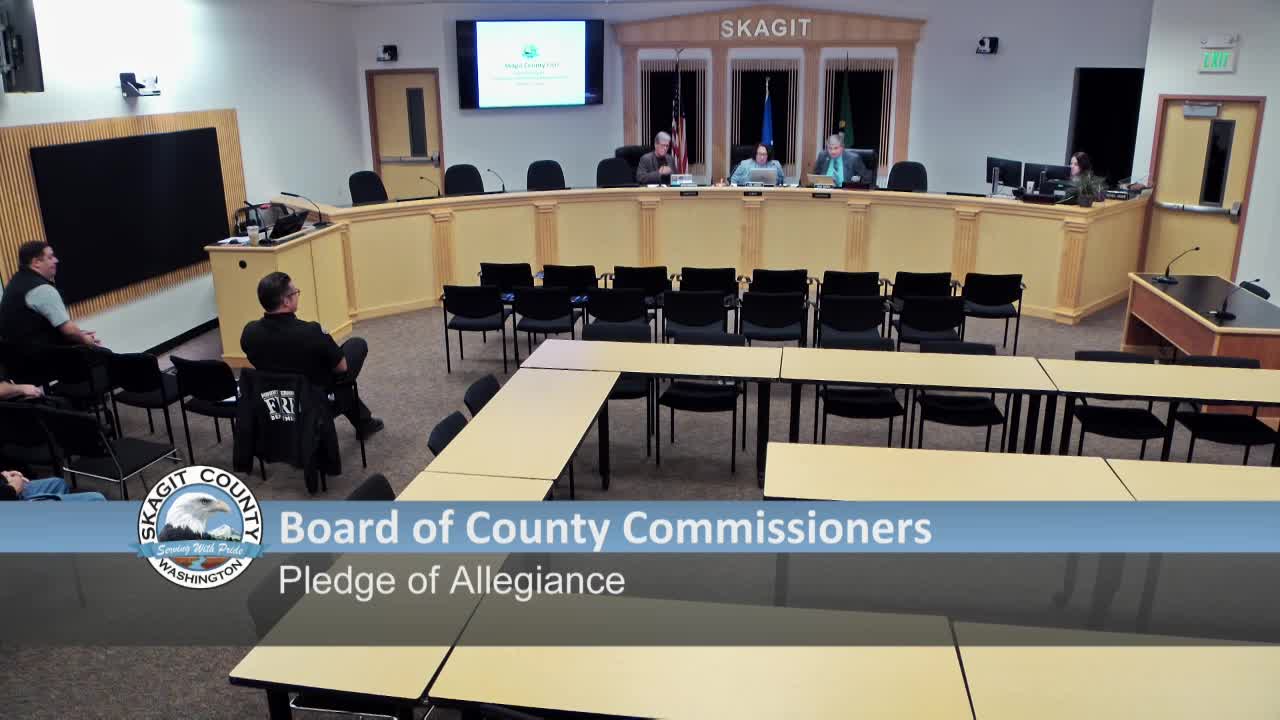
Skagit County holds public hearing on proposed ambulance transport fee schedule
Summary
County Emergency Medical Services (EMS) held a public hearing on Oct. 6 to consider revising the county’s ambulance transport fee schedule; director Josh Polonio urged board approval so the county can submit rates to the Washington Office of the Insurance Commissioner by Nov. 1 and align with recent state protections on balance billing.
Skagit County held a public hearing Oct. 6 on revisions to the county ambulance transport fee schedule as part of a federally- and state-influenced shift in how ground ambulance providers are reimbursed.
Emergency Medical Services Director Josh Polonio told the Board of County Commissioners the county must submit locally set ground-ambulance rates to the Washington Office of the Insurance Commissioner (OIC) by Nov. 1. “We want to make sure that our rate is up to date so that we can maximize cost recovery for the services provided and keep our system sustainable,” Polonio said during his presentation.
The hearing followed an overview of recent legislation. Polonio explained that the Balance Billing Protection Act has been expanded to include ground ambulance services, which limits the ability of providers to bill patients for amounts not covered by insurers. He also told the commissioners that health plans will be required to reimburse ambulance agencies based on the locally set rates they submit to the OIC — a change the county must reflect in its schedule.
Nut graf: The county’s recommended revision would (a) eliminate a separate resident/nonresident transport rate in favor of a single rate for all patients and (b) adopt a 3 percent automatic annual adjustment to the schedule. County staff say the change will simplify billing and align collections with the new state-level billing and reimbursement rules.
Polonio presented 2024 transport data showing 9,525 total ambulance transports across the county’s five contracted providers. He summarized payer mix and average collections: Medicare and Medicaid are “capitated” payers with lower, federally set reimbursements (average collected per transport in 2024: Medicare $497, Medicaid $467), commercial insurance averaged about $960 per transport, and private/self-pay averaged about $104. Polonio said the proposed schedule affects the roughly 19 percent of transports covered by non-capitated payers and estimated the schedule change would increase collections by about $71,000 based on current collection rates and payer mix.
Polonio also flagged uncertainty from federal policy changes (referred to in the presentation as “HR 1”), which could reduce Medicaid enrollment and shift more uncompensated care onto local providers. He said staff will monitor federal and state developments and review the schedule periodically, including any future need to add a reimbursement for “treatment-on-transport” (care given when a patient is treated but not transported) if the OIC and Health Care Authority adopt such a payment.
Public comment largely came from local ambulance and fire service leaders. Mount Vernon Fire Chief Brian Harris, who noted his department averaged roughly $3.75 million in transport revenue against about $8.38 million in costs (2022–2024 figures for his agency), said he supported Polonio’s recommendation and warned of a widening gap between cost and revenue. Burlington Fire Chief Rob Toth and Tony Smith, director of Aero Skagit Emergency Services (a private nonprofit), also spoke in support. Smith said Aero Skagit operates on thin margins and faces uncertainty over Medicare add‑ons that had not been reauthorized prior to a federal funding lapse.
Commissioners and members of the public asked about timing and outcomes. Polonio said the OIC submission requirement creates a hard deadline, and staff plan to finish the administrative adoption so the schedule can be submitted in time.
The public hearing was closed by the commissioners; Polonio said the recommended schedule is expected to come forward on the consent agenda for formal adoption at a later meeting, which would allow the county to meet the OIC’s Nov. 1 timing requirement.
Ending: County staff will finalize plan language and submit the locally set rates to the OIC. Commissioners and chiefs emphasized the county’s EMS levy as a stabilizing revenue source while staff monitor federal and state policy changes that could affect collections and patient coverage.