Get Full Government Meeting Transcripts, Videos, & Alerts Forever!
Get email alerts on the Grantmaking Reform topic
No spam. Unsubscribe anytime.
Richmond to pilot competitive grant‑making partners for FY27, city staff say
Summary
City staff proposed shifting administration of most non‑departmental grants to competitively selected external grant‑making partners for fiscal year 2027, citing audit findings, staffing limits and faster contracting timelines. Council members pressed for conflict‑of‑interest language and clarity on budget allocations and fees.
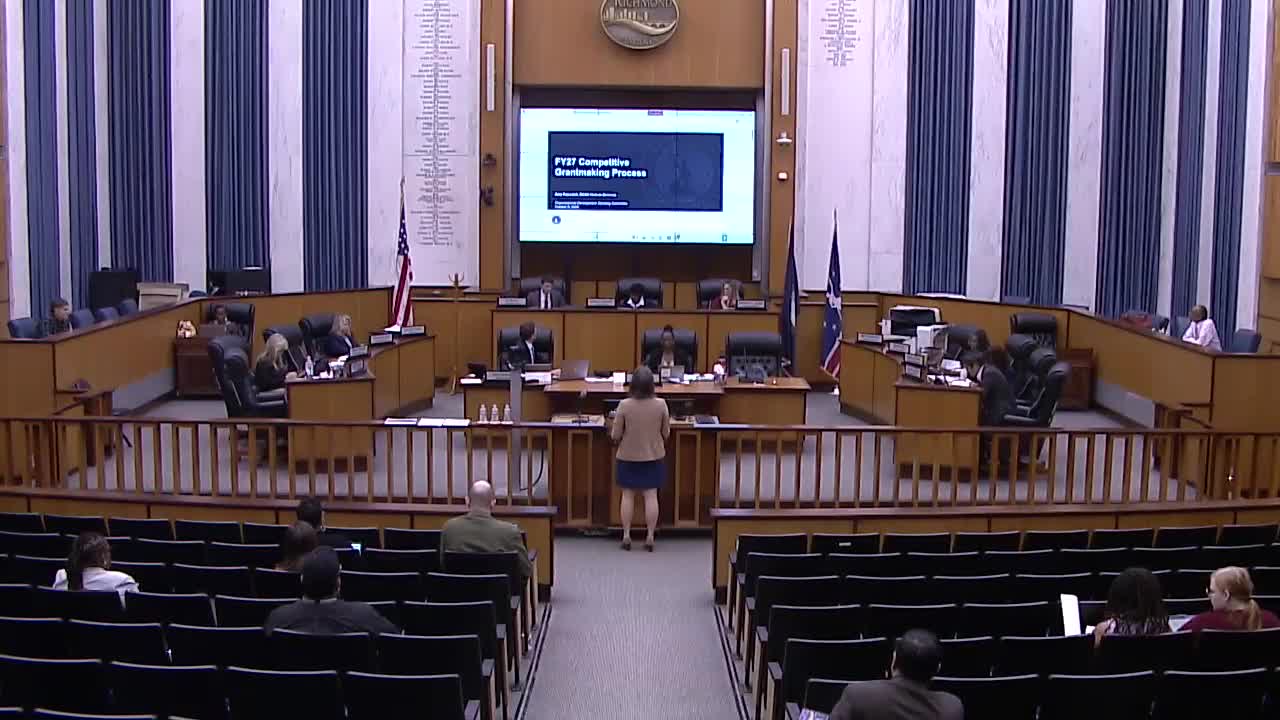
The Organizational Development Standing Committee of the Richmond City Council heard a presentation from Amy Popovich, DCIO for Human Services, on a plan to change how the city awards and manages non‑departmental grants, moving toward competitively selected external grant‑making partners for fiscal year 2027.
Popovich said the change is “a significant shift in the grant making process here at the city to really focus on increasing impact in our communities, and to really, ensure best practices in grant making.” She said the city currently manages about 70 individual contracts across multiple departments and that the existing process can take nearly 11 months from application to executed contract and payment.
The new framework would competitively select up to four subject‑matter grant‑making organizations to manage grants in four priority focus areas—children and families, health, economic mobility, and arts and culture—while the mayor would propose allocations and council would retain final budget authority through the normal budget process. Popovich said the model aims to shorten the timeline so awards and contracting occur in roughly three months (July–September) rather than the existing October–September cycle.
Popovich cited a February 2025 audit of the city’s grant processes and said the audit found two important weaknesses: applicants often do not know the total amount available at the outset of a cycle, and the city lacks centralized professional capacity. She said the city’s consultant estimated it would cost about $1,000,000 to hire the staff needed to perform the work in‑house and that the auditor’s report suggested five additional FTEs would be required to run the process internally. “It’s actually going to be cost effective. It’s gonna be cheaper, to use our grant making partners than it would be to staff up inside city hall,” Popovich said.
City staff said they plan a shared short‑term consulting engagement to stand up the approach: the consultant named in the meeting was Kelly Chopas on a two‑month, shared contract between council and the city for $25,000. Popovich said the draft approach foresees an administrative fee for selected grant‑making organizations; she described typical market administrative costs as “ranges, for that are 7 to 15% or so” and said the draft would cap the administrative fee “around 10%.”
Council members sought more detail on transparency and conflicts of interest. Councilwoman Gibson asked how the new process would address audit findings that some prior grantees did not meet eligibility criteria and how the city would ensure transparency and avoid conflicts. Popovich said the city would include “subject to audit” language in contracts and that a conflict‑of‑interest clause would be specified in grant‑making partner contracts. She said one goal of hiring external partners is to bring professional scoring and subject‑matter expertise to the review process.
Several council members probed the risk that organizations selected to administer grants could also be prior or future grantees. Popovich said the procurement would follow standard RFP rules and that an organization selected to manage a grant program would not also award itself funding for that program, though a selected partner “might apply to another bucket” if appropriate and allowed under RFP rules. Councilwoman Jones and others pressed that the process explicitly prevent a “double dip” and Popovich confirmed the draft would disallow grant‑making organizations from receiving awards from the same funds they administer.
Councilman Bridal and others asked how the four budget “buckets” would be sized. Popovich said the mayor’s proposed budget will include proposed allocations for each of the four focus areas and council would review and approve allocations through the budget process; staff will also examine historical funding for those categories when shaping the draft allocations. Popovich also clarified that existing contracts with quasi‑governmental partners such as Richmond Behavioral Health Authority and Richmond Ambulance Authority (RAA) would remain city‑managed and would not move into the competitive partner model.
Popovich described planned next steps: outreach this month to current and past grantees and stakeholders, stakeholder meetings to refine the competitive process, development of priority‑area indicators and outcomes with subject‑matter experts, and an evaluation period built into future cycles: “we’ll evaluate this in a year or two,” she said.
The committee did not take a formal vote on a policy change during the meeting; members asked staff to provide additional details and draft contract language on conflicts of interest, administrative fees and proposed indicators before the model advances.