Get Full Government Meeting Transcripts, Videos, & Alerts Forever!
Get email alerts on the Sustainable Mobility topic
No spam. Unsubscribe anytime.
Air District extends contract to sustain community electric car‑share program
Summary
The Sacramento Metropolitan Air Quality Management District board approved staff authority to extend and increase contract funding to continue the district’s zero‑emission community car‑share program, citing ridership growth and efforts to make the service financially sustainable while retaining low‑income access.
The Sacramento Metropolitan Air Quality Management District board on Sept. 25 approved a staff recommendation to extend and increase contract authority so the district can continue operating its zero‑emission community car‑share program.
The vote came after a presentation from Paul Philly, program manager for transportation and climate change at the district, who described the program’s role in reducing mobile‑source emissions and providing essential travel options. “Mobile sources are the largest form of emissions and pollution in the Sacramento Valley,” Philly told the board, adding that the district has a responsibility under state health and safety code to support clean fuels and vehicle‑use reduction measures.
The approval allows the executive director to extend existing service contracts and raise the contract amount; funding for the current program period comes from a state grant and other partner sources. The board passed the motion by roll call (recorded as unanimously in favor by the directors present). No individual mover or seconder was named on the public record.
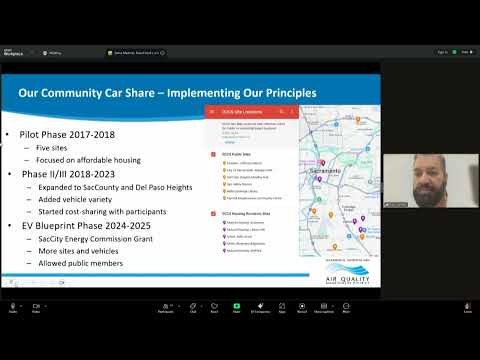
Why it matters: district staff said community car share (referred to in the presentation as OCCS) targets access for low‑income residents and complements transit and other mobility programs. Philly said the program began in 2017 centered on affordable‑housing sites and later expanded to Del Paso Heights and unincorporated Sacramento County. He said the program has shifted from largely grant‑funded free rides to a hybrid model with public hourly fees intended to increase fiscal sustainability while preserving subsidized access for qualifying residents.
Program details and results: Philly presented quarter‑by‑quarter electric vehicle miles traveled (EVMT) showing a pandemic dip and a recovery after the district introduced cost sharing. He said the program reached roughly 45,000 EVMT in the most recent quarter and that the system could hit 1,000,000 zero‑emission miles by November. The district waived membership fees for low‑income users, offered eight free starter hours, created a community representative rides program, and partnered with nonprofit and local agency partners for eligibility screening and outreach.
Partners and funding: Philly said the program uses multiple funding sources: state funds administered by the California Air Resources Board, federal funds through SACOG, and California Energy Commission grants tied to local EV infrastructure programs. Director Hume asked whether CARB funding includes federal dollars; Philly replied that funding currently comes from state (CARB), SACOG (federal), and CEC sources. The District staff said current contract funding was secured through July 2027.
Public comment and workforce connections: Cameron Belton, manager of the Green Tech Mobility Hub in Del Paso Heights, told the board the hub also functions as a training site. “We’ve been able to train 16 to 24 year olds on the importance of ... workforce development,” Belton said, and reported the hub has trained “at least 46” people in workforce programs tied to EV charger installation and maintenance.
Board discussion and next steps: Directors praised the presentation and the district’s coordination with partners. Vice Chair Maple highlighted the program’s regional relevance and international interest in Sacramento’s mobility work; Director Maple also asked to continue outreach and follow‑up reporting. The staff noted plans to work with the City of Sacramento on EV infrastructure and with program operators to convert some formerly gated sites to public locations to increase use and revenue.
Vote at a glance: the board approved the staff recommendation to grant the executive director authority to extend the contract and increase the amount (motion recorded on the public record with a roll‑call “aye” by Chair Aquino and directors who responded during the roll call). The motion passed and staff will return with any required contract documents and implementation details.
Ending: Staff said they will continue to monitor program metrics and fiscal sustainability and will coordinate with city and regional partners to expand sites and infrastructure. The board did not attach additional conditions to the extension during the Sept. 25 meeting.