Get Full Government Meeting Transcripts, Videos, & Alerts Forever!
Get email alerts on the Rally Austin Bond Request topic
No spam. Unsubscribe anytime.
Rally Austin asks Music Commission to support 2026 bond request to preserve creative spaces
Summary
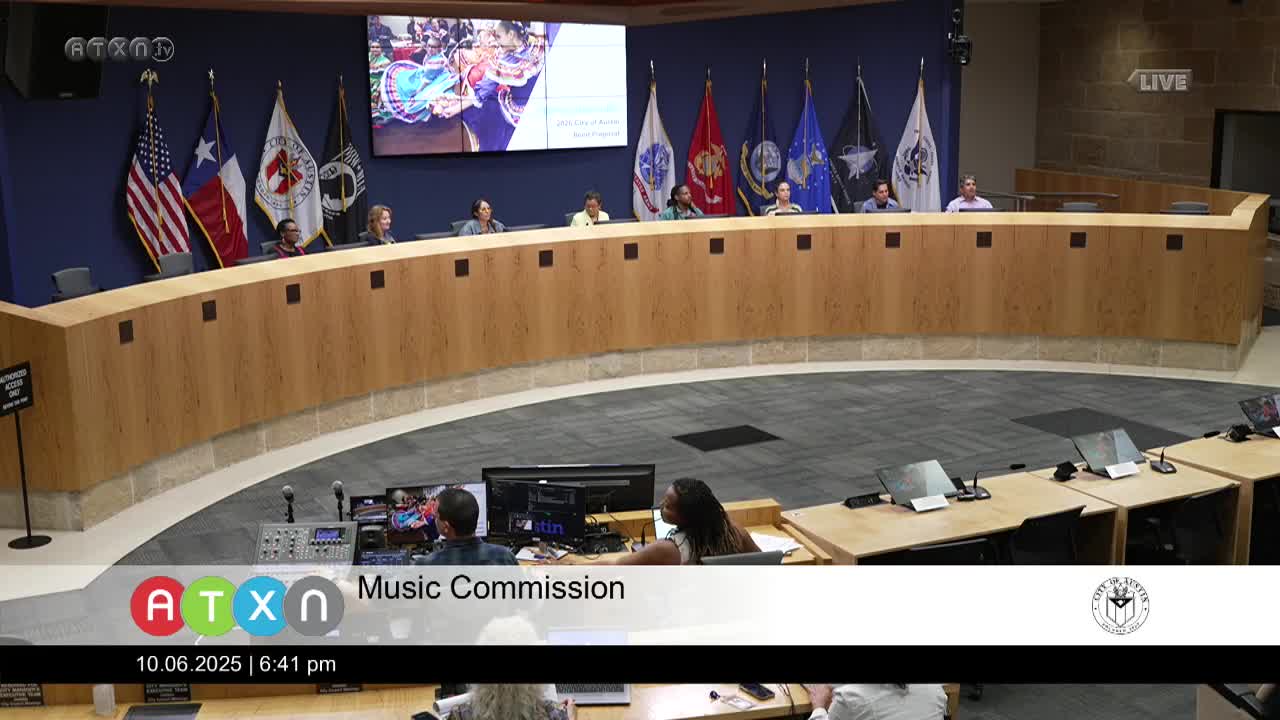
Rally Austin representative David Colligan briefed the Austin Music Commission on a proposal to seek city bond funding in 2026 for three programs — cultural trust acquisitions, a commercial 'legacy business' trust, and affordable live‑work space — and asked commissioners to consider formal support ahead of a November council briefing.
David Colligan, a representative of Rally Austin, told the Music Commission that Rally wants the city to include programs supporting arts, music and legacy businesses in the 2026 bond package. Colligan said Rally will present to City Council in mid‑November and asked the commission to consider articulating support at that time. "You'll have a past presentation that I made, to the bond advisory task force here for the city of Austin, and this is all focused on the 2026 bond, which is currently being evaluated," Colligan said.
Why it matters: Colligan framed the request as an effort to preserve locally owned music venues, legacy shops and affordable creative workspace that Rally says are central to Austin’s identity and local economy. Rally described itself as a quasi‑governmental, multipurpose local government corporation formed to secure and steward creative real estate and programming in Austin.
What Rally asked for and how the money would be used: Colligan outlined three program areas Rally hopes the bond will fund, describing amounts Rally is asking to be considered for each: property acquisitions for cultural uses ($80,000,000 requested), capital construction for cultural facilities ($50,000,000 requested), a commercial trust to preserve legacy small businesses (Rally proposed a $45,000,000 acquisition package plus $20,000,000 for capital construction), and a live‑work workforce housing proposal that requests $46,500,000 for property acquisition and an additional $14,500,000 for capital construction to deliver roughly 100 affordable live‑work units. Colligan said the programs would also seek to leverage hotel occupancy tax and private investment.
Process and timeline: Colligan described the bond development process: City staff will inventory needs and propose projects, the Bond Election Advisory Task Force (BTIF) will make recommendations and the City Council will decide what appears on the ballot. He said Rally is engaging BTIF, city staff and community stakeholders now and aims to appear before City Council in November to brief the Economic Opportunity Committee.
Commissioner follow‑up requests: Commissioners asked for additional details before deciding whether to endorse the request. One commissioner asked Rally to return with examples of how prior awardees used funds and to clarify whether previous arrangements were grants or long‑term real estate agreements. Colligan responded that many of Rally’s agreements are real estate negotiations that can span 20–40 years, and that details about specific arrangements are included in the presentation materials Rally provided to commissioners.
Ending: Colligan said Rally will continue outreach to commission members and staff and offered to return with more detailed materials. He said the organization hopes to present the full package to the Economic Opportunity Committee and, if the commission wishes, to have commissioners articulate support to City Council in November.