Get Full Government Meeting Transcripts, Videos, & Alerts Forever!
Get email alerts on the Wildfire Litigation Settlement topic
No spam. Unsubscribe anytime.
Maui County committee hears update on 2023 wildfire settlements; payouts delayed by subrogation dispute
Summary
County corporation counsel and special counsel told the Government Relations, Ethics and Transparency Committee on Oct. 7 that Ohana fund payments have started but settlement-fund payouts are on hold pending resolution of insurer subrogation appeals and other issues; phase 2 of the Ohana program will reopen to additional injury claims.
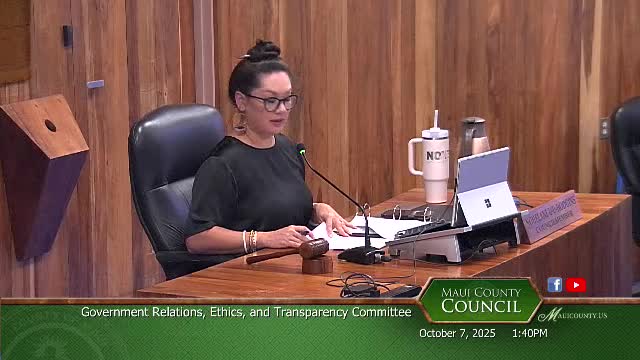
The Government Relations, Ethics and Transparency Committee of Maui County heard an update on the status of litigation and settlements stemming from the 2023 wildfires at its Oct. 7 meeting. Corporation Counsel Victoria Takayasu and special counsel Jordan Inafuku told the committee that payments have come from the privately funded Ohana fund but that payments from the larger settlement fund are not yet being distributed while a subrogation dispute and related appeals are resolved.
The Ohana fund, contributed by multiple defendants, totaled $175,000,000 and was set up to provide expedited payments for certain death and serious-physical-injury claims. Victoria Takayasu told the committee that Judge Abara, the fund administrator, approved and paid offers on a subset of claims: 23 death offers were accepted, totaling $34,500,000, and payouts on serious-injury claims brought the total paid from the Ohana fund to about $40,000,000 as of Aug. 8, 2025. Phase 1 of the Ohana program is closed; Takayasu said a Phase 2 expansion to cover additional serious-injury claims (defined to include overnight hospitalization or emergency outpatient treatment) has been scheduled but had not started as of the Oct. 7 briefing.
The committee was told there are approximately 3,965 cases filed against the county in the consolidated special proceeding in state court; because many filings contain multiple plaintiffs, special counsel Jordan Inafuku reported that individual-plaintiff releases received so far exceed 19,000. The overall settlement fund across defendants is approximately $1.2 billion. Takayasu said, “Payments have been made from the Ohana fund, but not from the settlement fund.”
Counsel explained that the timing of initial settlement-fund payouts depends on the resolution of subrogation and segregation disputes involving insurers and other payors. Those issues were litigated up through the Hawaii Supreme Court and are currently the subject of appellate filings; class counsel has filed an application to transfer an intermediate-appeal directly to the Hawaii Supreme Court to expedite resolution. Inafuku and Takayasu told the committee that those appellate and segregation issues are among the principal gating items before settlement-fund distributions can begin.
Committee members asked when payouts might begin. Takayasu said critical dates will be discussed at a status conference in the Second Circuit on Oct. 31 and that, while counsel could not guarantee a date, “I believe that payments could start” once segregation/subrogation issues are resolved; counsel also noted remaining uncertainties and that initial distributions could be structured in different ways (lump sum or installments) and prioritized by injury or other criteria.
The committee was also briefed on parallel federal class actions (named in the transcript as the Stover and Bash matters) that were filed by the same attorney. Counsel said the federal cases are currently stayed or are likely to be stayed because a consolidated class and claims process before Judge Cahill in state court is proceeding toward final approval and a unified claims administration.
Chair Nohelani'u'u Hudgins closed the public question period before the committee went into executive session to discuss legal strategy. In open session, the chair told members that the item would be deferred; committee staff later summarized that the executive session addressed insurance-coverage strategies and settlement considerations related to the 2023 wildfires. The committee did not adopt any further legislative measures on the item at the Oct. 7 meeting.
The update clarified three routes for claimants: accept an Ohana-fund offer (no litigation), pursue individual-plaintiff litigation/administration, or participate in the class claims process. Counsel said the claims administrators and special masters are accepting releases and that attorneys and claims administrators are handling authentication and intake processes, including electronic signatures subject to administration rules.
The committee was advised that additional details — including how distributions from the settlement fund will be prioritized and whether payments will be made as lump sums or in installments — remain to be determined, and that at least one status conference in late October should provide further scheduling and process dates.
The meeting’s public-record update left key elements unresolved: the timing and mechanism for initial settlement-fund distributions, the eventual dollar amounts any given claimant will receive from the $1.2 billion settlement fund, and the number of claimants who will qualify under Phase 2 of the Ohana program. Counsel emphasized that those items depend on court rulings and resolution of subrogation appeals.