Get Full Government Meeting Transcripts, Videos, & Alerts Forever!
Get email alerts on the Entertainment Permit Revocation topic
No spam. Unsubscribe anytime.
Winchester planning commission tables review of Milano’s entertainment permit, asks police for call records
Summary
The commission delayed a decision on whether to revoke the conditional use permit that allows live entertainment at Milano’s after staff said recurring police calls and citizen complaints triggered a notice of violation. The commission requested Winchester Police Department CAD reports and postponed the public hearing to the November cycle.
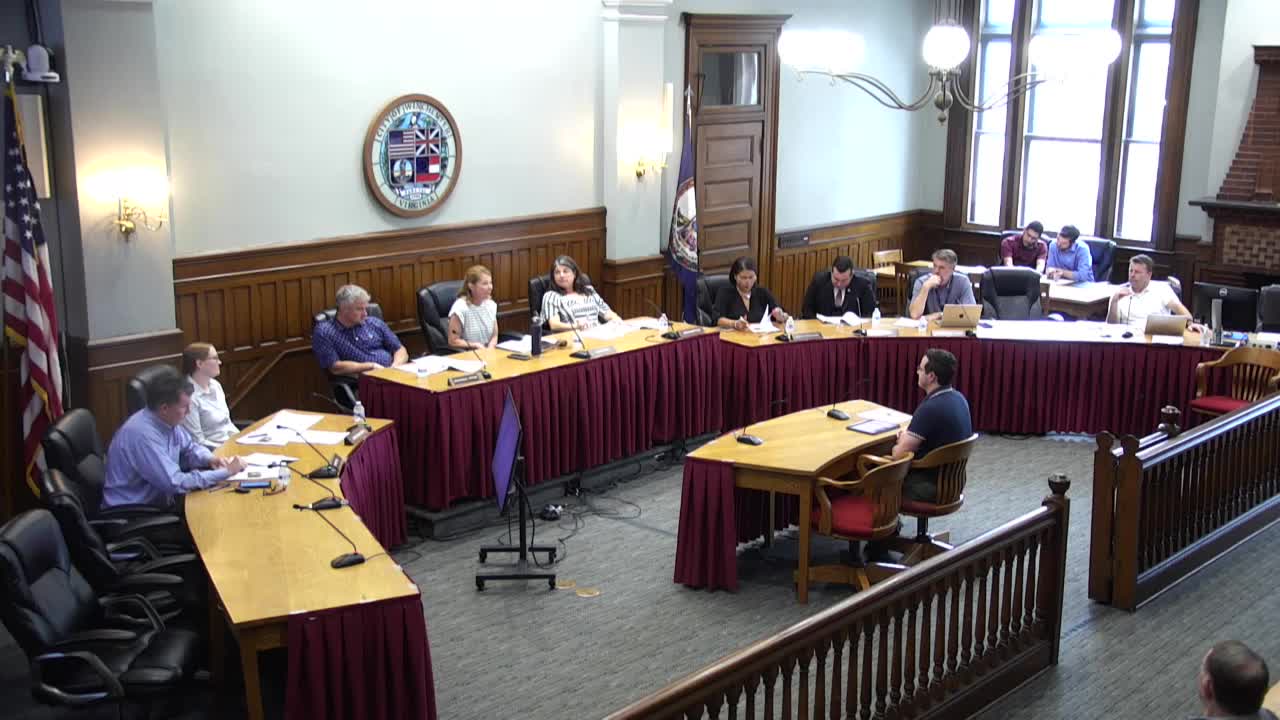
The Winchester City Planning Commission on Oct. 7 postponed a decision on whether to revoke the conditional use permit (CUP) that allows live entertainment at Milano’s (107 West Boscawen/Braddock Street), asking city police for original call records to clarify which calls are attributable to the business.
Zoning staff presented that repeated police calls and citizen complaints prompted a notice of violation in May and that the CUP’s conditions — including a limit of no more than four criminal-offense-related police calls per month attributable to the establishment — appear to have been exceeded at times in 2025. Zoning staff said the CUP in question is CU09198 and that the permit, approved by City Council in 2009, authorizes live entertainment and other activities that differ from a standard bar use.
Johnny Lanzetta, who said he runs day-to-day operations for Milano’s, told the commission the business has not had a DJ in about four months, performs regular cleanup outside the establishment, has implemented customer-control measures such as VIP-only entry after midnight in recent months, and that many calls to police result from activity in downtown public spaces rather than conduct inside Milano’s. “We do our best to try to keep the streets clean,” Lanzetta said, adding the business has operated at the site since 2005.
Deputy Chief Jason Poe of the Winchester Police Department told the commission that the dispatch (CAD) records exist and can be produced for the planning commission’s review; he said many calls involve activity that spills outside the premises — fights or large congregations outside the door — and that CAD entries use a variety of call-type codes (for example, fight, disorderly, trespass, DUI) that staff can break down for the commission. “I can break some of that down to some clarity,” Poe said.
Commissioners explored alternatives to revocation, including requiring private security under the zoning code’s existing remedy (Winchester Zoning Ordinance §18-24-1.2), amending the CUP’s hours, or retaining the CUP while increasing enforcement. Several commissioners said they were reluctant to remove the permit without seeing the underlying CAD reports and without information about whether Milano’s itself called police to report incidents — a factor commissioners said could change how calls are attributed.
On a motion to postpone the public hearing and place the matter on the commission’s next work session agenda, the body voted in favor to table the item and to request that police provide the unredacted (subject to lawful redactions) CAD data underlying the calls listed in staff’s packet. The commission directed staff to make CAD records and any evidence submitted by parties publicly available as part of the record and to ensure the business owner and property owner receive copies. The commission will re-advertise the public hearing for the November cycle after the additional documentation is provided.
Staff emphasized that revocation of the CUP would not bar Milano’s from operating as a bar or restaurant; revocation would remove the entertainment-establishment designation that permits live music, DJ performances, and ticketed events and could therefore alter the business’s primary draw. Staff also noted that a revoked CUP could be appealed in circuit court and that the CUP holder could reapply for an entertainment establishment in the future.
The commission did not take a final vote on revocation at the Oct. 7 work session. The item will return to a November work session with police CAD records and with law-enforcement staff present to answer commission questions about individual calls and attribution.