Baker County commissioners send Nehemiah Court, Barber Point traffic study back for clarifications
Loading...
Summary
County commissioners asked engineers for clearer recommendations and timing after a traffic study found that combined build-out of two developments could require new signals and turn lanes on Louder Street; the board deferred direction to a future meeting to coordinate with city hearings.
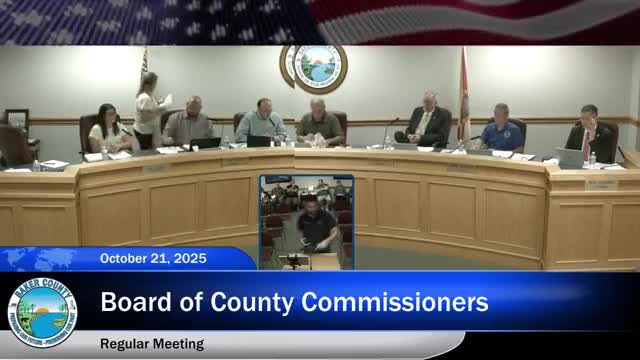
The Baker County Board of County Commissioners on Tuesday reviewed a traffic study for two proposed developments — Barber Point and Nehemiah Court — and asked staff and the consultant to return with clearer, itemized recommendations and timing before sending formal comments to the City of Macclenny.
The study, prepared by BCW Engineering and presented by Brian Pittman, found that when both developments are built to full capacity their combined traffic could trigger new turn lanes and traffic signals at several intersections on Louder Street. Pittman said the study’s corridor analysis identified the intersection of Milton Dale Road, North Boulevard and Louder Street as one location likely to need a signal at full build-out. The study also recommended additional northbound capacity on US 90 near McLennan and left-turn lanes at other Louder Street approaches.
Commissioners pressed for specificity on which improvement each development would be expected to fund, and on the timing of installations. Commissioner Mobley, among others, warned that waiting until “build out” to require improvements could leave residents exposed to heavier traffic before mitigation is in place and that the county’s leverage is limited once developers have connected to the road network. County staff and the presenter agreed there is uncertainty about which project would trigger which improvements and noted the city, not the county, controls many approvals on Louder Street access points.
Because Barber Point is operating under a prior settlement agreement and Nehemiah Court appears on the city’s calendar (the city’s hearing was noted for Oct. 18), the board decided to defer sending a final recommendation to the city. Commissioners asked staff to invite the engineer who prepared the report to the county’s November 4 meeting so commissioners can get specific answers on: (1) which mitigation items are required for each development, (2) whether the study’s apparent recommendation for a single signal vs. multiple signals is internally consistent, (3) suggested phasing or timing language to require improvements before connections are made, and (4) pedestrian/sidewalk provisions.
Commissioners also raised public-safety and peak-period concerns, citing school-bus traffic and long delays for local residents trying to enter Louder Street. Several commissioners said they favor requiring turn lanes and earlier installation of safety improvements rather than waiting until a theoretical build-out. Pittman agreed to follow up on inconsistencies the board flagged and to supply the county with a clearer, annotated recommendation list for the board’s November meeting.
The board did not adopt or reject the consultant's recommendations at the meeting and provided staff direction to return with the consultant and a revised, itemized set of mitigation proposals and timing options before the county issues final comments to the city.