Get Full Government Meeting Transcripts, Videos, & Alerts Forever!
Get email alerts on the Arts And Culture topic
No spam. Unsubscribe anytime.
Encinitas arts workshop gathers public ideas for a new arts element in the city general plan
Summary
The Encinitas Commission for the Arts held a public workshop to collect community priorities and draft goals to inform an arts element for the city general plan. Participants emphasized public art, sustained funding, arts education, accessibility and recognition of local cultural heritage.
The Encinitas Commission for the Arts held a special public workshop to gather community input on adding an arts element to the city’s general plan. Commissioners and members of the public met in a facilitated session that included three small-group brainstorming rounds and a sticker-prioritization exercise to surface long-term goals for arts and culture in Encinitas.
Workshop leaders framed the arts element as an optional but powerful addition to the city’s general plan; a staff presenter said the relevant authority is Government Code section 65303 and noted that optional elements, once adopted, carry the same authority as mandatory elements. “By adding an arts element, Encinitas is saying that arts and cultures aren't extras, but actually really core to our identity and to our quality of life,” the facilitator said during opening remarks.
Why it matters: a general-plan element becomes a reference point for council decisions, city staff and commissions. Participants said an arts element could steer funding, land-use decisions and programming for decades — affecting public art, venue development, arts education and partnerships with local institutions such as the Pacific View Art Center (PVAC).
Participants broke into three groups (identified in the workshop as red, blue and green) and reported back common themes. The most-cited priorities were: sustained funding for public art and arts organizations; making art visible and accessible across the city (“art everywhere,” one participant said); stronger support for local artists and arts education; more and diversified public-art installations and performance spaces; and explicit recognition of Indigenous and local cultural heritage, including the Kumeyaay Nation.
Specific ideas raised in the small groups included adopting a percent-for-art policy attached to city projects (participants discussed examples such as 1%–2% and, jokingly, “ask for 50%”), cultivating private and nonprofit donors, creating an arts district or branding Encinitas as an arts destination, developing a performing-arts venue or expanded performance spaces, and designating informal music/busking areas as a short-term step toward outdoor amphitheater space. “When you leave your house, we want to see art,” said Scott, a workshop participant who spoke for the red group, summarizing the “art everywhere” goal.
Several participants urged closer ties between arts planning and economic development, proposing that arts investment be treated as an economic driver tied to tourism and local business vitality. The blue group suggested regional art exchanges and continued sister-city exchanges to bring international artists to Encinitas and send local work abroad.
Community and facility notes: speakers highlighted the Pacific View Art Center, which the facilitator noted completed its first year of operation, and urged that the arts element support the center and other community venues (library, community center, school facilities). Diane identified herself as a board member of Encinitas Friends of the Arts and reminded attendees that the nonprofit already runs an events calendar and helps fund local public art.
Equity, access and audiences: participants stressed accessibility — transportation and programming that serves youth, veterans, people with disabilities and neighborhoods east of the coastal corridor. One participant urged the commission to “consider the veteran population” given San Diego County’s large veteran community. Others flagged the need to make the arts welcoming and visible to residents who do not now attend arts events.
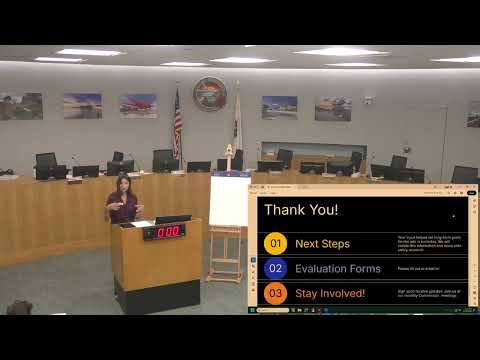
Process and next steps: there were no formal votes at the workshop. The commission said it will collate the workshop input and use it to craft recommended goals and policies for an arts element to send to City Council; the facilitator said the commission will present findings and policy research at upcoming meetings and referenced a joint City Council–Commission report session scheduled for Nov. 12 (approximately 4–6 p.m.). The facilitator also said the commission will report back on how public input from this session was used.
Attendance and timing: the workshop included several dozen participants working in three breakout tables; the public portion opened at about 5:01 p.m. and the facilitator closed the meeting at 6:59 p.m. The session was recorded for the public record.