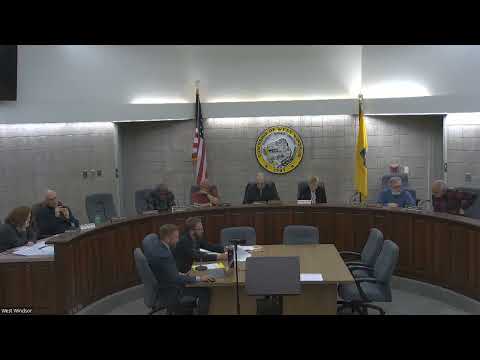
West Windsor planning board reviews draft sign ordinance updates, defers temporary and political sign rules
Loading...
Summary
On Oct. 15, 2025, the West Windsor Planning Board discussed a draft ordinance updating commercial and planned nonresidential signage rules — including blade and hanging signs, window signage, canopy signs and flag definitions — and deferred temporary and political sign regulations for further legal review.
WEST WINDSOR, N.J. — On Oct. 15, 2025, the West Windsor Planning Board held a working session to review a draft revision of the township sign ordinance that updates rules for commercial and planned nonresidential districts while postponing changes for temporary and political signs pending further legal review.
The draft ordinance discussed increases letter-height limits for hanging and blade signs in certain districts, raises the allowed portion of window area that may be used for signage, adds definitions and rules for blade, banner and a-frame (sandwich-board) signs, and sets a percentage limit for signage on automobile service station canopies. The board did not take final action; members instructed staff to send the draft to counsel and to prepare an appendix with visual examples for Council review.
Planner David (staff member) opened the item and said the board would not address temporary or political sign regulations at this time, explaining that staff found “a lot of conflicting opinions and case law” and that the topic requires additional research. He summarized other changes as largely based on past applications and waiver requests the board has seen.
Key clarifications and proposed changes discussed at the meeting included: - Hanging/blade sign letter height: increased in the draft from 6 inches to 18 inches for these sign types in commercial and planned nonresidential districts; the board discussed keeping a letter-height requirement in the Princeton Junction redevelopment area to support a pedestrian-oriented environment. - Blade sign definition: a blade sign is defined as a double-sided sign that projects perpendicular from a tenant facade and is oriented to pedestrian view; draft sets the maximum sign area at 10 square feet (the draft and presenters noted double-sided identical signs are treated in the definition of sign area so only one side may be counted toward total area where applicable). - Window signage: the draft raises the allowed percentage of window coverage for signs to 40% (previously 15%), measured as a percentage of total window area; the board discussed applying the percentage across total storefront window area. - A-frame (sandwich-board) signs: draft permits these signs with location limits and generally allows one per business. - Automobile service station canopy signs: the draft recommends that signage on a canopy not exceed 15% of the canopy face to which it is attached (presenter gave an example to illustrate how the percentage would be applied). - Flag and sign definitions: references favoring particular flags or organizations were removed from the definitions to pursue content neutrality; board members noted the legal sensitivity around regulating flags and examples such as the U.S. Flag Code and recent court decisions.
Board members asked for clearer drafting in several spots. One recurring request was to include visual examples (figures or images) near the definitions or in an appendix so readers and later reviewers can see typical blade, hanging, banner and canopy signs and better understand scale. Planner David said the staff will work with the code publisher on how to incorporate illustrations and will prepare sample visuals for council and the public.
During discussion the board also considered provisions currently listed as prohibited, including three-dimensional signs and signs erected on or above rooftops and parapets. Members debated whether older, longstanding signs such as the Pennington Market rooftop letters could reasonably remain in a revised code; several members supported flexibility for facade-mounted letter signs that do not extend above the roofline.
Council President Andrea Mandel spoke during public comment and thanked staff for the update, saying she had spent many years on planning matters and asking that the Township Council be shown samples and size references to make the proposed dimensional changes easier to evaluate.
No ordinance was adopted or transmitted to Council at the meeting. Planner David and staff will revise the draft to incorporate the board’s clarifications, add illustrations or linked appendix material, and send the draft to counsel before a future formal action or recommendation to Township Council. The board left discussion of temporary and political signs for a later meeting while staff completes additional legal research.