Get Full Government Meeting Transcripts, Videos, & Alerts Forever!
Get email alerts on the Active Transportation topic
No spam. Unsubscribe anytime.
2 Rivers Connect pilot reports 633 participants, app and employer outreach seen as keys to shifting trips
Summary
CLEAR Clean Energy for the Region presented results from the 2 Rivers Connect pilot and a potential transportation management organization, reporting 633 participants in August, employer engagement and seed funding from CDOT; app contract runs through June 2026.
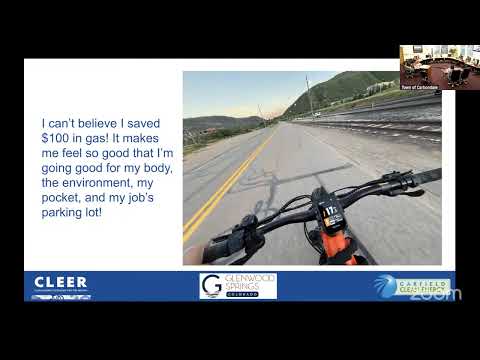
CLEAR Clean Energy for the Region told the Dover Bike & Trail Commission on Oct. 24 that a summer pilot called 2 Rivers Connect drew 633 participants and showed early signs of changing commuter behavior while forming the basis for a possible regional transportation management organization (TMO).
"My name is Emily Williams. I work for CLEAR Clean Energy for the region as their education and outreach manager," Emily Williams said while summarizing the pilot’s design, participation and next steps. The pilot used a trip-tracking app to reward alternatives to driving alone and combined employer outreach, incentives and a planned advisory structure to keep engagement going beyond the initial monthlong challenge.
The presentation outlined why the project is being pitched as both programming and a foundation for a TMO: the app collects trip logs and allows carpool matching, employer networks can create localized incentives, and an advisory committee — including chambers and municipal representatives — is guiding next steps. Williams said Colorado Department of Transportation provided seed funding and that Garfield Clean Energy members have contributed additional support.
The pilot’s August results, as presented, included 633 participants, more than 5,000 logged trips and roughly 48,000 miles recorded as “alternative” travel (modes other than driving alone). Williams said about 10% of participants completed a follow-up survey — roughly 50 responses — and that among respondents 44% reported changing some travel behavior, 37% said they were already using alternatives, and about 20% said the program made them more mindful or motivated. According to Williams, roughly 40% of trips originated or ended in Glenwood Springs and about 20% in Carbondale.
Williams cited employer engagement as central to the pilot’s success. She said Valley View logged over 40 employees in the challenge and that the Aspen School District is deploying its own employee incentives tied to the app. The app includes features for logged trips, a carpool-posting tool and the ability to enter raffles for prizes; Williams said the app contract has been paid for through June 2026.
Commission members asked about awareness and reach. Commissioner David (Commission member) said several commissioners had not heard of the August challenge before the meeting; Williams acknowledged outreach gaps and said repeated, multi-channel promotion is part of the plan. She also noted technical limits: the backend does not track whether carpool matches actually resulted in shared rides.
Next steps Williams listed were continued employer outreach; an October “mini” campaign to retain participants; fundraising to support more campaigns; a public-facing data dashboard; and coordination with chambers and transit providers about integrating local services (for example, WeCycle and Roaring Fork Transit Authority options) into a unified user experience.
Williams invited the commission to partner on local promotion and suggested Carbondale could be configured as a geographic network within the app so trips that start or end in town can be tracked and incentivized. "Carbondale is set up as, like, a network," she said, describing how the app can segment trips by municipal boundary. She provided her contact email for follow-up.
The presentation concluded with commissioners discussing possible tie-ins — spring or Bike Week campaigns, school-focused incentives, and use of wayfinding or priority-corridor messaging — and with staff and commissioners agreeing to continue coordinating on publicity and pilot design.
Ending
No formal action was taken by the commission on the pilot during the meeting; commissioners agreed to keep the item on future agendas for coordination on promotion, potential Carbondale-specific challenges and wayfinding integration.