Get Full Government Meeting Transcripts, Videos, & Alerts Forever!
Get email alerts on the Small Employer Health Insurance topic
No spam. Unsubscribe anytime.
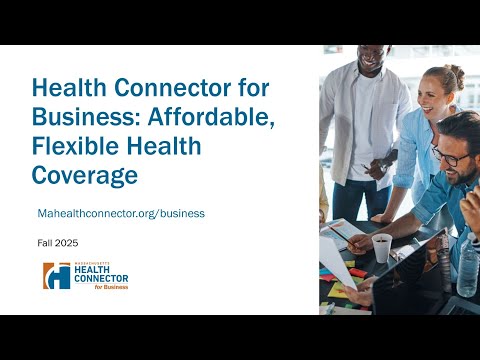
Massachusetts Health Connector briefs childcare providers on small-employer plans, enrollment timelines and rebates
Summary
Health Connector officials explained eligibility, enrollment steps, employer contribution requirements, the ConnectWell rebate and federal tax-credit rules for small employers, and demonstrated a free online employer-quote tool for childcare programs.
Massachusetts Health Connector officials told childcare providers in a virtual briefing that small employers with 1 to 50 full-time equivalent employees can offer qualified health and dental plans through Health Connector for Business, and they outlined enrollment steps, deadlines and cost-saving programs.
The presentation, led by Nikki Clonty, director of outreach and education at the Health Connector, and Jonathan (last name not provided), director of the Health Connector for Business program, explained eligibility rules, plan-choice models, an employer quick-quote tool and two major savings opportunities: the state ConnectWell wellness rebate and the federal small-business health care tax credit.
Health Connector staff emphasized eligibility and basic requirements. To use Health Connector for Business, an employer’s physical address must be in Massachusetts and the group must employ between 1 and 50 full-time equivalent employees on initial enrollment. At least one non-owner, non-family-member employee must be enrolled. The group must show 75% employee participation (either enrollment or waiver) to activate coverage, and the employer must submit an initial binder payment; staff said the binder payment is typically due on the 23rd of the month before coverage begins.
Nikki Clonty summarized coverage standards and plan breadth: "All of the plans that anyone enrolls in through the health connector ... meet state and federal requirements," and include office visits, emergency and hospitalization care, pediatric services and prescription drugs. She also noted that the ConnectorCare program combines federal tax credits and state funds to lower premiums for lower-income individuals.
Jonathan demonstrated the Health Connector employer quick-quote tool that allows employers to test price scenarios without creating a formal account. The tool accepts either a manual employee roster or a spreadsheet upload and returns plan comparisons across three employer benefit models described by staff: - Single-plan (composite billing): the employer selects one plan and the group pays an averaged premium. This is the only model that may offer a bronze-level plan. - One-carrier, one-level (list billing): the employer selects one carrier; employees pick metallic levels offered by that carrier and are charged rates that vary by age and geography. - Reference-plan (one level, multiple carriers): the employer sets a reference metal level and contribution; employees may pick different carriers at the same metal level while the employer contribution stays fixed.
Jonathan noted plans on the Health Connector shelf include options compatible with health savings accounts (HSAs) and that some plans are flagged as having lower-than-market-average premiums. He explained that quick-quote results show costs at a 100% employer contribution by default and that an employer must contribute at least 50% when creating an official group account (with a January shopping exception described below).
Staff described two savings programs: - ConnectWell wellness rebate: employers that enroll in ConnectWell can receive up to 15% of their contribution toward premiums back if at least 33% of employees complete qualifying wellness activities. Staff reported last year’s average employer rebate was about $4,790 and that employees who participate may receive a $100 gift card. - Federal small-business health care tax credit: available to eligible small employers that enroll in the marketplace, pay at least 50% of a single plan’s premium and have fewer than 25 full-time equivalent employees with average wages below a threshold cited in the briefing (staff warned the IRS-published wage figures on their materials were not up to date and recommended consulting an accountant). Staff said the maximum credit can be up to 50% (or 35%, depending on business setup) and that the Health Connector does not administer the credit.
Enrollment timing and deadlines were described separately for business and individual coverage. For Health Connector for Business, staff said employers should create an online employer account and publish a benefit package by the 10th of the month; employees must create accounts and enroll or waive coverage by the 20th; and the employer’s initial binder payment is due by the 23rd for coverage effective the following month. Staff reiterated there is no single annual open-enrollment window for employer groups and that groups can enroll year-round, but January shopping has special flexibility. For individuals and families, staff explained eligibility for advanced premium tax credits, ConnectorCare and the need to show proof of income, Social Security numbers or immigration documents when applicable; they also noted the Health Connector may be in a closed-enrollment period at certain times of year and urged applicants to check for special-enrollment qualifying events.
Clonty and Jonathan pointed attendees to free assistance options: more than 500 licensed, certified brokers for Health Connector for Business and roughly 1,500 certified application counselors or community partners for individual applicants. They also provided the Health Connector customer-service number: (877) 623-6765.
The briefing included a live walkthrough of the employer quick-quote tool (roster upload and provider-finder features) and two sample employer scenarios (a family child-care operator with a small staff and a small center-based program) to show how different staff ages and dependent mixes affect estimated employer costs. Staff emphasized the tool creates a draft quote only; creating a formal group requires additional steps in the employer account and submission of documents such as quarterly wage reports.
At the end of the session, organizers invited questions and offered follow-up assistance and language services. The presenters closed by encouraging employers to start early, use the quick-quote and broker support to compare options, and consult accountants about tax-credit eligibility.
Ending: Health Connector staff said the resources, tools and rebate opportunities are intended to help small childcare employers weigh costs and begin offering health and dental coverage; employers interested in estimates or enrollment were directed to mahealthconnector.org and to contact the Health Connector for individualized assistance.