
Committee approves bill codifying Medicaid eligibility, adds guardrails against expansion
Get AI-powered insights, summaries, and transcripts
Subscribe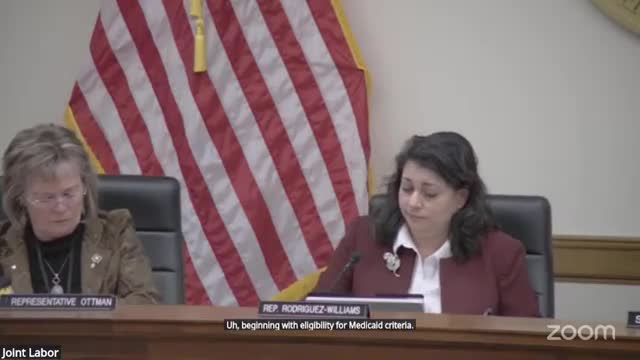
Summary
The Labor, Health & Social Services Committee approved a bill (26 LSO 139) to codify Medicaid eligibility criteria in state statute while adding amendments that require explicit legislative approval for expansion and delay the bill’s effective date to allow rulemaking.
The Labor, Health & Social Services Committee approved a bill to place Medicaid eligibility criteria into Wyoming statute and added several amendments that limit the possibility of future expansion and require a rulemaking period before the law takes effect.
LSO staff described 26 LSO 139 as a statutory restatement of Department of Health eligibility rules. Miss Johnson of the Legislative Service Office told the committee the draft is drawn from the Department of Health’s Medicaid rules and "in order to be eligible for Medicaid, the applicant must be a citizen or national of The United States, be a Wyoming resident, fulfill one of the following..." Director Stefan Johansson of the Wyoming Department of Health said the bill largely mirrors existing department rules: "You cannot just be low income and qualify for Medicaid in Wyoming." The department reiterated that many covered groups are set in federal law and that the bill should not be read as changing who the state must cover.
Why it matters: Medicaid is a large state budget program. Committee members repeatedly noted the program’s budget scale and said codifying eligibility in statute would make limits and responsibilities visible to the public and to future legislatures. Senator Scott pressed for explicit statutory language to prevent automatic expansion without the Legislature’s approval; the committee accepted his amendment to forbid any expansion "beyond the eligibility as of 07/01/2025" without prior legislative action. The panel also added a placeholder amendment to explicitly include federally mandatory populations so those groups are not inadvertently excluded by compact statutory language.
Key details and debate: LSO and health department witnesses walked through the bill’s provisions and the verification systems Wyoming uses—citizenship verification through Social Security and the Department of Homeland Security, residency verification through SAVE, and asset/income matches including the Department of Workforce Services. Jesse Springer, the state Medicaid administrator, told the committee that many data matches and system interfaces now allow faster, automated verification and that the bill largely codifies existing practice.
Committee members asked whether the draft could unintentionally permit Medicaid expansion or coverage for noncitizens if federal rules change. Miss Johnson and the director said the draft’s catch-all language could be read broadly; the committee adopted amendments to tighten that language and to add an explicit subsection covering federally mandatory groups. Senator Scott successfully moved to delay the bill’s effective date: the act will apply to applications submitted or renewed on or after July 1, 2027, and the Department must publish implementing rules by Oct. 1, 2026, to give the Legislature and agency time to identify and fix any unintended consequences.
Members also pressed to preserve a historical statutory eligibility item covering tuberculosis treatment. Senator Scott argued that tuberculosis coverage is a public‑health, non–means‑tested provision that should be explicit; the committee adopted a conceptual amendment to add tuberculosis eligibility language for staff to draft.
Outcome and next steps: After multiple amendments clarifying immigrant eligibility language, pausing the effective date for rulemaking and adding federally mandatory categories, the committee voted to pass 26 LSO 139. The bill passed the committee and will move forward in the legislative process. The Department of Health told the committee it does not expect the bill to require major operational changes but recommended legislative clarity to avoid unintended exclusion of large populations such as children and nursing‑home recipients.
Ending: The committee substantially left the substance of current policy in place while adding legislative guardrails—delaying implementation to permit rulemaking and explicitly preserving federally mandatory groups and tuberculosis treatment eligibility. The bill will proceed to the next floor or committee steps with the adopted amendments.