
City clerk and legislative department outline 2026 priorities: elections, records and a new research division
Get AI-powered insights, summaries, and transcripts
Subscribe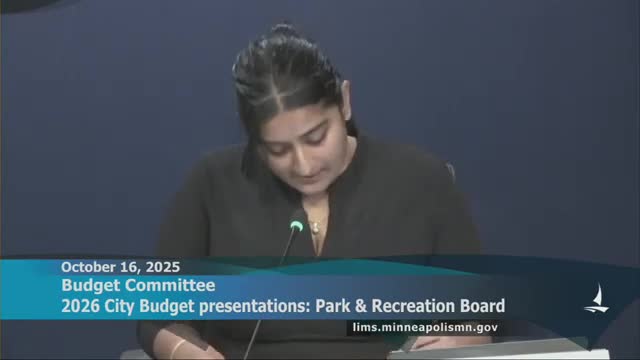
Summary
The legislative department presented the mayor's recommended 2026 budget covering the City Council, Office of City Clerk and a transferred Legislative Research & Oversight division; priorities include one‑time election funding, records modernization, a new data portal and reestablishing appointed boards and commissions.
The City of Minneapolis legislative department on Oct. 16 presented the mayor’s recommended 2026 budget for the City Council, Office of City Clerk and related divisions, highlighting funding for election administration, expanded information governance and the newly transferred Legislative Research and Oversight division.
Director of Administration Destiny Zhang presented the plan, describing the legislative department’s role under the city charter and outlining organizational changes. "The department encompasses the city council and the offices of city clerk and city auditor," Zhang said, and noted the budget reflects both ongoing work and one‑time election costs.
The mayor’s recommendation includes $6.2 million in one‑time funding to administer the February election, Zhang said, and the elections and voter services division reported several operational investments and accessibility initiatives. The clerk’s office said it received national recognition from the U.S. Election Assistance Commission for a student election judge interpreter program and launched a curbside voting hotline pilot for voters who need assistance.
On records and data, the information governance division told the committee it had streamlined the citywide retention schedule from more than 1,300 record series to about 200 (pending state approval), launched targeted "plays" to improve data practices, and planned to roll out an open city data portal with automated workflows in the fourth quarter to speed responses to data requests. Zhang said the office is tracking a 20% increase in data requests year‑over‑year and that 78% of requests are resolved within 29 days under the office’s targets.
The presentation also covered a structural transfer: the mayor’s recommended budget moves the Legislative Research and Oversight division (previously in the Office of City Auditor) to the Office of City Clerk. Zhang said the division will provide nonpartisan research and independent analysis in support of the council’s policymaking and oversight functions and has completed 17 detailed reports in recent periods. The transfer added 10 FTEs to the clerk’s budget, and the total recommended FTEs for the Office of City Clerk increased by 15 to reflect that realignment and some administrative FTE additions.
Zhang and staff highlighted operational accomplishments: reestablishing seven appointed boards and commissions, processing more than 400 applications for boards and commissions recruitment, implementing a new CRM to manage constituent cases, enhancing the legislative information management system (LIMS) toward WCAG 2.2 accessibility compliance by December 2025, and processing 269 domestic partnership certifications to date.
Council members questioned backlog and staffing. Council President Payne asked about election vendor security; staff said Minneapolis does not use Dominion tabulation equipment and reiterated pre‑election logic and accuracy tests, including public demonstrations and randomized post‑election hand counts of selected precincts. On records demand, Council Member Rashad Chavez and clerk staff discussed enterprise approaches including training department data liaisons and technology investments; the clerk’s office said adding staff alone would not sustainably solve exponential request growth and described escalation paths for overdue requests.
Zhang said the mayor’s recommendation reduced ongoing contractual services for the clerk’s office by about $445,000 while increasing budget authority overall for one‑time election and transferred programs. She warned that continued growth in data requests and the addition of body‑worn camera footage from the police department pose a risk to the office’s capacity to meet legal timelines without additional tools, staffing or process redesign.
Ending: The legislative department asked the budget committee to consider the one‑time election funding, the implications of the transferred research division, and sustained resourcing needs for information governance as the council progresses toward fall public hearings and the Dec. 9 budget adoption date.