Get Full Government Meeting Transcripts, Videos, & Alerts Forever!
Get email alerts on the Ptp Implementation Plan topic
No spam. Unsubscribe anytime.
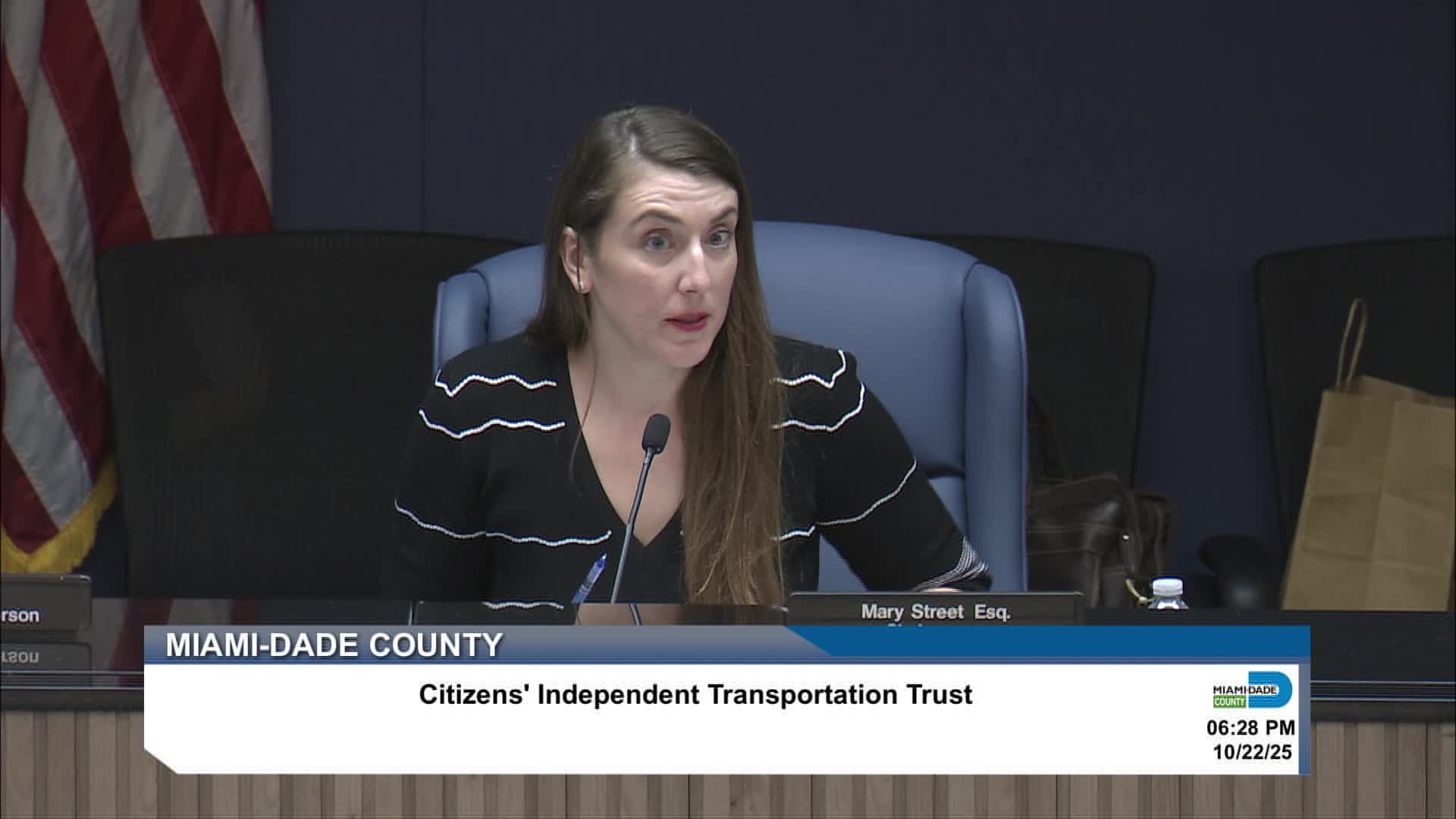
CITT approves FY2026–2035 implementation plan; members debate new projects, North Corridor TOD and maintenance eligibility
Summary
The trust recommended approval of the People's Transportation Plan (PTP) five‑year implementation update. Staff proposed four new projects — transitway lighting, bus powertrain replacement, Metrobus reliability planning, and a countywide bus‑stop sign program — and an increase to the Infrastructure Renewal Program; members debated the inclusion of
The Citizens' Independent Transportation Trust voted to recommend approval of the fiscal‑year 2026 through 2035 implementation plan of the People's Transportation Plan (PTP), advancing the county’s five‑year surtax project list to the Board of County Commissioners.
Key additions and changes: Department and OCITT staff told the trust they received four new project requests for surtax funding this cycle and recommended adding them to the five‑year plan: - Transitway lighting (South Dade Transitway and adjacent trail): PTP funding request $20,000,000 to install corridor and trail lighting along approximately 20 miles of transitway where lighting was not provided in the original BRT work. - Powertrain replacement for the CNG bus fleet: PTP request with FTA match, $20,000,000 for replacement of engines/ transmissions that reach useful life thresholds to improve reliability (department described this as a capitalized replacement program tied to fleets purchased with federal funds). - Metrobus high‑capacity transit reliability project: $1,500,000 requested for planning and ITS analyses (signal timing, intersection modifications and minor geometric changes) to improve on‑time performance for Metrobus corridors. - Countywide bus‑stop sign program: $5,000,000 requested to design, fabricate and install roughly 6,000 standardized bus stop signs countywide.
Staff also recommended an updated annual Infrastructure Renewal Program (IRP) allocation based on surtax receipts and CPI adjustments. Trust members voted to include these proposals in the implementation plan.
Debate and concerns: The plan approval prompted extended discussion among trust members about priorities and equity across corridors. Notable points raised: - North Corridor TOD timing: Several members — including representatives from North Corridor districts — questioned the timing and value of launching a transit‑oriented development (TOD) master‑planning process for the North Corridor now, given current project cost estimates and a projected completion date well beyond the near term. Members stressed community frustration that large sums have been spent on planning without construction milestones and urged prioritizing tangible neighborhood investments in Brownsville and North Central Dade over new master plans. - Maintenance vs capital: Members pressed staff on the powertrain replacement project and whether that represents routine maintenance or a capitalized project eligible for surtax funds. DTPW explained the replacement is treated as a capital cost — similar to a major component replacement — and noted the buses were purchased with federal funds and that replacement extends vehicle useful life; some members said they remained concerned about using surtax dollars for what they viewed as maintenance. - Elevator/escalator work and equity: Members asked whether the small set of stations listed for vertical conveyance replacement left other stations — many in northern and historically disinvested neighborhoods — still relying on older equipment. Staff replied there is a separate ongoing contract addressing more than 20 elevators/escalators and that the items in the five‑year plan are those remaining for full replacement. - Neighborhood improvements: Members asked whether remaining district‑level neighborhood improvement allocations could be reassigned to North Corridor communities; staff said those funds are established by a district allocation formula and cannot be moved between districts absent Board action.
Process and outreach: Staff summarized the broad public‑involvement work supporting the TDP and PTP updates: a survey (open through the 31st of the month at the time of the presentation) that saw roughly 4,000 responses, outreach at stations and community events, and an advisory review committee with municipal and regional partners. Staff emphasized coordination with FDOT, MPO/TPO plans and FDOT requirements that a transit development plan be current to qualify for certain state funding.
Vote: Trust members approved the implementation plan as presented. During roll call several members recorded “yes”; two members recorded “no” (Kenneth Kilpatrick and Harry Hoffman). The chair announced the motion carried and the plan will move to the Board of County Commissioners for final approval.
Next steps: With the trust’s recommendation, the Board of County Commissioners will consider the FY2026–2035 implementation plan. Staff said project scopes and final cost estimates will continue to be refined, and individual project funding steps (design procurements, construction contracts) will return to the trust and Board as required by procurement and budgeting rules.