
Tulsa staff propose code changes to comply with stateFood Truck Freedom Act; council weighs oversight, fee and inspection gaps
Get AI-powered insights, summaries, and transcripts
Subscribe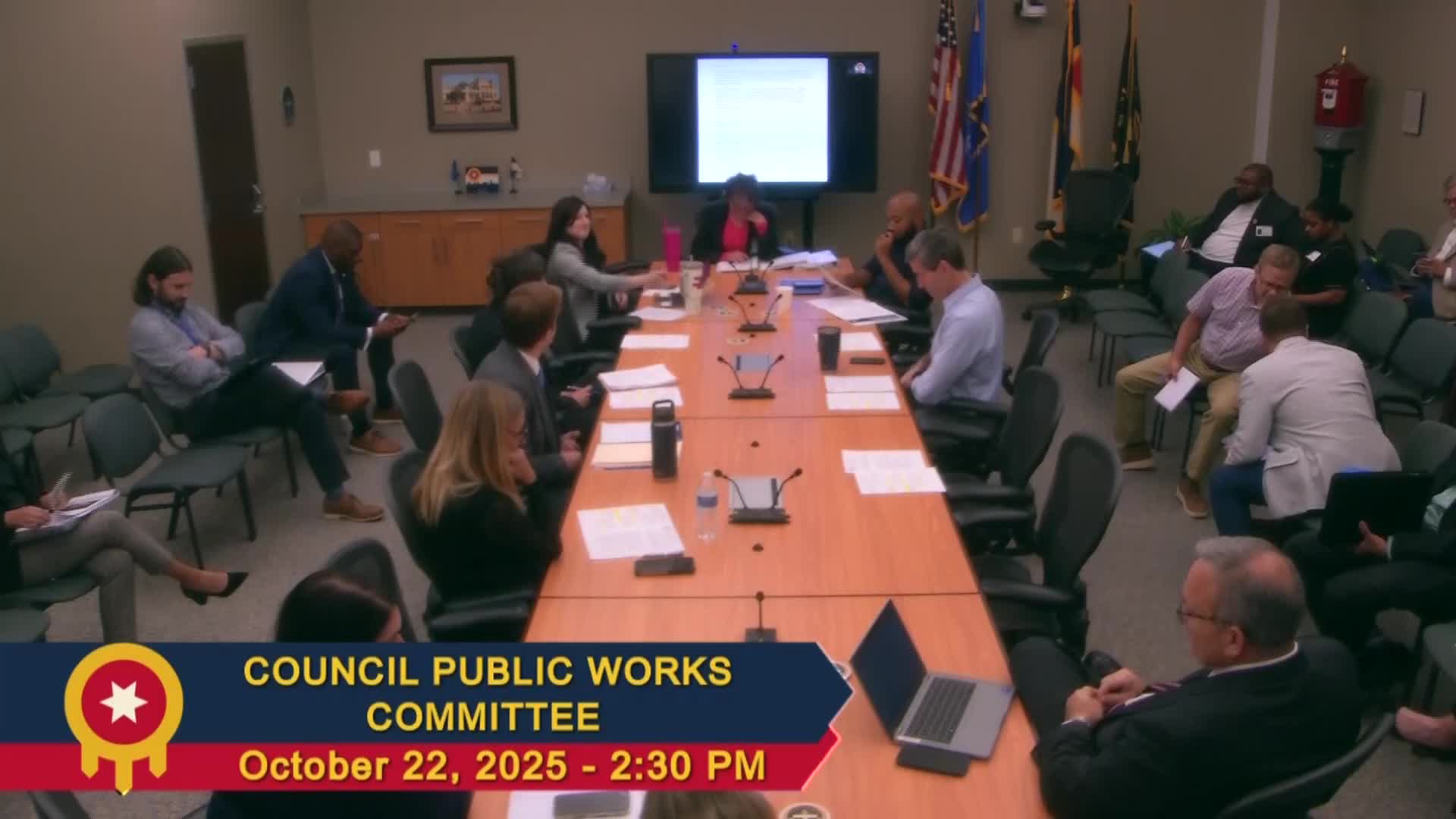
Summary
City legal staff recommended removing a local mobile-vendor license and limiting city fees for food trucks to an administrative processing charge to comply with House Bill 1076; the state fire marshal will assume inspections under House Bill 2459, raising local questions about oversight and a roughly $25,000 annual revenue shortfall.
City legal staff told the Tulsa City Council Public Works Committee on Wednesday that two recent state laws will force changes to local rules for mobile food vendors, including removal of the city—s separate mobile-vendor license and limits on what fees the city may charge.
Caroline Gerro Wolfe and Eric Kronf of the City—s legal department said the changes are required by House Bill 1076, the Food Truck Freedom Act, which preempts some local regulation of food trucks, and House Bill 2459, which moves life-safety inspections for food trucks to the state fire marshal—s jurisdiction. Kronf told the committee the state laws are due to take effect Nov. 1 and the city is updating its ordinances so local code complies.
The legal staff summarized three core adjustments. First, the city must eliminate a separate local mobile-vendor license: "The state allows for one license," Gerro Wolfe said, so the draft removes the local mobile-vendor license from Title 21. Second, the city must stop charging fees beyond the administrative cost of issuing local recognition of a state license; the draft exempts mobile vendors from a $155 city fee and leaves a $5 processing charge. Third, the city kept only regulations tied to public health and safety and struck language that appeared to regulate competition or impose restrictions the state now forbids.
Council members pressed staff on who will perform oversight if the city can only charge a nominal processing fee and the state takes over fire inspections. Councilor Bellas asked whether the $5 processing fee could be increased to cover oversight; Kronf said the city can set the fee to recover administrative cost. Finance staff estimated a budgetary impact of about $25,000 a year, a combination of losing the portion of the fee that previously flowed to the city and elimination of the mobile vendor license.
Cody Zhang of the State Fire Marshal—s Office told the committee the marshal—s office and associated state agents will conduct fire and LP-gas inspections under HB2459 and that staffing is limited. Zhang said statewide there are an estimated 7,000 food trucks that should be inspected under the new law and roughly a dozen state agents cover 77 counties; a Northeastern regional agent serves the Tulsa area. He said the state plans to run a limited number of large inspection events, or "food truck rodeos," where multiple units can be inspected at once, but acknowledged the schedule may not meet demand. Zhang said that under the state law a food truck without the state fire-marshal sticker would not be able to operate at a public event: "Per the state law, yes," he said.
Councilors asked staff to confirm whether the city will continue any health-department role in food-related inspections or remittances, whether code enforcement or Tulsa Police Department checks will continue, and whether staff can require proof of a state fire-marshal sticker as part of the city—s $5 processing procedure. Legal staff said they drafted a cross-reference in code to permit a verification check on the city side and would confirm details with finance and the health department. Several council members urged quick action to amend the ordinances so the city will be in compliance when the state provisions take effect in early November.
No final vote on the draft ordinances was recorded in the committee meeting; staff told the committee they expect to return for formal action with a schedule aligned to the state effective date.