Council tables 8‑story, 384‑unit Crossroads plan after debate over parking, setbacks and affordable units
Loading...
Summary
City Council moved to table applications for an eight‑story, 384‑unit multifamily project at 8151–8221 Peters Road to Nov. 19, to be heard with associated land‑use and rezoning items. The project seeks multiple waivers, offers several affordable‑housing options and includes traffic mitigation commitments.
The City Council on Oct. 22 voted to table three linked planning items for the proposed Plantation Crossroads multifamily development — an eight‑story building with 384 units at 8151–8221 Peters Road — until the council's Nov. 19 meeting. Staff asked that the site-plan, conditional-use application and several requested waivers be considered with pending land‑use and rezoning matters scheduled for November.
Dan Holmes, Plantation's planning, zoning and economic development director, briefed councilmembers on the application, describing an 8‑story residential building, a parking garage and ground‑level amenities on a 24.28‑acre site that currently contains two office buildings. The applicant has requested multiple zoning and landscape waivers, including reduced parking, shorter drive aisles in the garage, fewer loading spaces than the code requires, smaller minimum unit sizes for studios and one‑bedrooms, and reduced building setbacks along several property lines.
"With the discounts for bicycle storage and proximity to transit, the applicant's required parking drops from 874 spaces to 789," Holmes said, summarizing staff's calculation. The developer is proposing 632 spaces, a shortfall of 157 spaces (about a 20% reduction), and so has requested a parking waiver.
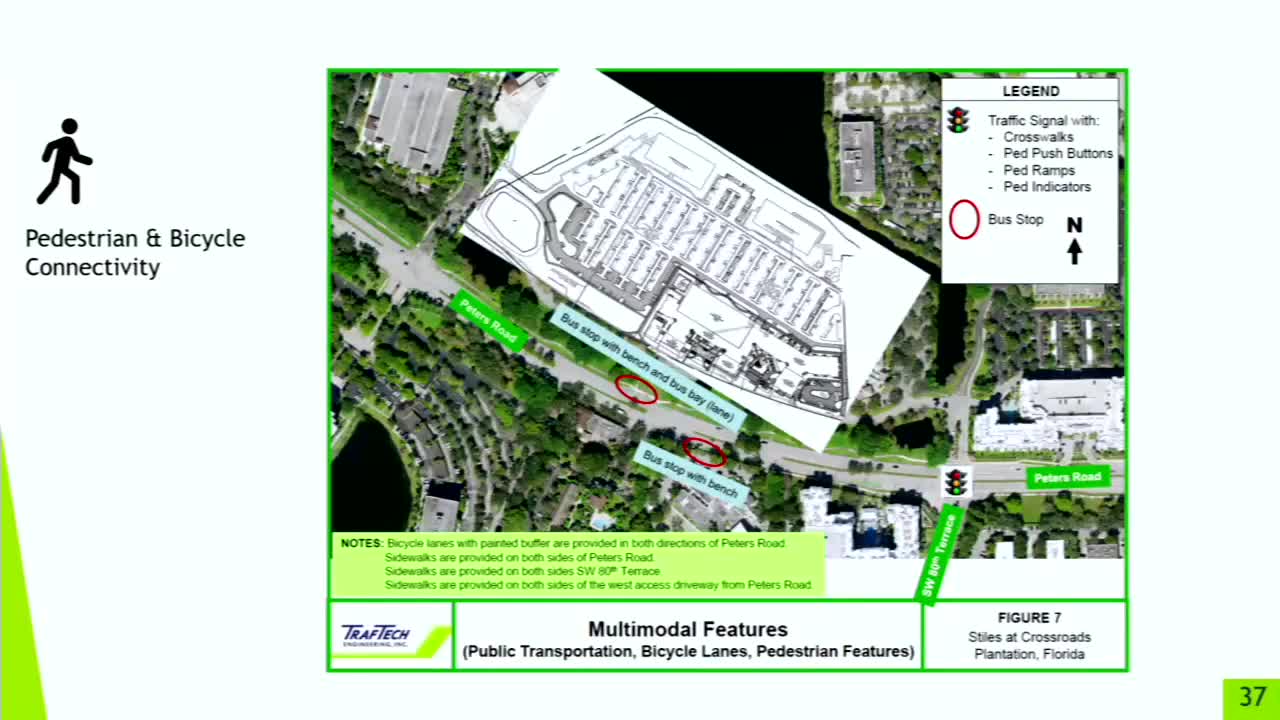
Traffic and multimodal mitigation were central to discussion. The city's review described an estimated 1,785 daily trips generated by the development and a council staff recommendation that the project participate cost‑sharing for multimodal improvements identified in the city's multimodal plan. The applicant agreed to a $158,630 cost share for lane repurposing and a roundabout project on nearby streets; staff also recommended coordination with Broward County on signal timing at two intersections.
Affordable housing was another focus. Under county land‑use amendment rules the developer originally offered a 10% set‑aside (about 39 units) at up to 120% of area median income for 30 years. The applicant said it had also discussed alternate models with Broward County that might yield a smaller number of units at lower AMI levels (for example 32 units at 80% AMI or a smaller number at varying AMI tiers). The developer said it will continue to negotiate the specific affordable‑housing mechanism with the county planning council; city staff said they would review any alternate approach for consistency.
John Auerbach, representing the developer, and agent Margo Utter summarized the project's design and community outreach, noting efforts to coordinate pedestrian connections to adjacent properties and to provide rooftop and ground‑level amenity space. Utter said the project team had held community and Midtown board meetings and solicited feedback from nearby retailers and office parks, which in some cases supported the development as potential customers for local businesses.
Public comment was split. Supporters who work in the adjacent office parks said nearby housing would bring customers and activity into a largely office‑park environment. Several residents and a longtime Plantation resident who addressed the council said they were concerned about increased traffic on Peters Road, the scale of an eight‑story building in places where two‑ and three‑story uses exist and the adequacy of public engagement notices.
Council members asked detailed questions about the unit sizes (city code specifies minimums for studios and one‑bedrooms), the financial and schedule impacts of the developer's proposed affordable‑housing options, and the project's proposed mitigation and monitoring of traffic impacts. Holmes noted that Midtown policy supports more urbanized, walkable development patterns and that the B7Q/planned commercial district standards permit tighter setbacks in those areas; the project asks for reduced setbacks consistent with that approach.
After discussion the council tabled the site‑plan, conditional‑use and waiver requests to Nov. 19 so staff can present the associated land‑use amendment and rezoning in the same hearing and to allow finalization of commitments and conditions. The motion to table passed by roll call: Council Member Andrew — yes; Council Member Fadgen — yes; Council Member Horland — yes; Council Member Anderson — yes; Council Member Reinstein — yes; Mayor Sordle — yes.
Staff flagged that the county review and the city's final conditions will include more detail on affordable‑housing commitments, pedestrian connections and engineering‑level traffic mitigation.