Get Full Government Meeting Transcripts, Videos, & Alerts Forever!
Get email alerts on the Land Development Code topic
No spam. Unsubscribe anytime.
City amends land-development code: administrative plat approvals and rules for irregular lots cleared on first reading
Summary
Oakland Park commissioners voted unanimously on first reading to update the land-development code to (1) implement state-mandated administrative plat/replat procedures (Senate Bill 784/Chapter 177) and (2) add a mechanism to regulate and evaluate irregular lots, changes staff said will speed reviews and clarify application standards.
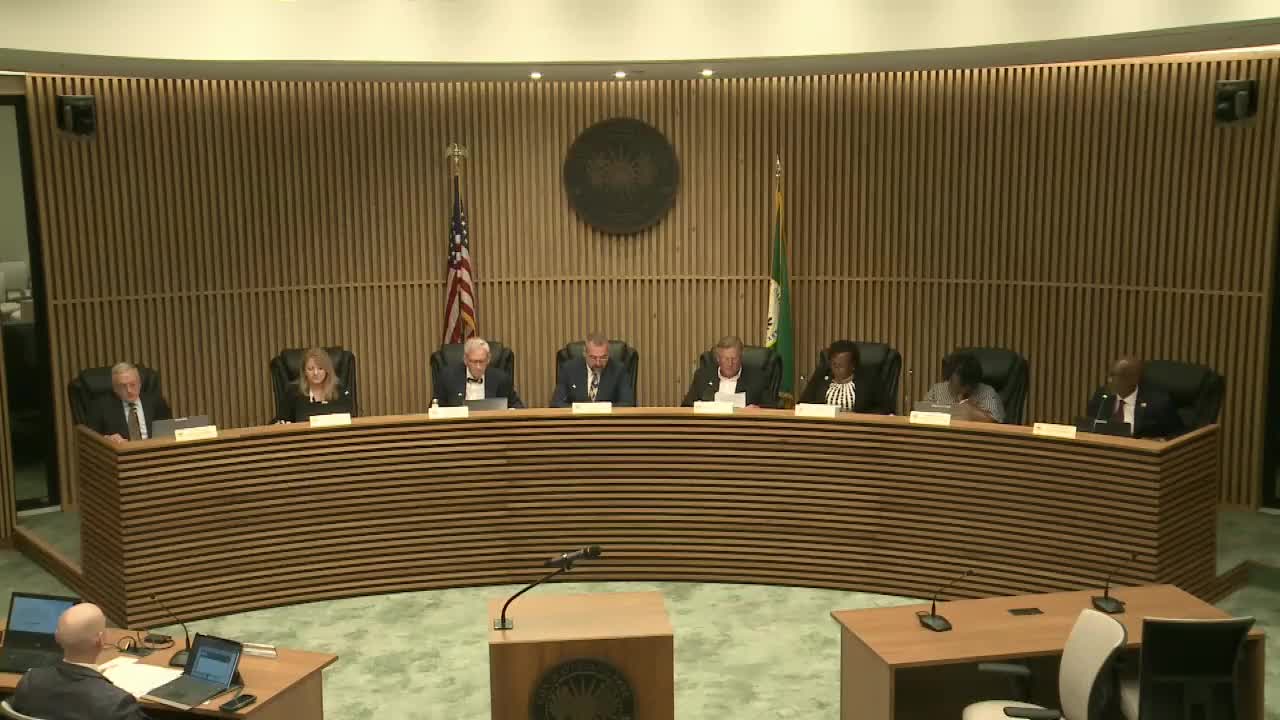
Oakland Park commissioners voted unanimously on Oct. 22 to approve two separate text amendments on first reading that staff said will modernize the city's land-development code and remove procedural conflicts with new state law.
What the commission approved - Administrative plats/replats (case CD25-13T): The ordinance amends Chapter 24 of the Land Development Code to implement the changes required by recent state law (including Chapter 177 of the Florida Statutes and Senate Bill 784). Staff said the amendment designates the director of engineering and community development as the city's administrative authority to process plats and replats and sets forth administrative procedures for application filing, completeness review and staff-level approval steps. - Regulation for irregular lots (case CD25-14T): The ordinance adds definitions and a mechanism for analyzing and approving development on irregularly shaped lots. Staff said the change does not alter minimum lot sizes, building-height limits or bulk standards but provides definitions and clarifying methods for determining lot width, lot depth and build-to lines when a parcel has multiple angles or non-rectangular geometry.
Why it matters: City staff told the commission that state law now requires municipalities to designate an administrative authority for plats and replats, which removes plat approvals from discretionary public hearing processes. Staff said the code changes align local procedures with state law, preserve existing technical standards and are intended to reduce processing delays. The irregular-lot amendment is intended to allow feasible architectural design and construction on infill parcels that do not conform to conventional rectangular lot geometry.
Votes and procedure Both ordinances were presented for public hearing and had no members of the public request to speak on either item. Both measures passed on first reading by unanimous roll call votes of the commissioners present.
Details cited by staff - Administrative-plat amendment: Staff said the city will continue to perform equivalently thorough technical reviews (similar reviewers as in the DRC process) but will perform the reviews administratively rather than through a public hearing before the commission. The director of engineering and community development will have final authority to sign plats and replats after staff review. - Irregular-lot amendment: Staff showed examples illustrating how the current code's lot-width and build-to-line rules can force building footprints to follow irregular parcel lines, creating impractical designs. The new language provides definitions and calculation methods to determine lot width/depth and to allow practical building placement without changing core development standards.
What the record shows (no inference) Both items were introduced, a public hearing was opened and closed (no speakers), and the commission adopted the ordinances on first reading by roll-call vote. Staff indicated no comprehensive-plan amendment was required for either change.
Next steps The ordinance texts will return for second reading and final adoption at the commission's next meeting (dates to follow). Staff said they will publish updated administrative procedures and provide guidance to applicants on how the new administrative plat process will function.