
Authority approves $405,000 in rental-assistance grants from Affordable Housing Trust Fund
Get AI-powered insights, summaries, and transcripts
Subscribe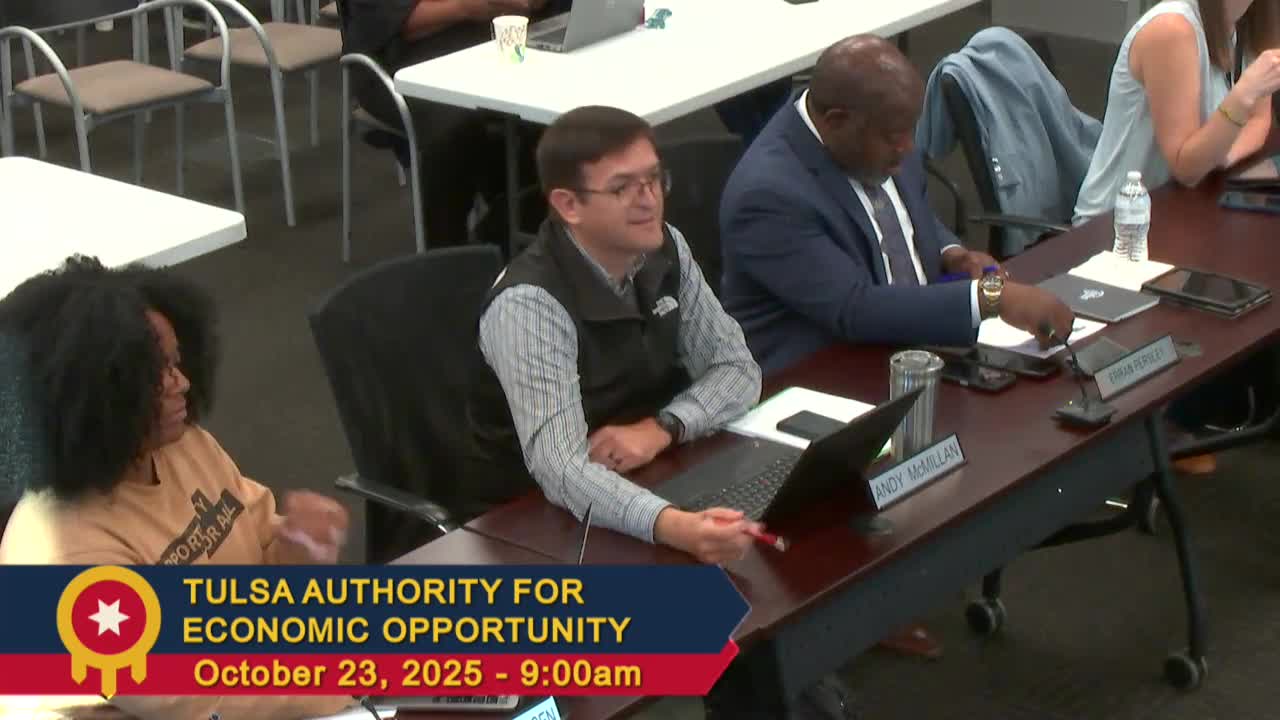
Summary
The Tulsa Authority for Economic Opportunity approved three grant awards from its Affordable Housing Trust Fund totaling $405,000 to support rental-assistance programs operated by Restore Hope Ministries, Urban Strategies and East Side Rise.
The Tulsa Authority for Economic Opportunity on Oct. 23 approved three Affordable Housing Trust Fund grants totaling $405,000 to expand rental-assistance programs for households at risk of homelessness.
Staff presented a funding recommendation that would direct $275,000 to Restore Hope Ministries Inc., $75,000 to Urban Strategies and $55,000 to East Side Rise. Nia, a staff member presenting the item, said Restore Hope has operated rental-assistance programs in Tulsa County for more than 30 years and currently has a pipeline of over 100 households awaiting help.
The board moved and voted to approve the three separate grant agreements. Trustee votes were recorded on the roll call and the motions passed.
The awards follow a July application round in which staff sought agencies that could quickly administer funds to low-income tenants. Nia told trustees the $405,000 total is expected to assist roughly 134 households using an $3,000 per-household cap: about 91 households through Restore Hope, 25 through Urban Strategies and 18 through East Side Rise.
Nia said program conditions include a six-month period for grantees to stand up a program (if one is not already operating) and 18 months to disperse funds. Agencies receiving awards must file quarterly reports with Partner Tulsa detailing demographics served and disbursements. Tenants assisted as part of the grants are required to meet with the Financial Empowerment Center in Tulsa.
Trustees discussed oversight for newer grantees and remedies if a program fails to launch. Staff said the six-month start-up period is a contractual backstop: if a grantee has not established operations after that timeframe, the authority can require funds to be returned or withhold initial draws until program readiness is demonstrated.
The grants were approved as three separate agenda votes; board members made and seconded motions for each award and the items passed on roll-call votes.