
Central Coast presenters warn that enforceable A–R limits could force small operations if agronomic viability gap persists
Get AI-powered insights, summaries, and transcripts
Sign Up Free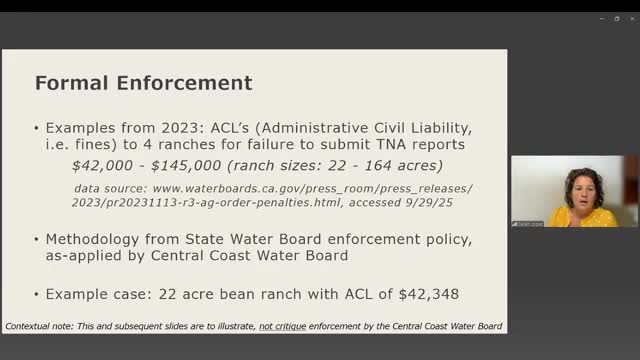
Summary
Central Coast presenters told the expert panel that numeric limits can produce punitive monetary fines for small specialty‑crop operations and that soft administrative tools and incentives are underused.
Central Coast conservation groups and technical advisors told the panel that formal enforcement under numeric limits can have severe financial consequences for small specialty‑crop operations and that regional orders limit the use of several softer enforcement options.
What was presented - Administrative civil liabilities: Sarah Lopez of Central Coast Water Quality Preservation, Inc. described ACLs issued for failure to file nitrogen application reports ranging from roughly $42,000 to $145,000 for ranches between 22 and 164 acres. Lopez outlined the multi‑step penalty calculation process used in Region 3, which can yield fines that approach a large percentage of estimated gross revenues. She warned that for low‑margin specialty crops, a large fine can effectively end operations. - Soft consequences and incentives: Lopez argued that water boards and coalitions have a range of non‑monetary tools (six ‘‘soft consequences’’ she listed) that can encourage compliance without formal limits. She said some orders (including Ag Order 4 and the State Board’s ESJ remand) restrict access to certain soft tools in the Central Coast. - Viability gap: Preservation, Inc. highlighted a perceived gap between a protective A–R value (Central Coast staff cited a protective level of 50 lb N/acre) and the lower limit of agronomic feasibility for some crops. In that scenario, growers believe their agronomic needs exceed the protective A–R, creating a risk they would face enforcement they cannot feasibly avoid without innovation or allowances.
Why it matters: panelists warned that if enforceable numeric limits are set without mechanisms to account for legitimate agronomic needs, or transition pathways (incentives, innovation funds, reduced administrative burden for compliant low‑load farms), enforcement could be financially destructive for small specialty producers.
Ending: Central Coast presenters asked the panel to recommend a suite of tools — greater use of soft consequences, temporary incentives, reduced administrative burden for farms already operating within protective load ranges, and alternative pathways for small diversified operations — while the state and regions work toward durable limits and innovation support.