
DWR releases draft subsidence best‑management practice; urges regional coordination
Get AI-powered insights, summaries, and transcripts
Subscribe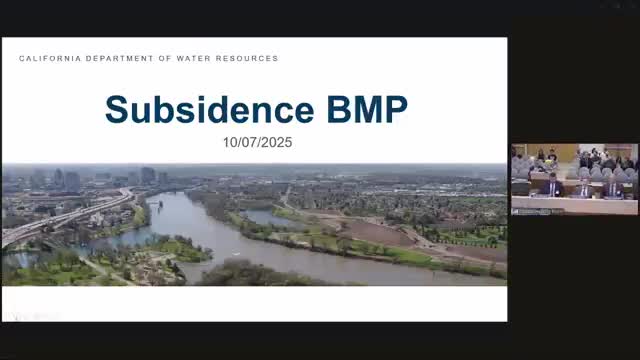
Summary
The Department of Water Resources presented a draft Land Subsidence Best Management Practice document to the State Water Board, urging groundwater sustainability agencies to act now to avoid long‑term, irreversible subsidence and to coordinate regionally where subsidence crosses basin boundaries.
Sacramento — The Department of Water Resources (DWR) presented a draft Land Subsidence Best Management Practice (BMP) to the State Water Resources Control Board on Oct. 7, laying out technical guidance, monitoring expectations and management pathways for basins facing—or at risk of—land subsidence tied to groundwater extraction.
The BMP, DWR officials said, is intended as a practical, statewide guide for groundwater sustainability agencies (GSAs), regional agencies and the board’s staff. DWR Deputy Director Paul Gosselin said the document clarifies existing Sustainable Groundwater Management Act (SGMA) requirements and offers a tiered approach for basins depending on (1) whether subsidence has already occurred and (2) where basin groundwater levels are set relative to historical lows.
Why it matters: Subsidence—permanent settling or compaction of aquifer materials—can damage canals, levees, roads and well infrastructure and is difficult to reverse. DWR and board staff told members that basins now experiencing subsidence need more immediate action, while basins with stable groundwater levels should still adopt monitoring and guardrails.
What DWR proposed - Four management scenarios: The BMP describes four hypothetical basin scenarios and suggested actions scaled to local conditions, from monitoring and conservative threshold setting to active demand management and coordinated regional projects for areas with ongoing subsidence. - Technical tools and monitoring: The draft recommends remote sensing (InSAR), continuous GPS and extensometer networks, and provides guidance on estimating a “critical head” (the groundwater level below which compaction and subsidence begin). DWR said that uncertainty in critical head estimates argues for conservative groundwater level targets. - Regional coordination: DWR stressed subsidence often crosses basin boundaries and urged GSAs to plan regionally—particularly where surface conveyance or federal infrastructure could be affected. - Implementation approach: DWR said the BMP is not a new regulation but a guidance document that will inform technical assistance, local facilitation, and DWR’s oversight and periodic evaluation of GSP implementation.
Public process and next steps: DWR held public workshops and compiled written comments on the draft. Staff said they will continue to review and revise the BMP, with a target to finalize by year‑end, then follow up with basin‑by‑basin engagement in 2026 to assess how each GSA plans to meet the BMP’s recommendations.
Board reaction: Chair Joaquin Esquivel and board members applauded the document’s synthesis of technical material. Board members and staff stressed the need for practical finance and technical help for GSAs and for the state and board to coordinate in basin evaluations and, where necessary, in enforcement or probationary actions.
Ending: DWR officials said they expect the BMP to be a multi‑year tool that will help GSAs prioritize monitoring, evaluate risks to infrastructure and identify near‑term projects to reduce overdraft and subsidence.