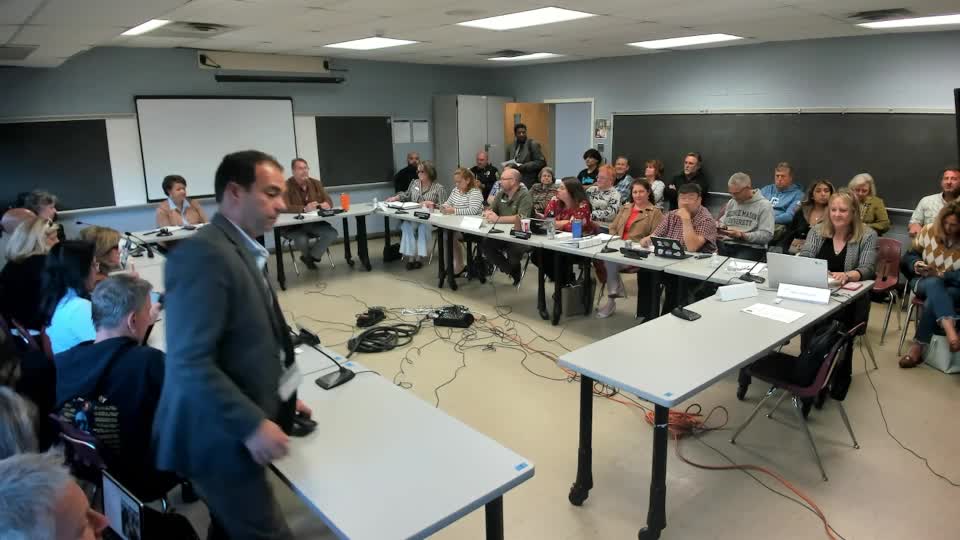
City leaders review Manassas Shopping Center redevelopment concepts; council urges bolder, higher-density options
Loading...
Summary
The Manassas City Council and the Economic Development Authority on Wednesday reviewed redevelopment concepts for the 15‑acre Manassas Shopping Center and asked consultants for bolder, higher‑density alternatives that account for long‑term leases, zoning changes and public priorities.
The Manassas City Council and the Manassas Economic Development Authority on Wednesday reviewed draft redevelopment concepts for the Manassas Shopping Center and heard council members press for a bolder, higher-density vision while balancing existing tenant leases and a multistep timeline.
Denise Harover, chair of the Economic Development Authority, introduced consultants and said the work reflects community feedback gathered in summer “community conversations.” Sukriti Ghosh, principal with RHI, told the joint session the site is “approximately 15 acres” and that consultants used input from more than 100 in-person participants and 67 online respondents to shape two alternative concepts.
The alternatives show a transition from higher-intensity uses along Mathis Avenue to lower-intensity housing near Portner Avenue, with proposals for a linear buffer, a central plaza and a mix of townhomes, multifamily and street‑front retail. Concept A sketches about 50,000 square feet of commercial space, roughly 122 multifamily units and 338 off‑street parking spaces (excluding on‑street parking). Concept B increases commercial to about 58,000 square feet with roughly 129 multifamily units and 371 required off‑street spaces; both concepts include about 42 townhome/multiplex units at the rear.
Why it matters: the shopping center sits at a gateway into Downtown Manassas and abuts two historic districts, making reuse consequential for adjacent neighborhoods, traffic patterns and the city’s long‑range plans. Council members and EDA directors said the site also presents a rare opportunity to plan incrementally while market forces and long‑term leases play out.
What consultants and staff told the joint meeting
- Consultants said the Mathis Avenue sector plan (2006) and the city’s 2040 comprehensive plan support mixed‑use redevelopment and greater multimodal connectivity; staff noted the site’s current zoning is B‑4, which does not currently allow residential without rezoning. The presentation referenced possible use of federal ARPA funds to help advance planning.
- The public engagement summary emphasized a community preference for mixed use, a range of housing types including attainable units, new dining/experiential retail, two‑to‑four story development and improved pedestrian and bicycle connections.
Council and EDA reaction: common themes
- Demand for a more distinctive design: Council member Tom Ocina said he did not want a generic plan and urged concepts with “multifunctional spaces, flexible layouts” that could adapt over decades; he said, “I want a place that’s iconic or has the potential to be iconic.” Several other council members echoed the call for a stronger “wow” concept rather than a repeat suburban pattern.
- Density and housing mix: Some council members asked for higher density in at least parts of the site to support retail and achieve attainable‑housing goals. Council member Rosina and others said the concepts felt too low in units for some long‑term visions and encouraged consideration of 4–5 story buildings where appropriate.
- Parking and circulation tradeoffs: Vice Mayor Wolf and others noted parking garages are costly but can reduce surface parking and free land for housing or open space. Several members asked the team to model a parking‑structure scenario to understand tradeoffs.
- Green space and gathering places: Council members questioned whether the proposed linear park would function as a true gathering place; some preferred a larger centralized plaza or other features (one council member suggested a splash pad) that would better serve residents.
- Tenant leases and phasing constraints: Staff and EDA members reminded the group that the site has active leases of varying lengths (staff cited leases extending into the 2030s) and that redevelopment will likely require phasing. EDA members said leasing strategy and tenant transitions must be planned alongside concept refinement.
Process, timing and next steps discussed
- Public engagement and schedule: Consultants said this is roughly a 10‑month planning process; the team scheduled a public open house for November 13 to present refined concepts and collect feedback.
- Regulatory pathway and timing: Staff and consultants noted that residential development requires rezoning from B‑4; they estimated a thorough rezoning process could take about a year, with site planning and construction adding multiple years (consultants and staff discussed a 3–5 year horizon once entitlement and financing are in place).
- Direction to staff/consultants: Council members and EDA asked Roadside/RHI and city staff to return with at least one additional concept that shows higher density and a parking‑structure option (a “bubble” or revised alternative rather than highly detailed architectural plans) so the council can assess whether a more ambitious option is desirable and economically viable. The presentation materials will be posted to the city website and the project team will use the November open house to collect public feedback.
No formal votes or commitments were taken at the joint session; council members and EDA directors framed the meeting as guidance for refining concepts and for future public outreach.
What is unresolved
- The council did not set a final preferred concept, a specific density cap or a firm schedule for sale or city‑led development; those items will depend on rezoning outcomes, market interest and lease expirations. Staff emphasized the city is not committing public funds to design or construction of private buildings and that the city’s role is to shape a development vision that can attract private investment.
Next steps and public engagement
Roadside/RHI will refine the materials for the November 13 public open house and add at least one higher‑density/parking‑structure alternative for council and public review. The EDA will continue to examine leasing strategy during the transition period and report back to council with recommended timelines and possible phasing options.