Get Full Government Meeting Transcripts, Videos, & Alerts Forever!
Get email alerts on the Reentry Housing Returning Home St Paul topic
No spam. Unsubscribe anytime.
Evaluation finds Returning Home St. Paul placed 12 people but struggled with recruitment and rent stability
Summary
A city-commissioned evaluation presented to the St. Paul Public Safety and Community Wellness Committee found the Returning Home St. Paul pilot housed 12 participants, showed promising tenant stability for some, and identified recruitment, geographic limits and lack of ongoing rent assistance as major barriers to long-term success.
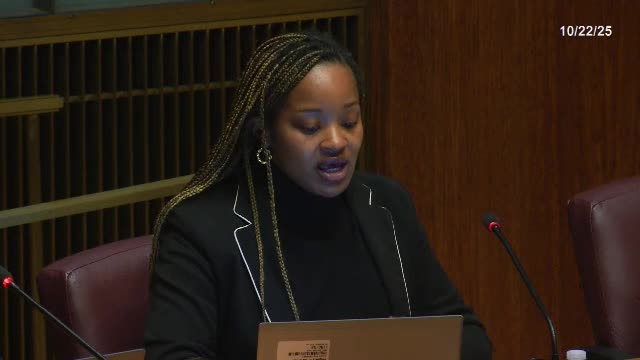
At a St. Paul City Public Safety and Community Wellness Committee meeting, Kathleen “Katie” (research director, Minnesota Justice Research Center) presented an evaluation of Returning Home St. Paul, a small pilot reentry housing program that ran from December 2020 through early 2022 and aimed to place people returning from incarceration into market-rate housing with supportive services.
The Minnesota Justice Research Center evaluation found the program placed 12 participants in housing (10 in St. Paul and two in Minneapolis) against an original target of 20 participants. Katie said “the overarching story of this returning home St. Paul…was of hope and inspiration” for the people who were housed, while also noting multiple program limitations.
The nut graf: the evaluation showed that receiving stable housing can be transformative but that the pilot’s limited scale, geographic restriction to St. Paul, difficulty recruiting participants and the lack of ongoing rental assistance left many participants financially vulnerable and limited the program’s ability to reduce long-term homelessness or recidivism at scale.
Most important findings
- Enrollment and retention: The pilot aimed for 20 participants but housed 12. Of those enrolled, the evaluation reported that six participants “graduated” (remained housed for one year). The transcript states that five of those six “resigned their leases” (transcript wording). Four participants—about 40 percent—exited the program early, including two mutual lease terminations and two evictions.
- Landlord engagement: Housing Link recruited roughly 53 interested landlords, and nine landlords ultimately housed participants through the program. However, the evaluation found that every landlord who actually housed program participants already had a prior history of renting to people with criminal records; the landlord mitigation fund was not used. Katie said, “None of the landlords ended up coming to access any of that money.”
- Criminal-legal outcomes: The report found that 70 percent of participants housed in St. Paul had no additional criminal-legal involvement while enrolled. Of the 30 percent who did have involvement, the evaluation reported no new felonies and mainly technical violations.
- Financial supports and affordability: The pilot provided limited one-time financial support for application fees and security deposits and, in some cases, first month’s rent. The program did not provide recurring rent assistance. Katie and committee members repeatedly emphasized that maintaining housing was the primary challenge: “nearly all of the participants struggled to pay their rent on time,” the evaluation found.
- Recruitment and geography: Program partners reported that limiting eligibility to St. Paul hindered enrollment because many prospective participants identified housing outside city limits and became ineligible. Housing Link’s larger pool of interested landlords was concentrated outside St. Paul, which reduced housing matches for program-eligible participants.
Recommendations and next steps
The Minnesota Justice Research Center recommended that any future iteration expand wraparound supports—especially ongoing rental assistance—broaden recruitment pipelines beyond a single community partner and local geography, and focus landlord outreach on landlords already willing to rent to people with criminal histories. The report also urged partners to revisit automatic-denial policies for specific offenses and “look-back” periods (eight- to ten-year screening windows) that landlords and applicants perceived as barriers.
Committee discussion
Councilmember Coleman asked about unit affordability and whether participating units were market-rate or deeply affordable housing; Katie said the evaluation did not analyze rents paid and suggested Housing Link’s database could answer that question. Chair Terry Buie (chair, Public Safety and Community Wellness Committee) framed the presentation as a refresher for council members and said the committee could re-explore continuing the pilot and coordinate with the Office of Financial Empowerment or other city departments.
What the city heard
Program partners and participants described the pilot as life-changing for some but too small and under-resourced to address the full set of barriers—especially job instability and ongoing rent arrears—that people returning from incarceration face. The evaluation emphasized that without shifting some landlord mitigation funds or securing additional rental assistance to cover rent over time, maintaining housing remained the principal obstacle to long-term success.
The committee did not take formal action at the meeting; members and presenters discussed options for re-engaging departments and community partners if the council wishes to explore continuing or scaling the program.