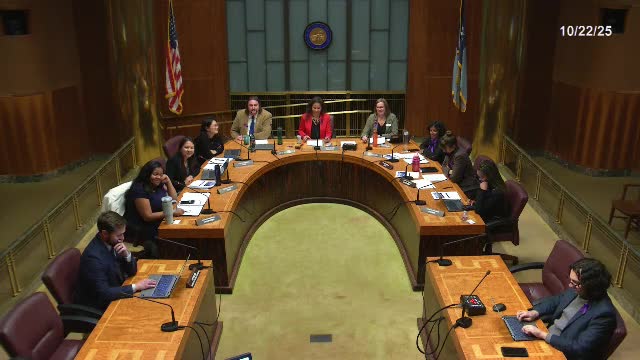
Saint Paul council holds first reading of ordinance proposing local limits on assault weapons, ghost guns and high-capacity devices
Loading...
Summary
The council heard a staff report and held a first reading of an ordinance that would ban public possession of assault weapons, large-capacity magazines and ghost guns and require signage for sensitive public spaces. Enforcement would not begin until state preemption is lifted or comparable state law is passed.
The Saint Paul City Council held a first reading on an ordinance that would ban the public possession of assault weapons, prohibit large-capacity magazines and binary triggers, bar ghost guns and require serial numbers on firearms and signage at sensitive public spaces.
Mayor Melvin Carter framed the proposal as part of a broader push to reduce gun violence locally and urged the council to prepare an ordinance that could take effect if state restrictions on local firearm rules are removed. “If nothing else is going to change, then we have to change something,” Carter said, describing the measure as a step cities can take if state law allows it.
The ordinance, introduced by city staff, would: ban public possession of assault weapons as those are defined in Minnesota state law; prohibit magazines that hold 20 or more rounds; prohibit binary triggers; and make it unlawful to possess a firearm without a serial number (commonly called a “ghost gun”), except for firearms manufactured before 1968 and other narrowly defined exemptions. The measure also would require the city to post standardized signs at every entrance to city-owned, leased or controlled “sensitive places” and at active internal entry points such as service desks and gymnasiums.
Brynn House, the city’s intergovernmental relations director, presented the staff report and walked the council through timeline and technical language. She said the ordinance is contingent on either repeal of Minnesota Statutes section 471.633 (the state preemption provision) or the passage of state law that allows substantially similar local restrictions. House said the city would not enforce the ordinance until one of those conditions was met and noted that offenses would be treated as misdemeanors to the extent municipal law allows.
The ordinance includes several exemptions commonly used in firearm policy: active-duty law enforcement and military personnel acting in the scope of duty; licensed curators and transport; firearms rendered permanently inoperable; and narrow, defined circumstances for medical aid or authorized state law exceptions. House emphasized that the ordinance text specifies the sign content, size and font to make compliance clear to visitors.
Council members asked staff for clarifications about which parts, if any, could take effect before state preemption changes; House said she would confirm with the city attorney. The council scheduled a public hearing and second reading for Nov. 5 and a third reading and final passage for Nov. 12, but the ordinance would only be enforceable after the contingent state-level change occurs.
Next steps: staff will bring a clarifying amendment before the Nov. 5 public hearing and follow up with the council on legal questions about signage and early implementation.