Get Full Government Meeting Transcripts, Videos, & Alerts Forever!
Get email alerts on the Grants Management topic
No spam. Unsubscribe anytime.
City staff say Salesforce glitch cut applicant responses in public-service grants; appeals adjusted final rankings
Summary
Staff described a text-field parsing error in a new Salesforce application that truncated some grant responses. The public-service grant appeals board rescored eight appeals, approved five and denied three; staff described mitigation steps for next year.
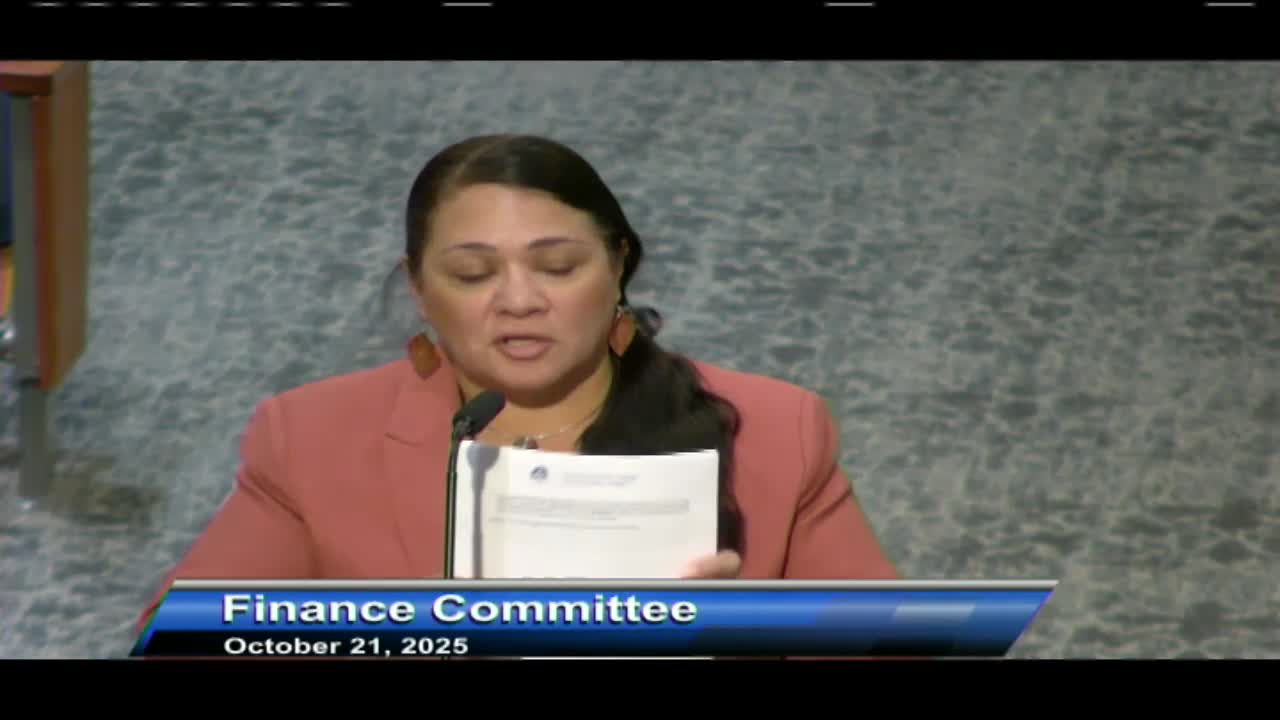
City grant administrators told the Finance Committee on Oct. 21 that a configuration error in a new Salesforce application platform caused some public-service grant (PSG) application text fields to truncate responses, prompting appeals and adjustments to final rankings.
Maribel Figueroa, chief of GRAMA and contract compliance, told the committee that some application text boxes had been created as 'display text' fields and the system misinterpreted characters such as parentheses, asterisks, greater-than signs and certain indentations as syntax codes. "The problem... certain characters that are used are also syntax programming codes such as parentheses and, greater signs and, semicolons... and it confused the system," Figueroa said on the record.
Nut graf: City staff said the glitch mainly affected question 2 (board demographics and similar fields); two applicants alerted staff immediately after the deadline and provided full intended submissions to scorers. The PSG appeals board reviewed eight applications (from six agencies); five appeals were approved and three denied. Staff said rescoring changed some placements but did not move any applicant into the funded range for their category in this cycle.
Key details reported to committee members: - Scope: the PSG cycle evaluated applicants across three categories and $7 million in total PSG funding. The city divides that $7 million into category percentages set by ordinance (two categories at 35% each and prevention/diversion at 30%), yielding uneven slotting across categories. - Appeals and rescoring: eight appeals were filed; five were approved, three denied (one no-show at appeals). Figueroa said First Coast Crime Stoppers was rescored on question 2 and moved from last to second-to-last in its section but still remained outside the funded range after rescoring. - Monitoring and payment: staff said the city now has 60 executed contracts of 81 awards; grant monitoring is handled by a five-person monitoring team. Grants are paid on a reimbursement basis (no upfront payments); staff described site visits within 60 days of contract execution, monthly invoice reviews, quarterly programmatic reports, midyear desk audits and end-of-contract closeouts. "All public service grants are paid are paid on a reimbursement basis," Figueroa said.
Committee members pressed for clarity on thresholds, program overlap and the interplay between PSG and direct appropriations. Staff noted that ordinance 1-18 part 8 (the PSG authorizing ordinance) does not set a minimum cutoff score; awards are given from top to bottom until program funding is exhausted. Council members argued the ordinance's category allocations—set by council direction—can produce cases in which lower-scoring organizations in one category receive funding while higher-scoring applicants in another category do not, because the total pot is split by category percentages.
Policy and process changes described to the committee: - System fixes: staff changed affected fields to 'long text area' and tested the platform; Accenture (the vendor) was notified and implemented the fix. - Applicant education: staff will add guidance to mandatory application workshops, add a user guide, and add submission pop-ups reminding applicants to review submissions and report truncation errors immediately. - Future ordinance changes: several council members said they intend to propose amendments to Chapter 1-18 Part 8 in January to revisit allocation limits (number of awards per organization) and maximum award sizes.
What staff said about scope and workload: Figueroa said five grant monitors handle PSG awards in addition to direct appropriations and mayoral appropriations; monitoring includes introductory site visits, midyear audits and monthly invoice reviews. Asked whether money is paid upfront, staff repeated that payments are reimbursement-based; audit follow-ups and the council auditor's office can pursue clawbacks for disallowed payments, though staff described such cases as "very, very rare."
Committee members asked for more transparency on long-term repeat awardees and whether the council should place caps or phased reductions on organizations that have received city funds for multiple consecutive years. Several members said they expect a phase-two ordinance amendment to be introduced after the New Year to address those policy choices.
Provenance: Maribel Figueroa described the glitch and mitigation steps; appeals outcomes and monitoring details were discussed during the committee's PSG presentation and Q&A.