Richland council approves binding arbitration award for battalion chiefs, raising pay and preserving 'me too' wage parity
Loading...
Summary
Council approved Resolution No. 2025-135 to adopt the arbitration decision for the 2023–2025 collective bargaining agreement covering five battalion chiefs in Richland Fire & Emergency Services, implementing wage differentials and grandfathered tobacco rules.
RICHLAND — The Richland City Council on Oct. 21 approved Resolution No. 2025-135 adopting the decision from interest arbitration that resolves open issues in the 2023–2025 collective bargaining agreement with the International Association of Fire Fighters (IAFF) representing five battalion chiefs.
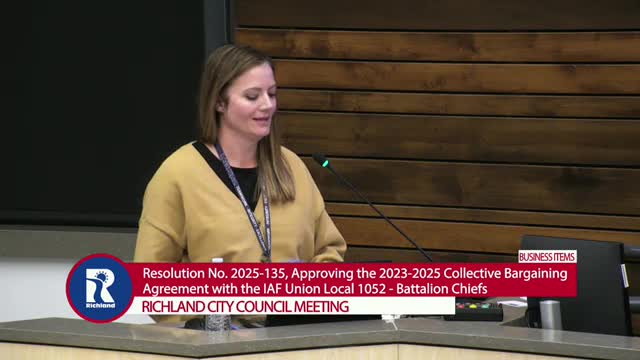
Labor relations specialist Lacey Paulson summarized the arbitration process: negotiations began in late 2022 and early 2023, mediation occurred with the Public Employment Relations Commission (PERC), and disputed economic issues were certified to interest arbitration. Paulson said the arbitrator sided largely with the union on the contested economic issues and with the historical “me too” approach that anchors battalion-chief pay to rank-and-file increases.
Paulson outlined the award’s economic terms. Effective the first payroll period in 2023 the contract establishes an 11.5% differential between captain EMT and battalion-chief EMT positions. The award provides scheduled increases thereafter: a 4% increase (first payroll 2024), a 1% increase on July 1, 2024, a 2% increase in the first payroll period of 2025, and a 2% increase on July 1, 2025. Paulson included incentive calculations: battalion chiefs with paramedic certification (12%) and a bachelor’s degree (10%) can see base wages in the $177,000 range; a day-shift battalion chief with those certifications would be compensated about $193,500 in base pay, Paulson said.
On a workplace conduct issue, the arbitrator limited the city’s ability to ban smokeless tobacco for incumbents. Paulson said the decision grandfathered existing employees: “any new hires that are hired in the contract cycle from ‘23 to ’25, anyone hired after that date can no longer use smokeless tobacco in the workplace, and others will be grandfathered.”
Council member Margaret Jones expressed concern about the fiscal impact and asked whether the city could stop requiring EMT certification for new hires to lower wage benchmarks; the city chief (present but not named in the public transcript) explained battalion chiefs typically acquire paramedic certification earlier in their careers, and noted EMS-transport revenue funds roughly 40% of current operations, meaning eliminating EMS services would require either a large general-fund substitution or service reductions.
Council approved Resolution No. 2025-135 by unanimous consent. Paulson recommended adoption of the arbitrator’s full decision, which was included in the council packet.
Why it matters: The arbitrator’s award raises base wages and preserves a pay-comparison mechanism tied to rank-and-file increases; the decision has direct fiscal implications for personnel costs and for how the fire department’s EMS role factors into compensation.