Get Full Government Meeting Transcripts, Videos, & Alerts Forever!
Get email alerts on the Cluster Mailbox Theft topic
No spam. Unsubscribe anytime.
San Antonio task force proposes public-awareness campaign, lighting and UDC change to address rising cluster-mailbox thefts
Summary
San Antonio Police and city staff briefed the Public Safety Committee on rising cluster-mailbox thefts, task-force recommendations including a bilingual public-awareness campaign, targeted lighting through CPS Energy's all-night security program, and a proposed Unified Development Code change to require lighting at new mailbox clusters.
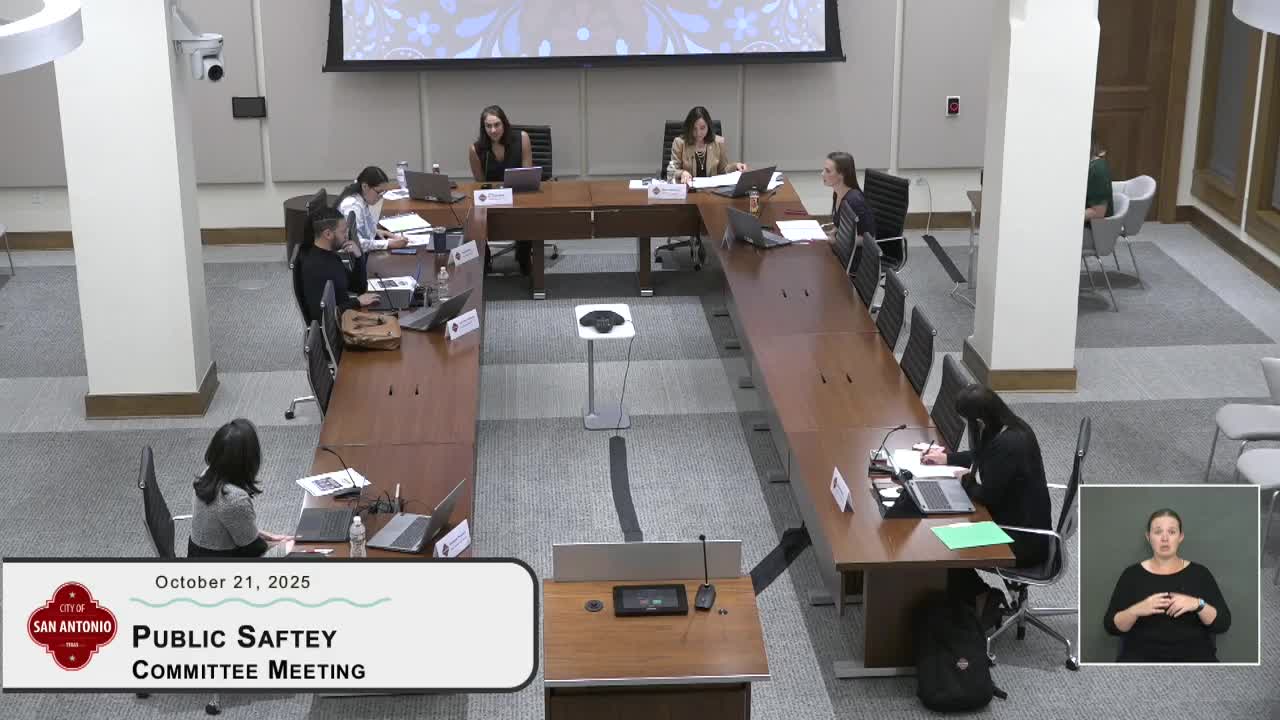
San Antonio's Public Safety Committee received an update on an interagency task force's work to address a documented increase in cluster-mailbox thefts across the city, including recommendations for a bilingual public-awareness campaign, guidance for homeowners associations on reporting and prevention, and changes to development code for future projects.
The briefing, led by Deputy Chief Michelle Ramos of the San Antonio Police Department and Alana Reid, the city's director of communications and engagement, summarized state and federal law, three years of local incident data, solvability challenges, and the task force's recommended next steps. "We collected data for the last three years," Ramos said, noting that thefts where fewer than 10 addresses were affected rose to 1,323 year-to-date in 2025 from 1,570 in 2023. She also said thefts from 30 or more addresses rose from about 70 in 2023 to 126 year-to-date in 2025. Ramos added that arrests remain limited; for fewer-than-10-address offenses SAPD reported seven arrests year-to-date in 2025, and for 30-or-more-address incidents arrests rose from two in 2023 to six in 2025 year-to-date.
The nut graf: City staff and community partners told the committee the thefts are widespread, concentrate in apartment-rich areas such as the Medical Center corridor, are difficult to investigate because of limited evidence and delayed reporting, and that local prevention steps could reduce victims, complementing federal responsibilities for mail delivery.
Task-force composition and recommendations
Ramos said the task force brought together SAPD, the U.S. Postal Service and Postal Inspection Service, Bexar County Sheriff's Office, City Neighborhood and Housing departments, CPS Energy, San Antonio Board of Realtors, San Antonio Apartment Association and HOA representatives. The group identified two central aims: improve reporting and investigative processes, and reduce opportunities for theft through environmental measures and resident education.
Recommendations presented to the committee included: - A bilingual public-awareness and education campaign with printed flyers, posters for libraries and senior centers, social-media graphics and an English/Spanish PSA directing residents to SAPD nonemergency and U.S. Postal Inspection Service reporting channels. Reid showed examples of the templates and said the materials will be posted on COSA and SAPD web pages and distributed by SAPD SAFE officers and code-enforcement staff. - Guidance for residents and HOAs on how to report mail theft to both SAPD and the USPS, and materials on mailbox/lock replacement and deterrent measures such as lighting, cameras and signage. - Encouraging HOAs and property owners to pursue CPS Energy's all-night security lighting program; staff described the program as billed monthly to the account or meter associated with the light, with CPS owning and maintaining lights after installation and a minimum 36-month contract required. - A proposed Unified Development Code (UDC) amendment to require a light at each mailbox cluster for new developments; staff said the next formal amendment cycle begins in January 2027.
"Lighting is one of the simplest, most effective ways to deter crime," Councilman Aldrete Gavito said in support of the task force's recommendations. Gavito, who introduced the council consideration request, also urged city participation to reduce HOA costs and asked staff to work with federal partners to press USPS on replacement responsibility for cluster boxes.
Evidence and implementation metrics
Ramos and Reid described an evaluation plan that will compare reported mailbox thefts, arrests or investigations, website visits, PSA views, USPS informed-delivery signups and CPS ANZIL program requests pre- and post-campaign. Staff said they will ask USPS for counts of mail-hold requests and informed-delivery signups and CPS for counts of HOA requests for security lighting. SAPD and the Department of Neighborhood and Housing Services will launch the education campaign in coordination with USPS; staff said they will return with a progress update to the Public Safety Committee in June 2026, after six months of post-implementation data.
Limitations and police perspective
Ramos described investigatory challenges including lack of surveillance footage, physical evidence, reliable descriptions of suspects or vehicles, and underreporting. She said some incidents also lead to identity theft and other crimes when financial documents are taken. Ramos said most arrests occur when officers arrive while a theft is in progress, a circumstance she said is uncommon because crimes often happen overnight and are reported later.
Next steps and city roles
Staff said SAPD and CNE will launch the education campaign, train SAFE and code officers to present prevention strategies at HOA and apartment community meetings, and coordinate with CPS and USPS on lighting and other services. Development Services will pursue the UDC streetlight requirement as part of the January 2027 amendment cycle.
Ending: Committee members asked about program costs, CPS's installation timelines and whether solar lighting options were being considered for lower-income areas. Staff said CPS's program is case-by-case depending on meter proximity and infrastructure needs and that solar options were under review. The committee did not take formal action on the briefing.