Get Full Government Meeting Transcripts, Videos, & Alerts Forever!
Get email alerts on the Water Meters Ami topic
No spam. Unsubscribe anytime.
Tucumcari reviews proposal to replace aging water meters with Kamstrup AMI system
Summary
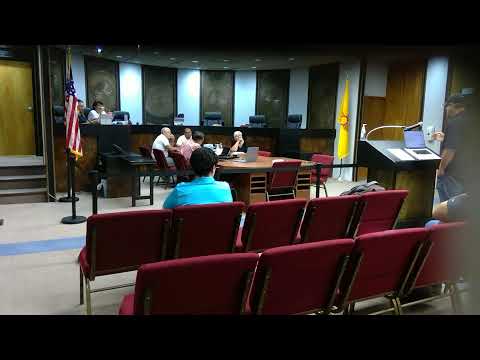
At a Tucumcari City Commission work session, city staff and vendors ResourceWise, Kamstrup and Sustainability Partners presented a proposal to replace the city's aging water meters with Kamstrup ultrasonic meters and an AMI network.
At a Tucumcari City Commission work session, city staff and vendors ResourceWise, Kamstrup and Sustainability Partners described a proposal to replace the city’s aging water meters with Kamstrup ultrasonic meters and a new advanced metering infrastructure (AMI) network that would include built-in acoustic leak detection.
The vendors said the current meter system has a large number of units that are no longer reporting to the radio network and must be read manually. John (water department staff) said, “We have almost 400 meters now that we have to read manually every single month that aren't reporting to the radio system,” and described frequent battery failures, backward-counting registers and limited vendor support for the existing system.
The vendors framed the replacement as both an operational improvement and a revenue-recovery measure. Tracy Hernandez, solutions manager for Kamstrup Water Management, described the technology: “An ultrasonic meter basically means that it's a static meter where there are no moving parts in the water chamber,” and said the meters include integrated radios and built-in acoustic leak detection that listens upstream and downstream of the meter multiple times each day.
Why it matters: presenters estimated the city is incurring high operational costs from manual reads and failing commercial meters while losing revenue from low-flow underregistration and undetected leaks. ResourceWise and Sustainability Partners presented cost and timeline estimates they said were based on comparable New Mexico projects and the city’s meter inventory.
Technical and operational details - Kamstrup meters: Vendors described ultrasonic (static) meters that have no moving parts in the flow chamber, integrated radios, tamper, dry-meter and reverse-flow alerts, and acoustic leak detection that samples the water column roughly 26 times per day (about every 55 minutes). Tracy Hernandez said the meters detect low flows (quoted minimum: 0.008 gallons per minute) and can generate alarms for continuous low-volume flow (a leak) or a high-rate flow lasting 30 minutes or more (a burst). - Warranties and durability: Vendors said small residential Kamstrup meters carry a 20-year warranty and larger meters typically a 10-year warranty; some larger meters have field-replaceable batteries so the meter need not be removed for battery replacement. - Communications: The proposed AMI network would operate on a licensed 450–470 MHz frequency band with collector devices that create a parent–child relationship for battery efficiency and to reduce interference.
Costs, savings and schedule presented - Per-meter bill: Vendors presented an illustrative financing option that would charge about $6 per month on the residential side (the quoted figure was described as an estimate and subject to final project counts and contract terms). - Payback and savings: Presenters estimated payback on the investment could be about 2½ years in their scenarios, citing recovered revenue from more-accurate meters and operational savings. One vendor asserted the city currently spends roughly $400,000 per year on maintenance, lost time and manual reads (presented as an estimate derived from prior projects). - Deployment timeline: For very large projects (12–15,000 meter points) the vendors said comparable deployments can take about 12 months; for Tucumcari they estimated a substantially shorter field deployment — vendor comments cited a 3–4 month installation window for a project of the city’s scale when using local installers contracted by the vendor.
Data and inventory questions City staff and vendors acknowledged incomplete local data during the presentation. Vendors used an inventory list that included about 3,200 service-line entries from a lead-service-line review but said the relevant figure for billing and replacement would be the active-meter count in the billing system. John said staff do not have full access to or control of the existing AMI/billing system and that legacy equipment and configuration problems have prevented reads and proper system synchronization.
Vendor commitments and next steps Vendors said they would provide detailed quotes and supporting documentation on request and offered to assist with data transfer and software integration to the city’s billing system. A vendor representative asked to email the city manager a copy of the installer quote during the meeting.
What was not decided No formal action or contract award occurred at the work session. The meeting recorded discussion, vendor presentations and staff descriptions of system problems; there was no recorded vote or direction that committed the city to purchase or financing. The vendors suggested month-to-month contract terms would be possible and said no monthly charge would begin until each meter was installed and operating plus a 30-day acceptance period.
Ending: The discussion closed with vendors offering follow-up materials (quotes, propagation studies and case studies) and continued staff–vendor coordination to refine counts, costs and an installation schedule. Further review and a formal procurement decision were left to subsequent Commission action.